Home
Class 12
PHYSICS
A parallel beam of nitrogen molecules mo...

A parallel beam of nitrogen molecules moving with velocity `v = 400 m s^(-1)` imprings on a wall at an angle `theta = 30^(@)` to its normal. The concentration of molecules in the beam is `n = 9 xx 10^(18) cm^(-3)`. Find the pressure exerted by the beam on the wall, assuming that collisions are perfectly elastic.

Text Solution

Verified by Experts
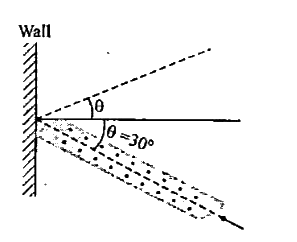

Figure-2.27 shows a beam of molecules in cylindrical form striking the wall. According to elastic collision, each molecule is reflected from the wall at the same angle of incidence as shown with same speed. If `m_(0)` is the mass of each nitrogen molecule, momentum of each molecule is
`P_(0)=m_(0)v`
During collision change in momentum of each molecule or momentum imparted to wall by each molecule is
`DeltaP_(0)=2m_(0)v cos theta`
If S is the cross-sectional area of beam and v be the velocity of molecules in the beam then number of molecules incident on wall per second are
`N=n_(0)"v S "[n_(0)="moleculear density"]`
Thus total momentum imparted to the wall per second by the beam or the force exerted on wall is
`F=(DeltaP_(0))/(Deltat)=2m_(0)v cos theta xxn_(0)vS" "...(2.60)`
As equation-(2.60) gives that total momentum imparted to the wall per second, this is the net force exerted by beam on wall.
Thus the pressure on wall by beam is
`P=(F)/(S)=2m_(0)v^(2)cos theta.n_(0)`
`=2xx(28xx10^(-3))/(6.023xx10^(23))xx9xx10^(24)xx(400)^(2)xx cos^(2)(30^(@))`
`=10^(5)Pa~=1" atm"`
Promotional Banner

Topper's Solved these Questions

  • Kinetic Theory of Gases and Gas Laws

    PHYSICS GALAXY - ASHISH ARORA|Exercise Discussion Question|18 Videos
  • Kinetic Theory of Gases and Gas Laws

    PHYSICS GALAXY - ASHISH ARORA|Exercise Conceptual MCQs Single Option Correct|27 Videos
  • HEAT TRANSFER

    PHYSICS GALAXY - ASHISH ARORA|Exercise Unsolved Numerical Problems for Preparation of NSEP,INPhO&IPhO|66 Videos
  • MAGNETIC EFFECTS OF CURRENT AND MAGNETISM

    PHYSICS GALAXY - ASHISH ARORA|Exercise U.N.P|79 Videos

Similar Questions

Explore conceptually related problems

A parallel beam of particles of mass m moving with velocity v impinges on a wall at an angle theta to its normal. The number of particles per unit volume in the beam is n . If the collision of particles with the wall is elastic, then the pressure exerted by this beam on the wall is

A stream of particles each of mass m moving with velocity v with number of particles per unit volume n strike against a wall at an angle theta to the normal elastically. Find the pressure exerted by the exerted by the stream on the wall.

The mass of hydrogen molecule is 3.23 xx 10^(23) hydrogen molecules strike 2 cm^(2) of a wall per second at an angle of 45^(@) with the normal when moving with a speed of 10^(5) cm s^(-1) , what pressure do they exert on the wall ? Assume collision to be elasitc.

A molecule of mass m moving with a velocity v makes 5 elastic collisions with a wall of the container per second. The change in its momentum per second will be

A body of mass 3 kg moving with velocity 10 m/s hits a wall at an angle of 60^(@) and returns at the same angle. The impact time was 0.2 s. Calculate the force exerted on the wall.

10^(23) molecules of a gas, each having a mass of 3xx10^(-27) kg strike per second per sq. cm. of a rigid will at an angle of 60^(@) with the normal and rebound with a velocity of 500m//s . What is the pressure exerted by the gas molecules on the wall?

A beam of helium atoms moves with a velocity of 2xx10^(3) m s^(-1) . Find the wavelength associated with helium atoms.

The density of a gas is 6xx 10^(-2 )kg//m^(3) and the root mean square velocity of the gas molecules is 500 m/s. The pressure exerted by the gas on the walls of the vessel is

The mass of hydrogen molecule is 3.32xx10^(-27) kg. If 10^(23) hydrogen molecules strick per second at 2 cm^(2) area of a rigid wall at an angle of 45^(@) from the normal and rebound back with a speed of 1000 ms^(-1) , then the pressure ezxeted on the wass is

PHYSICS GALAXY - ASHISH ARORA-Kinetic Theory of Gases and Gas Laws-Unsolved Numerical Problems for Preparation of NSEP, INPhO & IPhO
  1. A parallel beam of nitrogen molecules moving with velocity v = 400 m s...

    Text Solution

    |

  2. An electron tube was sealed off during manufacture at a pressure of 1....

    Text Solution

    |

  3. The mass of hydrogen molecule is 3.23 xx 10^(-27)Kg. If 10^23 hydrogen...

    Text Solution

    |

  4. A lamp of voume 50 cc was sealed off during manufacture at a pressure ...

    Text Solution

    |

  5. An electric bulb of volume 250 cm^(3) was sealed off during manufactur...

    Text Solution

    |

  6. Calculate the kinetic energy of translation of the molecules of 20g of...

    Text Solution

    |

  7. A cubic box of volume 8.0xx10^(-3)m^(3) is filled with air at atmosphe...

    Text Solution

    |

  8. Calculate the number of molecules/m^(3) in an ideal gas at STP.

    Text Solution

    |

  9. The lowest pressure attainable using the best available vacuum techniq...

    Text Solution

    |

  10. In outer space the density of matter is about one atom per cm^(3), mai...

    Text Solution

    |

  11. Calculate the density of oxygen at STP using the ideal gas law.

    Text Solution

    |

  12. A tank contains 28.0 kg of O(2) gas at a gauge pressure of 6.80 atm. I...

    Text Solution

    |

  13. A house has a volume of 600 m^(3). What is the total mass of air ins...

    Text Solution

    |

  14. A house has a volume of 600 m^(3). If the temperature rises to 25^(@...

    Text Solution

    |

  15. A tire is filled with air at 15^(@)C to a gauge pressure of 1.9xx10^(5...

    Text Solution

    |

  16. An electric bulb of volume 250 cm^(3) was sealed off during manufactur...

    Text Solution

    |

  17. A column of mercury of 10cm length is contained in the middle of a nar...

    Text Solution

    |

  18. Two cylinder having m(1)g and m(2)g of a gas at pressure P(1) and P(2...

    Text Solution

    |

  19. In a toy truck the volume of its tyre tube is 2000 cm^(3) in which air...

    Text Solution

    |

  20. Show that the volume thermal expansion coefficient for an ideal gas at...

    Text Solution

    |

  21. The temperature of a room of volume Vrise from T(1) to T(2). How much ...

    Text Solution

    |

