

Home
Class 11
PHYSICS
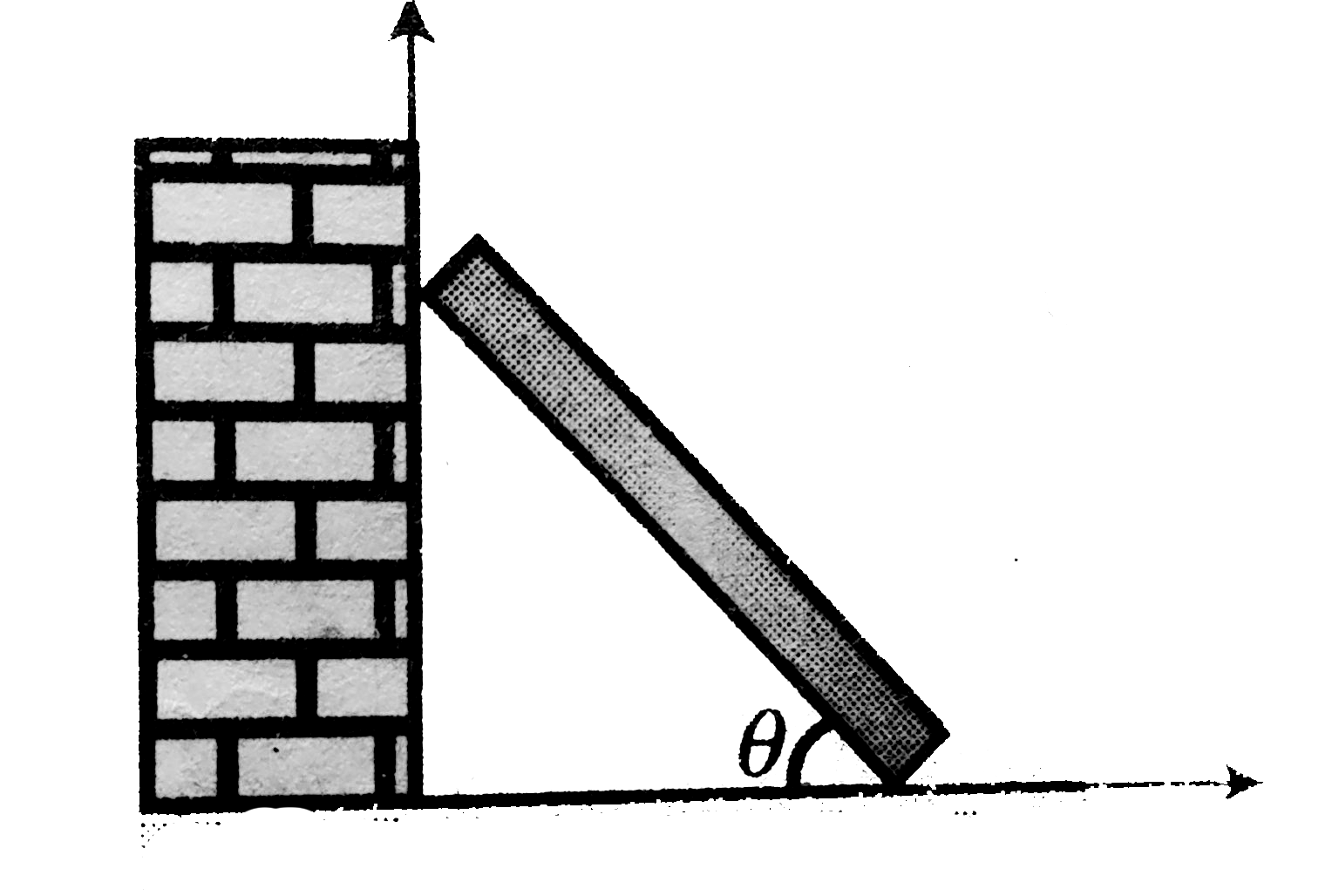
A uniform bar of length I and mass m sta...

A uniform bar of length `I` and mass `m` stands vertically touching a vertical wall (`y`-axis). When slightly displaced, its lower end begins to slide along the floor (`x`-axis). Obtain an expression for the angular velocity (`omega`) of the bar as a function of `O`. Neglect friction everywhere.

Promotional Banner

Similar Questions

Explore conceptually related problems

A uniform wooden bar of length l and mass m hinged on a vertical wall of a containing water, at one end. 3//5th part of the bar is submerged in water. Find the ratio of densities of the liquid and the bar.

A uniform wooden bar of length l and mass m hinged on a vertical wall of a containing water, at one end. 3//5th part of the bar is submerged in water. Find the ratio of densities of the liquid and the bar.

A uniform rod of length 4l and mass m is free to rotate about a horizontal axis passing through a point distant l from its one end. When the rod is horizontal its angular velocity is omega as shown in figure. calculate (a). reaction of axis at this instant, (b). Acceleration of centre of mass of the rod at this instant. (c). reaction of axis and acceleration of centre mass of the rod when rod becomes vertical for the first time. (d). minimum value of omega , so that centre of rod can complete circular motion.

A uniform rod of length 4l and mass m is free to rotate about a horizontal axis passing through a point distant l from its one end. When the rod is horizontal its angular velocity is omega as shown in figure. calculate (a). reaction of axis at this instant, (b). Acceleration of centre of mass of the rod at this instant. (c). reaction of axis and acceleration of centre mass of the rod when rod becomes vertical for the first time. (d). minimum value of omega , so that centre of rod can complete circular motion.

A conical pendulum, a thin uniform rod of length l and mass m , rotates uniformly about a vertical axis with angular velocity omega (the upper end of the rod is hinged). Find the angle theta between the rod and the vertical.

A uniform rod of length l is slightly disturbed from its vertical position. Find the angular velocity of the rod just after if hits the step. (Friction is sufficient everywhere to prevent slipping)

A uniform thin rod of mass m and length L is standing vertically along the y-axis on a smooth horizontal surface, with its lower end at the origin (0,0). A slight disturbane at t = 0 causes the lower end t slip on the smooth surface along the positive x-axis, and the rod starts falling. (i) What is the path followed by the centr of mass of the rod during its fall? (ii) Find the equaiton to the trajectory of a point on the rod shape of the path of this point?

A uniform thin rod of mass m and length L is standing vertically along the y-axis on a smooth horizontal surface, with its lower end at the origin (0,0). A slight disturbane at t = 0 causes the lower end t slip on the smooth surface along the positive x-axis, and the rod starts falling. (i) What is the path followed by the centr of mass of the rod during its fall? (ii) Find the equaiton to the trajectory of a point on the rod shape of the path of this point?