

Home
Class 12
PHYSICS
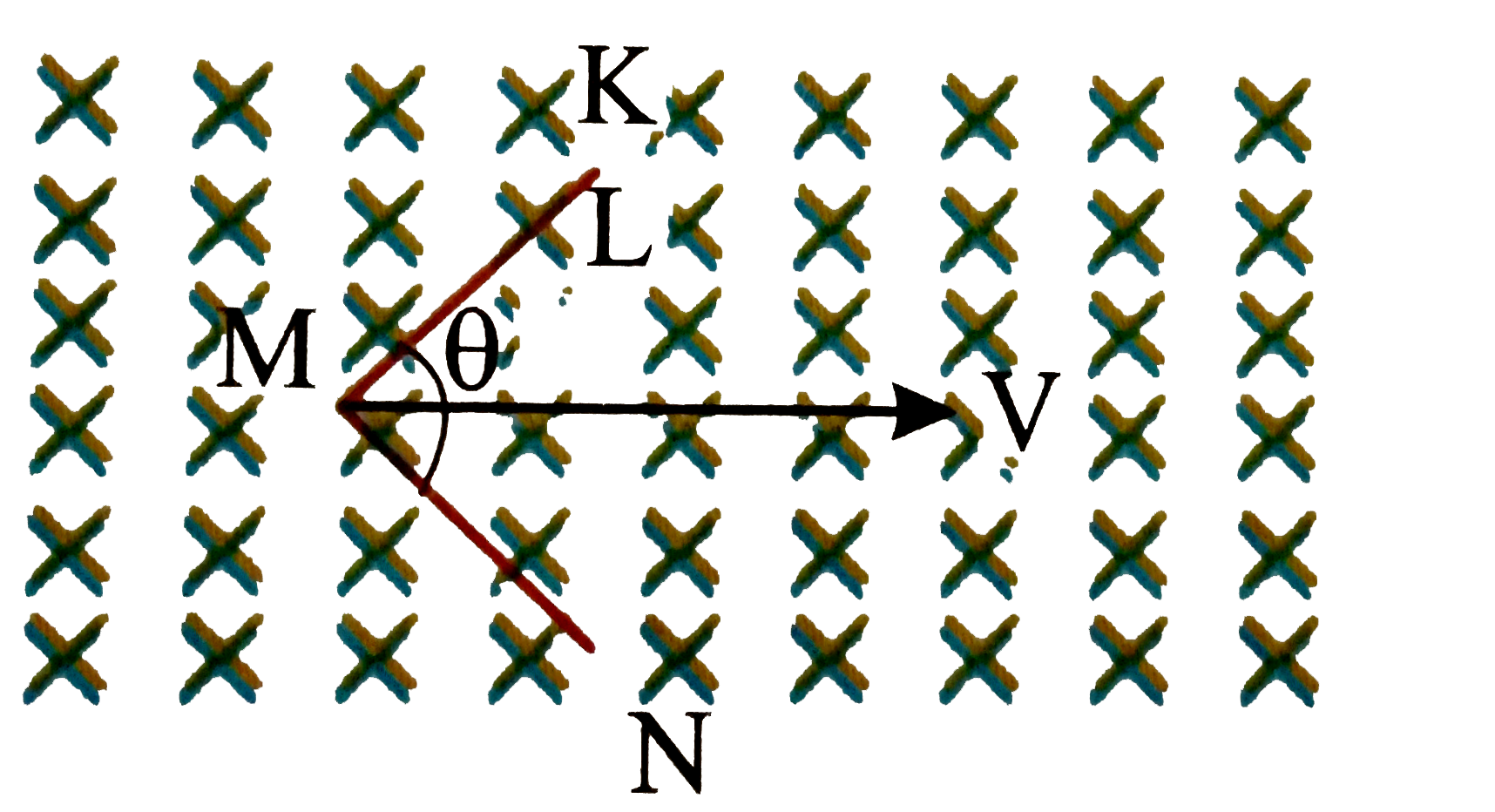
A wire KMN moves along the bisector of t...

A wire `KMN` moves along the bisector of the angle `theta` with a constant velocity `v` in a uniform magnetic field `B` perpendicular to the plane of the paper and directed inward. Which of the following is correct?

Promotional Banner

Similar Questions

Explore conceptually related problems

The counductor AD moves to the right in a uniform magnetic field directed into the plane of the paper.

The counductor AD moves to the right in a uniform magnetic field directed into the plane of the paper.

A long conducting wire AH is moved over a conducting triangular wire CDE with a constant velocity v in a uniform magnetic field vec(B) directed into the plane of the paper. Resistance per unit length of each wire is rho . Then

A long conducting wire AH is moved over a conducting triangular wire CDE with a constant velocity v in a uniform magnetic field vec(B) directed into the plane of the paper. Resistance per unit length of each wire is rho . Then

An irregular shaped wire PQRS placed in a uniform magnetic field perpendicular to the plane of the paper changes into a circular shape. What will be the direction of the induced current in the loop.

A copper wire bent in the shape of a semicircle of radius r translates in its plane with a constant velocity v. A uniform magnetic field B exists in the direction perpendicular to the plane of the wire. Find the emf induced between the ends of the wire if (a) the velocity is perpendicular ot the diameter joining free ends, (b) the velocity is parallel to this diameter.

A copper wire bent in the shape of a semicircle of radius r translates in its plane with a constant velocity v. A uniform magnetic field B exists in the direction perpendicular to the plane of the wire. Find the emf induced between the ends of the wire if (a) the velocity is perpendicular ot the diameter joining free ends, (b) the velocity is parallel to this diameter.

A copper wire bent in the shape of a semicircle of radius r translates in its plane with a constant velocity v. A uniform magnetic field B exists in the direction perpendicular to the plane of the wire. Find the emf induced between the ends of the wire if (a) the velocity is perpendicular ot the diameter joining free ends, (b) the velocity is parallel to this diameter.

A metallic ring (radius R) of negligible resistance has a resistance r connected across its diameter as shown in the figure. It is moving with velocity v_(0) in a constant magnetic field B_(0) acting perpendicular to the plane of the paper in the inward direction. The current in the resistance is :