Home
Class 12
PHYSICS
Which of the following may represent the...

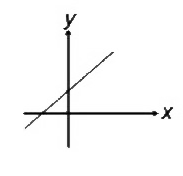
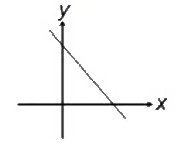
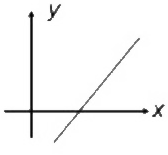
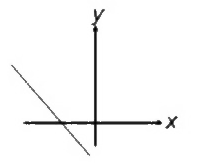
Which of the following may represent the curve x = 2y+ 3?

A

B

C

D

Text Solution

AI Generated Solution

The correct Answer is:

To solve the question "Which of the following may represent the curve x = 2y + 3?", we will follow these steps: ### Step 1: Rearrange the given equation The given equation is: \[ x = 2y + 3 \] We want to express this in the form of \( y = mx + c \) (the slope-intercept form). ### Step 2: Solve for y To isolate \( y \), we can rearrange the equation: \[ 2y = x - 3 \] Now, divide both sides by 2: \[ y = \frac{1}{2}x - \frac{3}{2} \] ### Step 3: Identify the slope and y-intercept From the equation \( y = \frac{1}{2}x - \frac{3}{2} \): - The slope \( m \) is \( \frac{1}{2} \). - The y-intercept \( c \) is \( -\frac{3}{2} \). ### Step 4: Determine points for graphing To graph this line, we can find two points: 1. When \( y = 0 \): \[ 0 = \frac{1}{2}x - \frac{3}{2} \implies \frac{1}{2}x = \frac{3}{2} \implies x = 3 \] So, the point is \( (3, 0) \). 2. When \( x = 0 \): \[ y = \frac{1}{2}(0) - \frac{3}{2} = -\frac{3}{2} \] So, the point is \( (0, -\frac{3}{2}) \). ### Step 5: Plot the points and draw the line Now, we can plot the points \( (3, 0) \) and \( (0, -\frac{3}{2}) \) on the graph. Draw a straight line through these points. ### Step 6: Compare with options Finally, we compare the graph we have drawn with the options provided in the question to identify which one matches our graph. ### Conclusion The graph that matches our derived equation \( y = \frac{1}{2}x - \frac{3}{2} \) will be the correct representation of the curve \( x = 2y + 3 \). ---
Promotional Banner

Similar Questions

Explore conceptually related problems

Which of the following can represent the curve x^(2) = -2y ?

Which ofthe following curves may represent the energy of electron in hydrogen atom as a function of principal quantum number n:

A process is shown in the diagram. Which of the following curves may represent the same process ? BC is rectangular hyperbola.

Which of the following curves may represent the radius of orbit (r_(n)) in H-atoms as a function of principal quantum number (n)

Which of the following curves may represent the radius of orbit (r_n) in a H-atoms as a function of principal quantum number(n)

A hot liquid is kept in a big room. Its temperature is plotted as a function of time. Which of the following curves may represent the plot?
