Home
Class 12
PHYSICS
Which of the following can represent the...

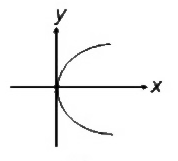
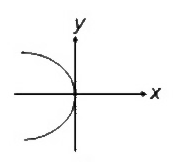
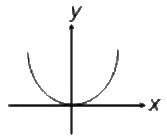
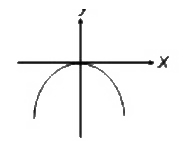
Which of the following can represent the curve `x^(2) = -2y` ?

A

B

C

D

Text Solution

AI Generated Solution

The correct Answer is:

To solve the equation \( x^2 = -2y \) and determine its representation, we can follow these steps: ### Step 1: Rearranging the Equation Start by rearranging the equation to express \( y \) in terms of \( x \): \[ x^2 = -2y \implies y = -\frac{1}{2}x^2 \] ### Step 2: Understanding the Form of the Equation The equation \( y = -\frac{1}{2}x^2 \) is a quadratic equation in \( x \). It represents a parabola that opens downwards because the coefficient of \( x^2 \) is negative. ### Step 3: Identifying the Vertex The vertex of the parabola can be found from the equation \( y = -\frac{1}{2}x^2 \). The vertex occurs at the point where \( x = 0 \): \[ y = -\frac{1}{2}(0)^2 = 0 \] Thus, the vertex is at the point \( (0, 0) \). ### Step 4: Analyzing the Symmetry The parabola is symmetric about the y-axis because the equation involves \( x^2 \). This means that for every positive \( x \), there is a corresponding negative \( x \) that gives the same \( y \) value. ### Step 5: Sketching the Graph To sketch the graph, we can plot a few points: - For \( x = 1 \), \( y = -\frac{1}{2}(1)^2 = -\frac{1}{2} \) → Point (1, -0.5) - For \( x = -1 \), \( y = -\frac{1}{2}(-1)^2 = -\frac{1}{2} \) → Point (-1, -0.5) - For \( x = 2 \), \( y = -\frac{1}{2}(2)^2 = -2 \) → Point (2, -2) - For \( x = -2 \), \( y = -\frac{1}{2}(-2)^2 = -2 \) → Point (-2, -2) Plotting these points will show that the parabola opens downwards and is symmetric about the y-axis. ### Step 6: Conclusion The curve represented by the equation \( x^2 = -2y \) is a downward-opening parabola with its vertex at the origin (0, 0).
Promotional Banner

Similar Questions

Explore conceptually related problems

Which of the following may represent the curve x = 2y+ 3?

Which of the following is represented by 'Lorenz Curve'?

which one of the following can best represent the graph of quadratic polynomial y=ax^(2)+bx+c (where a 0)?

Which of the following are true for the curve represented by the differential equation sec^2y dy/dx+2x tany=x^3 satisfying y(1)=0 (A) equation of curve is 2tany=x^2-1 (B) equation of curve is y^2=x^3-1 (C) curve is a parabola (D) curve is not a conic

The differential equation of the family of curves represented by the equation x^(2)y=a is

Which of the following options is not the asymptote of the curve 3x^(3)+2x^(2)y-7xy^(2)+2y^(3)-14xy+7y^(2)+4x+5y=0
