Home
Class 12
PHYSICS
A particle falls from a height h and reb...

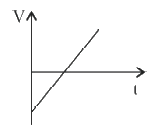
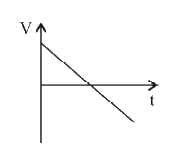
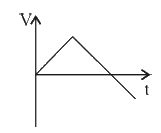
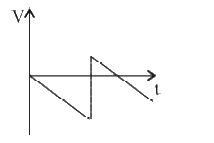
A particle falls from a height h and rebounds to a height `h _(1) ( h _(1) lt h),` then which of the graph represents the motion correct ?

A

B

C

D

Text Solution

AI Generated Solution

The correct Answer is:

To solve the problem, we need to analyze the motion of a particle that falls from a height \( h \) and rebounds to a height \( h_1 \) (where \( h_1 < h \)). We will describe the motion in terms of velocity and time, and then determine the correct graph that represents this motion. ### Step-by-Step Solution: 1. **Understanding the Motion**: - The particle falls from a height \( h \) under the influence of gravity. As it falls, its velocity increases due to gravitational acceleration. - Upon reaching the ground, it collides with the ground and rebounds to a height \( h_1 \), which is less than \( h \). 2. **Velocity During Free Fall**: - As the particle falls, its velocity increases. If we take the downward direction as negative, the velocity just before hitting the ground can be calculated using the equation: \[ v = \sqrt{2gh} \] - At the moment just before impact, the velocity is at its maximum and directed downwards (negative). 3. **Impact and Rebound**: - Upon hitting the ground, the particle's velocity direction changes from negative to positive. This is an instantaneous change in direction. - After the impact, the particle moves upwards, and its velocity decreases as it rises until it reaches the maximum height \( h_1 \) where the velocity becomes zero. 4. **Velocity During Ascent**: - As the particle ascends, it decelerates due to gravity until it reaches the height \( h_1 \). The velocity decreases from a positive value to zero at the peak of the rebound. 5. **Graph Representation**: - The graph of velocity versus time will show: - A negative slope as the particle falls (increasing negative velocity). - A sudden change in direction at the point of impact (from negative to positive). - A positive slope as the particle rises (decreasing positive velocity until it reaches zero). ### Conclusion: The correct graph will show a continuous increase in negative velocity as the particle falls, a sudden change to positive velocity at the point of impact, and a gradual decrease in positive velocity as the particle rises until it reaches the height \( h_1 \).
Promotional Banner

Similar Questions

Explore conceptually related problems

Two steel balls fall freely on an elastic slab. The first ball is dropped from a height h_(1) and the second from a height h_(2)(h_(2) lt h_(1)) sec after the first ball. After the passage of time T, the velocities of the balls coincide in magnitude and direction. Determine the time T and the time interval during which the velocities of the two balls will be equal assuming that the balls do not collide.

A ball released from a height ho above a horizontal surface rebounds to a height h_(1) , after one bounce. The graph that relates h_(0) to h_(1) is shown Fig. If the ball (of the mass m ) was dropped from an initial height h and made three bounces, the kinetic energy of the ball immediately after the third impact with the surface was

A ball of mass m falls vertically to the ground from a height h_1 and rebound to a height h_1 and rebound to a height h_2 . The change in momentum of the ball on striking the ground is.

A body is allowed to fall on the ground from a height h_(1) . If it is rebound to a height h_(2) then the coefficient of restitution is:

A ball falls from rest from a height h onto a floor, and rebounds to a height h//4 . The coefficient of restitution between the ball and the floor is
