Home
Class 12
PHYSICS
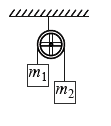
Two masses m(1) and m(2) ( m(2) gt m(1))...

Two masses `m_(1)` and `m_(2) ( m_(2) gt m_(1))` are hanging vertically over frictionless pulley. The acceleration of the two masses is `:`

A

`( m_(1))/( m_(2))g`

B

`( m_(2))/( m_(1))g `

C

`((m_(2)-m_(1))/(m_(1)+m_(2)))g`

D

`((m_(1)+m_(2))/(m_(2)-m_(1)))g`

Text Solution

Verified by Experts

The correct Answer is:

C
Promotional Banner

Similar Questions

Explore conceptually related problems

Two masses are hanging vertically over frictionless pulley. The acceleraton of the two masses is -

Two masses m_1=5kg and m_2=4.8kg tied to a string are hanging over a light frictionless pulley. What is the acceleration of the masses when left free to move?

Two blocks of masses m_(1) and m_(2)(m_(1) gt m_(2)) connected by a massless string passing over a frictionless pulley Magnitude of acceleration of blocks would be

Two blocks m_(1) = 5 g and m_(2) = 10 g are hung vertically over a light frictionless pulley as shown in figure. What is the acceleration of the masses when left free ?

Fig. shows a block of mass m_(1) resting on a smooth surface. It is connected to a mass m_(2) by a string passing over a massless and frictionaless pulleys m_(2) gt m_(1) . The acceleration of the hanging mass m_(2) is :

Two masses m and m (mgtm) are connected by massless flexible and inextensible string passed over massless and frictionless pulley. The acceleration of centre of mass is

Two masses m_(1) and m_(2) . Which are connected with a light string, are placed over a frictionless pulley. This set up is placed over a weighting machine, as shown. Three combination of masses m_(1) and m_(2) are used, in first case m_(1)=6 kg and m_(2)=2kg in second case m_(1)=5kg and m_(2)=3kg and in third case m_(1)=4kg and m_(2)=4kg .Masses are held stationary initiallly and then released. If the readings of the weighing machine after the release in three cases are W_(1) , W_(2) and W_(3) respectively then :-

If two particles of masses m_(1) and m_(2) are projected vertically upwards with speed v_(1) and v_(2) , then the acceleration of the centre of mass of the system is

Two masses m_(1) and m_(2) are accelerated uniformly on a frictionless surface as shown in figure given below. The ratio of the tensions T_(1)/T_(2) is:
