Home
Class 12
PHYSICS
Calculate the acceleration of the masses...

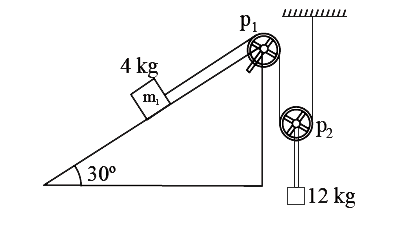
Calculate the acceleration of the masses 12 kg shown in the set up of fig. Also calculate the tension in the string connecting the 12 kg mass. The string are weightless and inextensible, the pulleys are weightless and frictionless.

A

`(g)/( 10), ( 56g)/( 5) N`

B

`(2g)/( 7) , ( 60g)/( 17) N`

C

`(10)/( g) , ( 5)/( 56g)`

D

`( g)/( 14), ( 5)/( 56g) N`

Text Solution

Verified by Experts

The correct Answer is:

B
Promotional Banner

Similar Questions

Explore conceptually related problems

Calculate the tension in the string shown in (a) The pulleys and the string are light and all surfaces are frictionless. (g=10m//s^(2))

Calculate the tension in the string shown in figure. The pulley and the string are light and all surfaces are frictionless. Take g=10 m/ s^2 .

Find the acceleration of two masses as shown in figure . The pulley are light and frictionless and string are light and frictionless and string are light and inextensible.

The system shown in fig, is released from rest. Calculate the tension in the string and the force exerted by the string on the pulleys, assuming pulleys and strings are massless.

A block of mass 30 kg is suspended by three string as shown in fig, Find the tension in each string.

In the shown ,two blocks one of mass 5kg and the other of mass 2kg are connected by light and inextensible string Pulleys are light an d frictionless Choose the correct statement .

Three equal weights of mass 2 kg each are hanging on a string passing over a fixed pulley as shown in fig What is the tension in the string connecting weights B and C?

Masses m_(1), m_(2), m_(3) and m_(4) are arranged in a system as shown in fig where m_(1) +m_(2) gt m_(3)+m_(4) The lower string keeping the system in equilibrium is burnt The masses start moving. Find the acceleration of masses if the threads are weightless and inextensible the springs are also weightless and the mass of the pulley is negligible.

Find the acceleration of masses m_(1) and m_(2) connected by an inextensible string, shown in figure-2.13(a). The string and pulley are assumed to be massless and frictionless.
