Home
Class 12
PHYSICS
A body mass 2kg has an initial velocity ...

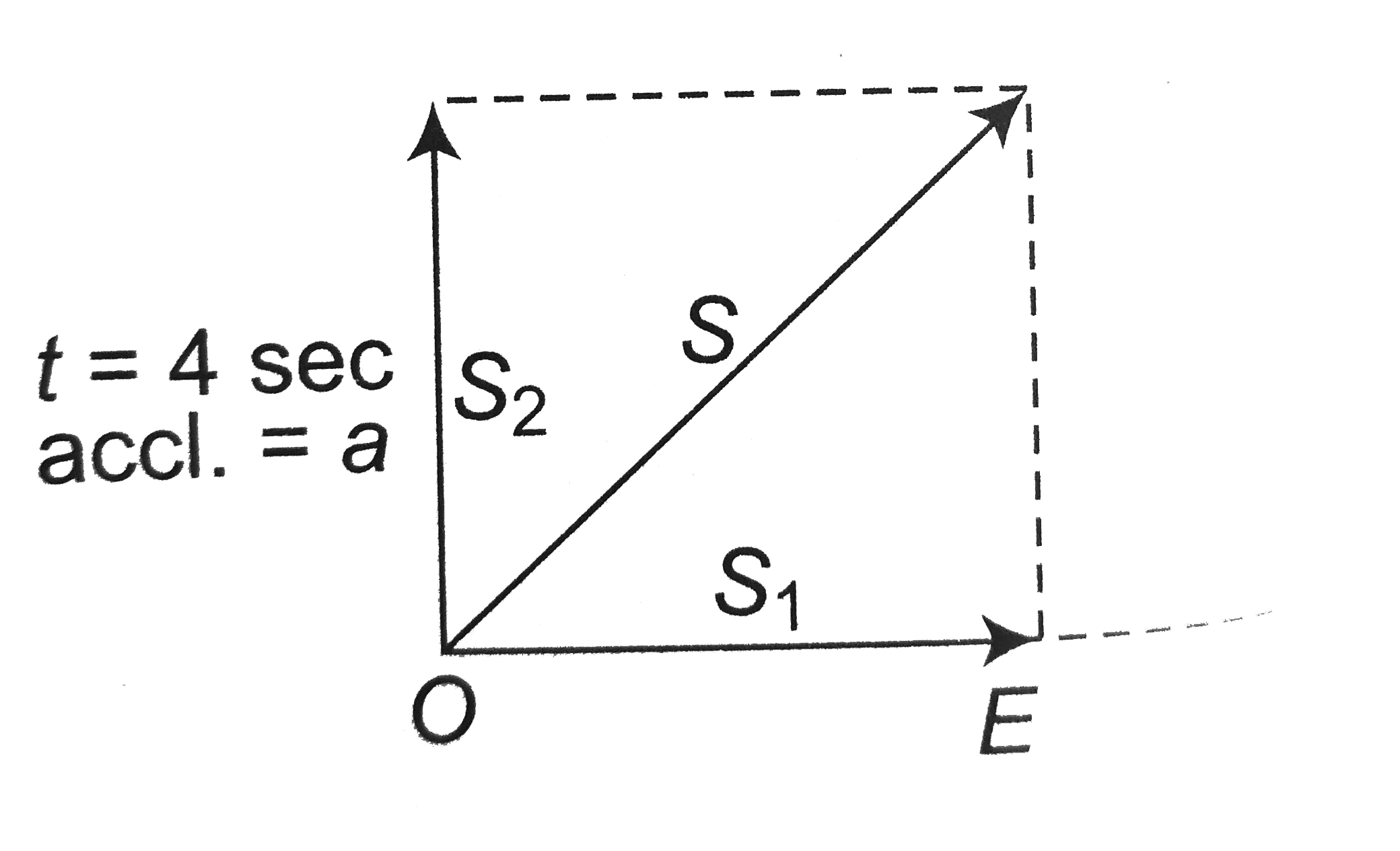
A body mass `2kg` has an initial velocity of 3 metre//sec along OE and it is subject to a force of `4N` in a direction perpendicular to OE. The distance of body from `O` after 4 sec will be:

A

12m

B

20m

C

8m

D

48m

Text Solution

Verified by Experts

The correct Answer is:

2
Promotional Banner

Similar Questions

Explore conceptually related problems

A body of mass 2 kg has an initial velocity of 3 m s^-1 along OE and it is subjected to a force of 4 N in O F direction perpendicular to O E . Find the distance of the body from O after 4 s . .

Assertion : A body of mass 4 kg has an initial velocity 5hat(i)ms^(-1) . It is subjected to a force of 4hat(j)N . The displacement of body from origin after 4 s will be 21.5 m . Reason : The equation v=u+a t can be applied to obtain v if a is constant.

A body is moving with a velocity 5m//s along a striaght line.A force of 10N is applied to the body perpendicular to the line of motion. If the body is of mass 2kg, then the acceleration of the body along the initial straight line of motion is :

A body has an initial velocity of 3m//s and has an acceleration of 1m//sec^(2) normal to the direction of the initial velocity. Then its velocity 4 seconds after the start is

A body of mass 5 kg initially at rest is subject to a force of 20 N. What is the kinetic energy acquired by the body at the end of 10 s ?

A body of mass 5kg initially at rest, is subjected to a force of 40 N. Find the kinetic energy acquired by the body at the end of 5 seconds :

A body has an initial velocity of 3 ms^-1 and has an acceleration of 1 ms^-2 normal to the direction of the initial velocity. Then its velocity 4 s after the start is.

A body of mass 2 kg is moving along x-direction with a velocity of 2 m//sec. If a force of 4 N is applied on it along y-direction for 1 sec, the final velocity of particle willbe-

A body of mass 2kg moving with a velocity of 10m//s is brought to rest in 5 sec . Calculate the stopping force applied.

A body of mass 2 kg moving with a velocity of 3 m/sec collides head on with a body of mass 1 kg moving in opposite direction with a velocity of 4 m/sec. After collision, two bodies stick together and move with a common velocity which in m/sec is equal to
