Home
Class 12
PHYSICS
For the system shown in fig., initially ...

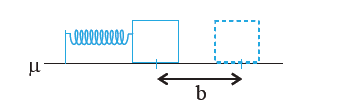
For the system shown in fig., initially the spring is compressed by a distance 'a' from its natural length and when released, it moves to a distance 'b' from its equillibrium position, the decrease in amplitude for half cycle (-a to +b) is :

A

`(mu mg)/(K)`

B

`(2mu mg)/(K)`

C

`(mu g)/(K)`

D

`(K)/(mu mg)`

Text Solution

Verified by Experts

The correct Answer is:

B
Promotional Banner

Similar Questions

Explore conceptually related problems

A mass-spring system oscillates such that the mass moves on a rough surface having coefficient of friction mu . It is compressed by a distance a from its normal length and, on being released, it moves to a distance b from its equilibrium position. The decrease in anplitude for one half-cycle (-a to b) is

The system shown in the figure can move on a smooth surface. The spring is initially compressed by 6 cm and then released.

Find the time period of mass M when displaced from its equilibrium position and then released for the system shown in figure.

The spring is compressed by a distance a and released. The block again comes to rest when the spring is elongated by a distance b . During this

Find the maximum tension in the spring if initially spring at its natural length when block is released from rest.

A block of mass m=0.1 kg is connceted to a spring of unknown spring constant k. It is compressed to a distance x from its equilibrium position and released from rest. After approaching half the distance ((x)/(2)) from the euilibrium position, it hits another block and comes to rest momentarily, while the other block moves with velocity 3ms^(-1) . The total initial energy of the spring is :

The ration of kinetic energy to the potential energy of a particle executing SHM at a distance equal to half its amplitude , the distance being measured from its equilibrium position is

In the string mass system shown in the figure, the string is compressed by x_(0) = (mg)/(2k) from its natural length and block is relased from rest. Find the speed o the block when it passes through P ( mg//4k distance from mean position)

A block of mass m is pushed against a spring of spring constant k fixed at one end to a wall.The block can slide on a frictionless table as shown in the figure. The natural length of the spring is L_0 and it is compressed to one fourth of natural length and the block is released.Find its velocity as a function of its distance (x) from the wall and maximum velocity of the block. The block is not attached to the spring.
