Home
Class 12
PHYSICS
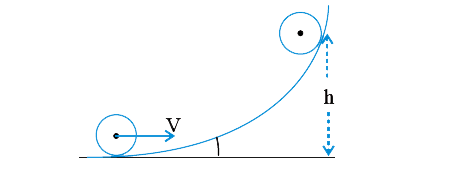
A disc of mass M and radius R rolls on a...

A disc of mass M and radius R rolls on a horizontal surface and then rolls up an inclined plane as shown in the figure. If the velocity of the disc is v, the height to which the disc will rise will be:

A

`(3v^(2))/(2g)`

B

`(3v^(2))/(4g)`

C

`(v^(2))/(4g)`

D

`(v^(2))/(2g)`

Text Solution

Verified by Experts

The correct Answer is:

B
Promotional Banner

Similar Questions

Explore conceptually related problems

A uniform disc of mass m and radius r rolls without slipping along a horizontal surface and ramp, as shown above. The disk has an initial velocity of upsilon . What is the maximum height h to which the center of mass of the disc rises ?

A disc having radius 'a' is rolling on an inclined plane as shown in figure. If acceleration of disc 2/b g sin(theta) then find b

A disc of mass M and radius R is rolling with angular speed w on horizontal plane as shown. The magnitude of angular momentum of the disc about the origin O is :

A sphere a ring and a disc of same mass and radius are allowed to roll down three similar sufficiently rough inclined planes as shown in the figure from same height. Which of the following order is true for final linear velocity of the bodies?

A semicircle disc of mass M and radius R is held on a rough horizontal surface as shown in figure. The centre of mass C of the disc is at a distance of (4R)/(3pi) from the point O . Now the disc is released from this position so that it starts rolling without slipping. Find (a) The angular acceleration of the disc at the moment it is relased from the given position. (b) The minimum co-efficient of fricition between the disc and ground so that it can roll without slipping.

A disc of mass 4.8 kg and radius 1 m is rolling on a horizontal surface without sliding with angular velocity of 600 rotations/min. What is the total kinetic energy of the disc ?

A sphere a ring and a disc of same mass and radius are allowed to roll down three similar sufficiently rough inclined planes as shown in the figure from same height. Which of the follwing order is true for final KE of the bodies?
