Home
Class 12
PHYSICS
Two beams of light are incident normally...

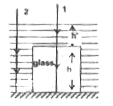
Two beams of light are incident normally on water (R.l. = `4/3`). If the beam 1 passes through a glass (R.l. = `3/2`) slab of height h as shown in the figure, the time difference for both beams for reaching the bottom is

A

zero

B

`(h^('))/(6C)`

C

`(6h)/C`

D

`h/(6C)`

Text Solution

Verified by Experts

The correct Answer is:

D
Promotional Banner

Similar Questions

Explore conceptually related problems

Two parallel beams of light P and Q are incident normally on a prism and the transmitted rays are brought to focus with the help of a convergent lens as shown in Fig. 2.23. If the intensities of the upper and lower beams immediately after transmission from face AC are 4I abd I, respectively, find the resultant intensity at the focus.

A laser beam propagates through a spherically symmetric medium, as shown in the figure. The refractive index varies with the distance to the symmetry centre C by the law mu(r )=mu_(0)(r )/(r_(0)) , where mu_(0)=1 , r_(0)=3cm , r_(0) le r lt oo . The beam's trajectory lies in the plane that includes C . At distance r_(1)=8sqrt(2)cm the beam makes an angle phi=30^(@) with vecr_(1) as shown in the figure. Find the minimum distance (in cm ) the beam reach relative to the symmetry centre C .

A massless beam of langth 5 m is placed on two wedges A and B. If three forces 3 kN, 4 kN and 5 kN are applied on the beam as shown in the figure, then find normal reaction at A and B.

A parallel beam of light is incident on the surface of a transparent hemisphere of radius R and refractive index 2.0 as shown in figure. The position of the image formed by refraction at the first surface is :

A parallel beam of light is incident normally on the flat surface of a hemisphere of radius 6 cm and refractive index 1.5 , placed in air as shown in figure (i). Assume paraxial ray approxiamtion. .

A diverging beam of light from a point source S having devergence angle alpha , falls symmetrically on a glass slab as shown. The angles of incidence of the two extreme rays are equal. If the thickness of the glass slab is t and the refractive index n, then the divergence angle of the emergent beam is

A light beam is incident on a rectangular glass plate (mu= 1.54) The reflected light OB passes through a nicol prism. On observing the transmitted light while rotating the prism, it is seen that
