To determine the floral formula for Ashwagandha, we will follow these steps:
### Step-by-Step Solution:
1. **Identify the Family**:
- Ashwagandha belongs to the Solanaceae family.
2. **Determine the Flower Characteristics**:
- The flowers of the Solanaceae family are bractate (having bracts), actinomorphic (radially symmetrical), and bisexual (having both male and female reproductive parts).
3. **Calyx (Sepals)**:
- The calyx consists of 5 sepals that are united.
- This can be represented as: \( \text{C} \, (5) \) where the number indicates the total sepals and the parentheses indicate they are united.
4. **Corolla (Petals)**:
- The corolla has 5 petals that are also fused, which is referred to as gamopetalus.
- This can be represented as: \( \text{P} \, (5) \) where the number indicates the total petals and the parentheses indicate they are fused.
5. **Androsium (Stamens)**:
- The androsium has 5 stamens. These stamens are epipetalous, meaning they are attached to the petals.
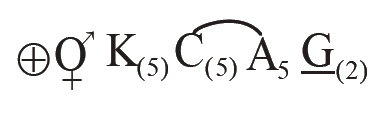
- This can be represented as: \( \text{A} \, (5) \) with a curve drawn between the corolla and androsium to indicate the epipetalous condition.
6. **Gynosium (Carpels)**:
- The gynosium is bicarpolary (having two carpels) and syncarpous (the carpels are fused).
- This can be represented as: \( \text{G} \, (2) \) where the number indicates the total carpels and the parentheses indicate they are fused.
7. **Ovary Position**:
- The ovary is superior, which is indicated by drawing a line under the G in the floral formula.
8. **Combine All Components**:
- Now, we can combine all these components to write the floral formula for Ashwagandha:
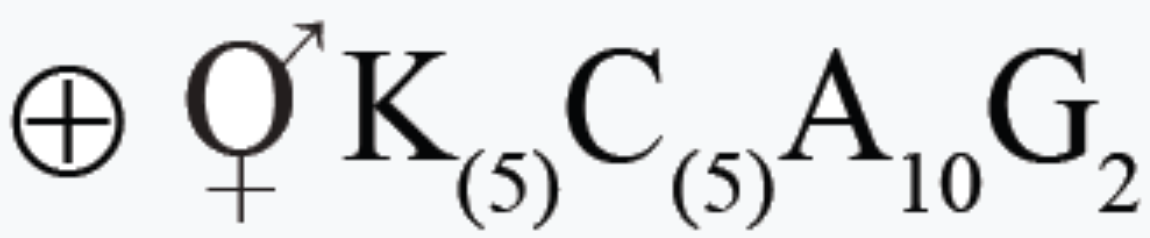
- The floral formula is represented as:
\[
\text{Br} \, \text{(5)} \, \, \text{C} \, (5) \, \, \text{P} \, (5) \, \, \text{A} \, (5) \, \, \text{G} \, (2) \, \, \text{(superior)}
\]
### Final Floral Formula:
The floral formula for Ashwagandha is:
\[
\text{Br} \, (5) \, \text{C} \, (5) \, \text{P} \, (5) \, \text{A} \, (5) \, \text{G} \, (2) \, \text{(superior)}
\]