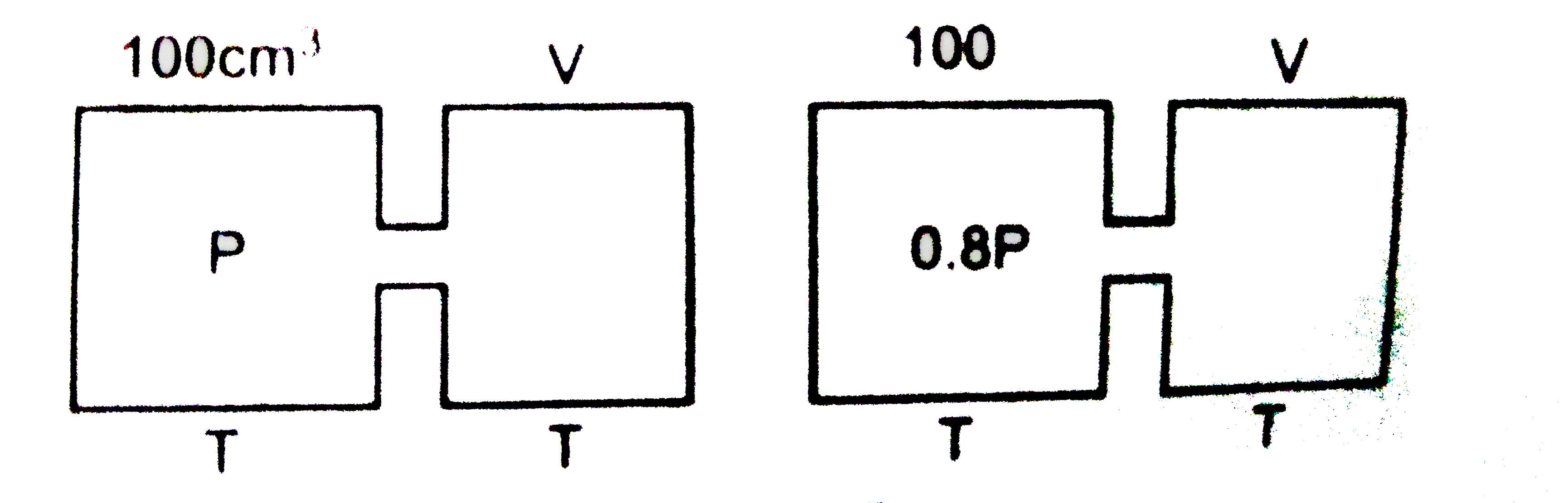
Two glass bulbs A and B are connected by a very small tube having a stop cock. Bulb A has a volume of 100 `cm^(3)` and contained the gas, while bulb B was empty. On opening th stop cock. The pressure fell down to 40%. The volume of the bulb B must be:
Two glass bulbs x and y are connected by a very small tube having a stop - cock. Bulb X has a volume of 100cm^(3) and contained the gas, while bulb Y was empty. On opening the stop - cock, the pressure fell down to 60% . The volume of the bulb Y must be
Two gases bulbs A and B are connected by a tube having a stopcock. Bulb A has a volume of 100 mL and contains H_(2) gas . After opening the gas from A to the evacuated bulb B , the pressure falls down by 40% . The volume (mL) of B must be
Two cylinders A and B of equal capacity are connected to each other vis a stop cock. A contains an ideal gas at standard temperature and pressure. B is completely evacuated. The sto cock is suddenly opened. The process is:
Initially bulb "a" contained oxygen gas at 27^(@)C and 950 mm of Hg and bulb "B" contained neon gas at 27^(@)C and 900 mm of Hg. These bulbs are connected by a narrow tube of negligible volume equipped with a stopcock and gases were allowed to mix-up freely. The pressure obtained in the combined system was found to be 910 mm of Hg. If volume of bulb B was measured to be 10 L, then find the volume of oxygen gas present initially in bulb "A" .
Two identical glass bulbs are interconnected by a thin tube of negligible volume. An ideal gas is filled in the bulbs at STP. One bulb is placed in a tub of melting ice and the other bulb is placed in a hot bath. The gas pressure in the bulbs becomes 1.5 times. Find the tem perature of the hot bath. Which bulb has more gas?
Two gas bulbs are connected by a thin tube. Calaculate the partial pressure of helium after the connective value is opened at a constant temperature of 27^(@)C