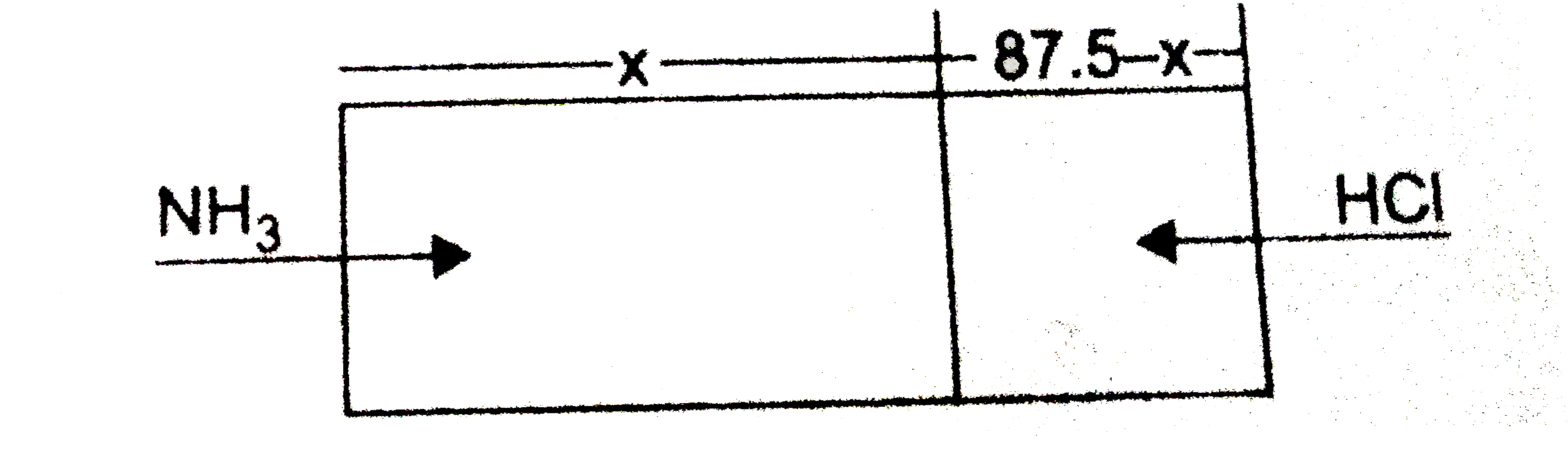
When two cotton plugs, one moistened with ammonia and the other with hydrochloric acid, are sumulataneously inserted into opposite ends of a glass tube 87.0 cm long, a white ring of `NH_(4)Cl` forms where gaseous `NH_(3)` and gaseous HCl first come into contact. `NH_(3)(g)+HCl(g)rarrNH_(4)Cl(s)` At what distance from the ammonis-moistened plug does this occur?
A bottle of dry NH_(3) and another bottle of dry HCl connected through a long tube are opened simultaneously at both ends of the tube. The white ring (NH_(4)Cl) first formed will be
Two flasks A and B of equal volume containing NH_(3) and HCl gases, are connected by a narrow tube of negligible volume. The two gases were prevented from mixing by stopper fitted in connecting tube. For further details of the experiment, refer to the given figure. What will be final pressure (in mm of Hf) in each flask when passage connecting two tubes are opened, assuming ideal gas behaviour of NH_(3) and HCl gas and the reaction NH_(3)(g)+HCl(g)rarrNH_(4)Cl(s) goes to completion.
At room temperature, ammonia gas at 1 atm pressure and HCl gas at pressure P atm are allowed to effuse through idential pin holes from opposite ends of a glass tube of 1 meter length and of uniform area of cross-section. NH_(4)Cl is first formed at a distance of 60 cm from the end through which HCl gas was sent in. Calculate the value of P.
In a 2 m long narrow tube, HCl is allowed to diffuse in the tube from one end and NH_(3) from the other end. If diffusion is started at the same time, predict at what point the white fumes of NH_(4)Cl will form ?
A 5.00L evacuated cylinder is charged with 25.5g of NH_(3) and 36.4 g of HCl. Calculate the final pressure at 85.0^(@)C after the two compounds have reacted completely: NH_(3)(g)+HCl(g)rarrNH_(4)CI(s)