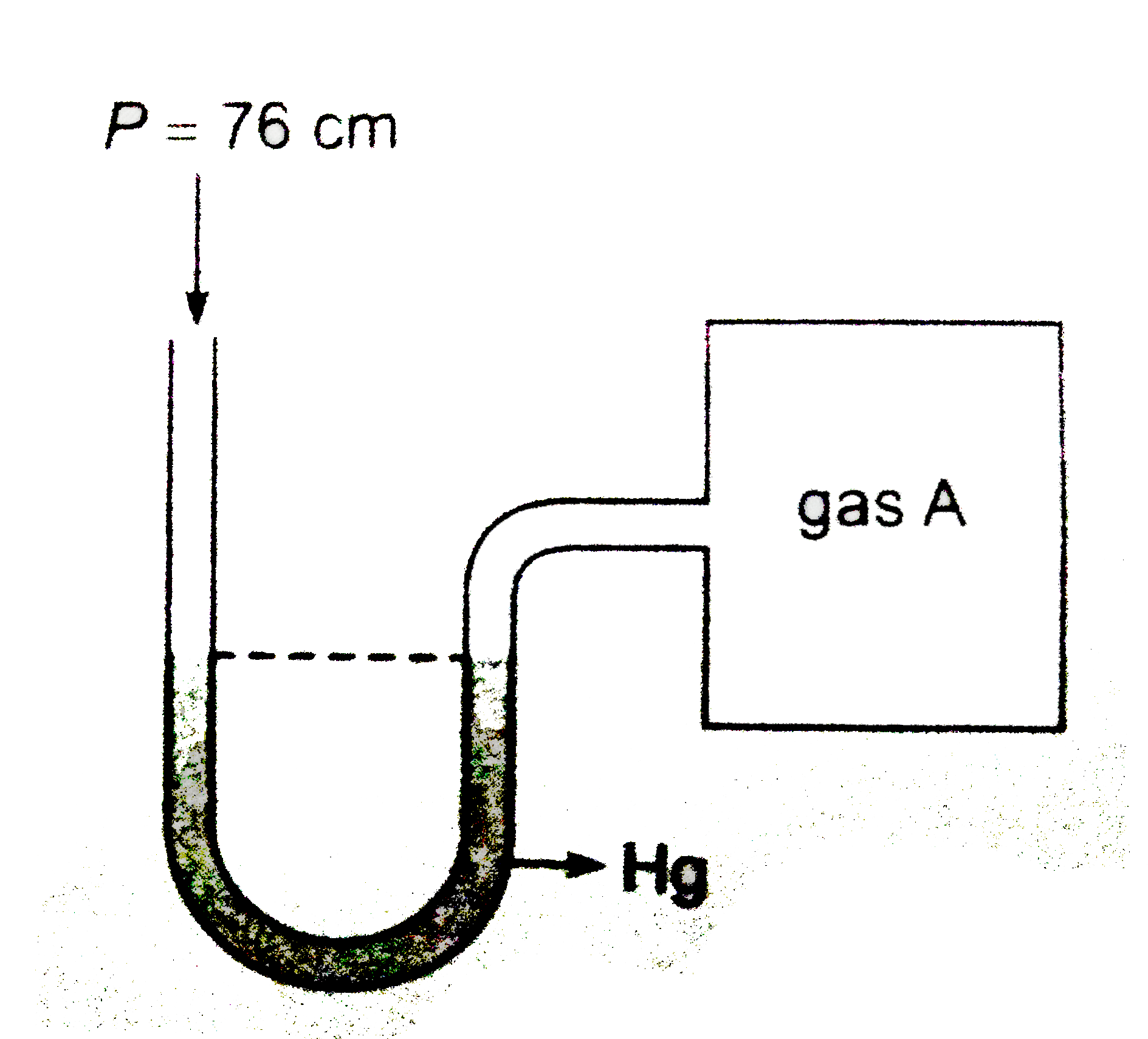
A open ended mercury manometer is used to measure the pressure exerted by a trapped gas as shown in the figure. Initially manometer shows no difference in mercury level in both columns as shown in diagram. After sparking 'A' dissociates according to following reaction `A(g)rarrB(g)+3C(g)` If pressure of Gas "A" dissociates to 0.9 atm, then (Assume temperature to be constant and is 300 K)
A
total pressure increases to 1.3 atm
B
total pressure increases by 0.3 atm
C
total pressure increases by 22.3 cm of Hg
D
difference in mercurry level is 228 mm.
Text Solution
Verified by Experts
The correct Answer is:
a,b,d
(a,b,d) `P_(T)=(1+3xx)=1+3xx0.1=1.3 atm.` `/_\P=0.2atm or 76xx0.3cm" of "Hg` `or 760xx0.3 mm " of " Hg`
Topper's Solved these Questions
GASEOUS STATE
NARENDRA AWASTHI|Exercise Level 1 (Q.31 To Q.60)|1 Videos
GASEOUS STATE
NARENDRA AWASTHI|Exercise Level 1 (Q.121 To Q.150)|1 Videos
An open ended mercury mnometer is used to measure the pressure exerted by a trapped gas as shown in the figure. Initially manometer shows no difference in mercury level in both columns as shown in diagram. After sparking A dissociates according to following reaction: 2A(g)rarr3B(g)+2C(g) ltbr. If pressure of Gas A decreases to 0.8 atm. Then: (Assume temperature to be constant at 300K)
A manometer attached to a flask contains with ammonia gas have no difference in mercury level initially as shown in diagram. After sparking into the flask, ammonia is partially dissociated as 2NH_(3)" (g)"rarr N_(2)" (g)"+3H_(2)" (g)" now it have difference of 6 cm in mercury level in two columns, what is partial pressure of H_(2)" (g)" at equilibrium?
Ammonium hydrogen sulphide dissociated according to the equation, NH_4HS(s) hArr NH_3(g) +H_2S(g) . If the observed pressure of the mixture is 1.12 atm at 106^@C , what is the equilibrium constant K_p of the reactions ?
Ammonium hydrogen sulphide dissociates according to the equation : NH_4 HS(s) hArr NH_3(g)+H_2S(g) The total pressure at equilibrium at 400 K is found to be 1 atm.The equilibrium constant K_p of the reaction is :
A tube of length 50 cm is containing a gas in two secitons separated by a mercury column of length 10 cm as shown in figure. The tube's open end is just inside the Hg surface in container, find pressure of gas in upper section. [Assume atmospheric pressure = 75 cm of Hg column]
Calculate the volume percent of chlorine gas at equilibrium in the dissociation of PCl_(5)(g) under a total pressure of 1.5 atm. The K_(p) for its dissociation =0.3 .