Home
Class 12
CHEMISTRY
Explain the dual behaviour of matter. Di...

Explain the dual behaviour of matter. Discuss its significance to microscopic particles like electrons.

Text Solution

Verified by Experts
de - Broglie's hypothesis :The light is found to exhibit wave nature as well as particle nature (dual nature ) . Based on this idea of ' duel nature of light '. De Broglie in 1924 proposed that " all micro -particles including the electron moving with high velcoity are as sociated with dual nature (i.e., ) both particle wave nature .
De- broglie an expression for the wavelength of the moving electron .
Expression for de-Broglie wavelengths :
According to 'Planck's quantum theory' , energy of a photon ,
`E=hupsilon, " But " upsilon=(c)/(lamda)`
`thereforeE=h.(c)/(lamda)......(1)`
Einstein's mass - energy equivalence equation is `E=mc^(2)" " .......(2)`
combining eqns. (1) and (2) ,
`(h.c)/(lamda)=mc^(2)" or " lamda=(h)/(mc)=(h)/(p)`
(p=mc=momentum)
This equations is applicable to photons as well as to all microparticles , moving with high speed .
`therefore` We can write in general, `lamda=(h)/(p)=(h)/(mv)`
where m = mass of the microparticle and v = its velocity
`lamda` , is called , de-Broglie wavelength or material wavelength .
Significance of de - Broglie's concept:
According to Bohr's theory , electron revolves in an orbit in which its angular momentum (mvr) is an integral multiple of `(h)/(2pi) ` . Bohr assumed electron as a particle .
Hence his equation can be taken as `"mvr"=n((h)/(2pi))` where n = a whole number .
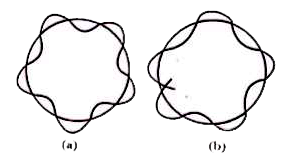
According de Broglie , electron behaves as a standing (or stationary ) wave which extends round the nucleus in a circular orbit . If the ends of the electron wave meet to give a regular series of crests and troughs , the electron - wave is said to be 'in phase' . It means , there is constructive interfernce of electron waves and the electron motion has a character of standing wave or non-energy radiating motion . Always it is a necessary condition motion . Always it is a necessary condition to get an electron-wave in phase'such that the circumference fo the Bohr's orbit `(=2pir)` is equal to the whole number of multiple of the wavelength `(lamda)` of the electron -wave .
`nlamda=2pir`
`lamda=(2pir)/(n)`
But `lamda=(h)/("mv")` (de-Broglie)
`therefore(2pir)/(n) = (h)/("mv") " or mvr"=(nh)/(2pi)`

(a) Wave in - phase (b) Wave out -of phase
This is Bohr's equation which stipulates that "the angular momentum of an electron moving round the nuclecus is an integral multiple of `(h)/(2pi)`" . This shows that, de-Broglie's theory and Bohr's theory are in agreement with each other .
Promotional Banner

Topper's Solved these Questions

  • ATOMIC STRUCTURE

    VGS PUBLICATION-BRILLIANT|Exercise ADDITIONAL QUESTIONS & ANSWERS|22 Videos
  • ATOMIC STRUCTURE

    VGS PUBLICATION-BRILLIANT|Exercise SHORT ANSWER QUESTIONS|18 Videos
  • AP MARCH-2018 I.P.E. PAPER

    VGS PUBLICATION-BRILLIANT|Exercise SECTION-C|5 Videos
  • CHEMICAL BONDING AND MOLECULAR STRUCTURE

    VGS PUBLICATION-BRILLIANT|Exercise LONG ANSWER QUESTIONS|9 Videos

Similar Questions

Explore conceptually related problems

Dual nature of matter was proposed by de Broglie in 1923, it was experimentally verified by Davisson and Germer by diffraction experiment. Wave haracter of matter has significance only for microscopic particles. De Broglie wavelength (lambda) can be calculated using the relation, (lambda) = (h)/(m v) where 'm' and 'v' are the mass and velocity of the particle. The wavelength of matter waves associated with a body of mass 1000g moving with a velocity of 100m/sec is :

Dual nature of matter was proposed by de Broglie in 1923, it was experimentally verified by Davisson and Germer by diffraction experiment. Wave haracter of matter has significance only for microscopic particles. De Broglie wavelength (lambda) can be calculated using the relation, (lambda) = (h)/(m v) where 'm' and 'v' are the mass and velocity of the particle. Which among the following is not used to calculate the de Broglie wavelength ?

Dual nature of matter was proposed by de Broglie in 1923, it was experimentally verified by Davisson and Germer by diffraction experiment. Wave haracter of matter has significance only for microscopic particles. De Broglie wavelength (lambda) can be calculated using the relation, (lambda) = (h)/(m v) where 'm' and 'v' are the mass and velocity of the particle. Planck's constant has same dimension as that of

Dual nature of matter was proposed by de Broglie in 1923, it was experimentally verified by Davisson and Germer by diffraction experiment. Wave haracter of matter has significance only for microscopic particles. De Broglie wavelength (lambda) can be calculated using the relation, (lambda) = (h)/(m v) where 'm' and 'v' are the mass and velocity of the particle. de Broglie equation is obtained by combination of which of the following theories ?

Valence bond theory successfully explains the magnetic behaviour of complexes. The substances which contains unpaired electrons are paramagnetic and paramagnetic character increases as the number of unpaired electrons increases. Magnetic moment of a complex can be determined experimentally and by using formula sqrt(n(n+2)) and we can determine the number of unpaired electrons in it. This information is important in writing electronic structure of complex which in turn also useful in deciding the geometry of complex. The magnetic moment of complexes given below are in the order : {:(Ni(CO)_(4),[Mn(CN)_(6)]),("(I)","(II)"),([Cr(NH_(3))_(6)]^(3+),[CoF_(6)]^(3+)),("(I)","(II)"):}

Valence bond theory successfully explains the magnetic behaviour of complexes. The substances which contains unpaired electrons are paramagnetic and paramagnetic character increases as the number of unpaired electrons increases. Magnetic moment of a complex can be determined experimentally and by using formula sqrt(n(n+2)) and we can determine the number of unpaired electrons in it. This information is important in writing electronic structure of complex which in turn also useful in deciding the geometry of complex. Which of the following are diamagnetic ? 1) K_(4)[Fe(CN)_(6)] 2) K_(3)[Cr(CN)_(6)] 3) K_(3)[Co(CN)_(6)] 4) K_(2)[Ni(CN)_(4)]

Valence bond theory successfully explains the magnetic behaviour of complexes. The substances which contains unpaired electrons are paramagnetic and paramagnetic character increases as the number of unpaired electrons increases. Magnetic moment of a complex can be determined experimentally and by using formula sqrt(n(n+2)) and we can determine the number of unpaired electrons in it. This information is important in writing electronic structure of complex which in turn also useful in deciding the geometry of complex. There are four complexes of Ni. Select the complex/es which will be attracted by magnetic field. underset((I))([Ni(CN)_(4)]^(2-))" "underset((II))([NiCl_(4)]^(2-))" "underset((II))(Ni(CO)_(4))" "underset((IV))([Ni(H_(2)O)_(6)]^(2+))

