Home
Class 12
CHEMISTRY
Use Lewis symbols to show electron trans...

Use Lewis symbols to show electron transfer between the following pairs of atoms to form cations and anions : (a) K and S (b) Ca and O (c) AI and N.

Text Solution

Verified by Experts
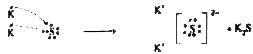
a) Electronic configuration of K and S
`""_(19)K=1s^(2)2s^(2)2p^(6)3s^(2)3p^(6)4s^(1)`
`""_(16)S=1s^(2)2s^(2)2p^(6)3s^(2)3p^(4)`
Lewis symbols for K, S and their ions.

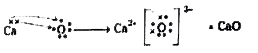
b) Electronic configuration of Ca and O
`""_(20)Ca=1s^(2)2s^(2)2p^(6)3s^(2)3p^(6)4s^(2)`
`""_(8)O=1s^(2)2s^(2)2p^(4)`
Lewis symbols of Ca, O and their ions.

c) Electronic configuration of AI and N
`""_(13)AI=1s^(2)2s^(2)2p^(6)3s^(2)3p^(1)`
`""_(7)N=1s^(2)2s^(2)2p^(3)`
Lewis symbols of AI, N and their ions.
Promotional Banner

Topper's Solved these Questions

  • CHEMICAL BONDING AND MOLECULAR STRUCTURE

    VGS PUBLICATION-BRILLIANT|Exercise LONG ANSWER QUESTIONS|9 Videos
  • CHEMICAL BONDING AND MOLECULAR STRUCTURE

    VGS PUBLICATION-BRILLIANT|Exercise LONG ANSWER QUESTIONS|9 Videos
  • ATOMIC STRUCTURE

    VGS PUBLICATION-BRILLIANT|Exercise ADDITIONAL QUESTIONS & ANSWERS|22 Videos
  • CHEMICAL EQUILIBRIUM AND ACIDS-BASES

    VGS PUBLICATION-BRILLIANT|Exercise ADDITIONAL QUESTIONS & ANSWERS|8 Videos

Similar Questions

Explore conceptually related problems

Arrange the order of increasing atomic volumes in : (a) Li, Na and K, (b) C, N and O , (c) Ca, Sr and Ba.

Which of the following species does have electrons equal to 18 ? (a) K^+ (b) Cl^- (c) Ca^+2 (d) K

Considering X-axis as the internuclear axis, which out of the following atomic orbitals will form a sigma bond ? a) 1S and IS b) 1S and 2 P_x c)2 P_y and 2P_y d) IS and 2S

Which element of the following pairs have smaller ionization enthalpy? (a) Ca or Be , (b) Ca or K , (c) Cl or I. Justify your answer.

Using the standard electron potentials given in the Table 8.1, predict if the reaction between the following is feasible : (a) Fe^(3+) (aq) and I^(-) (aq) (b) Ag^(+)(aq) and Cu(s) (c) Fe^(3+) (aq) and Cu (s) (d) Ag(s) and Fe^(3+)(aq) (e) Br_(2) (aq) and Fe^(2+) (aq)

Which of the following pairs of elements would have higher electron gain enthalpy? (a) N or O , (b) F or Cl . Explain.

Consider the sets φ, A = { 1, 3 }, B = {1, 5, 9}, C = {1, 3, 5, 7, 9} . Insert the symbol ⊂ or ⊄ between each of the following pair of sets: (i) φ . . . B (ii) A . . . B (iii) A . . . C (iv) B . . . C

Considerting x-axis as the internuclear axis, which out of the following atomic orbitals will form a sigma bond? a. 1s and 1s b. 1s and 2p_(x) c. 2p_(3) and 2p_(y) d. 1s and 2s

How many electrons in an atom may have the following quantum numbers ? (a) n = 3, m_(s) = -1//2 (b) n = 4, l = 0

Write the electronic configuration of the following ions. A) Na^+ b) O^2- c) Cl^- d) S^-2 e) Al^3+

VGS PUBLICATION-BRILLIANT-CHEMICAL BONDING AND MOLECULAR STRUCTURE-SHORT ANSWER QUESTIONS
  1. What is Octet rule ? Briefly explain its significance and limitations.

    Text Solution

    |

  2. Wite the resonance strutures for NO(2) and NO(3)^(-).

    Text Solution

    |

  3. Use Lewis symbols to show electron transfer between the following pair...

    Text Solution

    |

  4. Explain why H(2)O has dipolemoment while CO(2) does not have.

    Text Solution

    |

  5. Define Dipolemoment. Write its applications.

    Text Solution

    |

  6. Explain why BeF(2), molecule has zero dipolemoment although the Be-F b...

    Text Solution

    |

  7. Explain the structure of CH(4) molecule.

    Text Solution

    |

  8. Explain Polar Covalent bond with a suitable example.

    Text Solution

    |

  9. Explain the shape and bond angle in BCl(3) molecule in terms of Valenc...

    Text Solution

    |

  10. What are sigma " and " pi bonds ? Specify the differences betweeen the...

    Text Solution

    |

  11. Even though nitrogen in ammonia is in sp^(3) hybridization, the bond a...

    Text Solution

    |

  12. Show how a double and triple bond are formed between carbon atoms in ...

    Text Solution

    |

  13. Show how a double and triple bond are formed between carbon atoms in ...

    Text Solution

    |

  14. Explain hybridisation of phosphorous in the formation of PCl(5)

    Text Solution

    |

  15. Explain the hybridisation involved is SF(6).

    Text Solution

    |

  16. Explain the formation of Coordinate Covalent bond with one example.

    Text Solution

    |

  17. Which hybrid orbitals are used by Carbon atoms in the following molecu...

    Text Solution

    |

  18. Which hybrid orbitals are used by Carbon atoms in the following molecu...

    Text Solution

    |

  19. Which hybrid orbitals are used by Carbon atoms in the following molecu...

    Text Solution

    |

  20. Which hybrid orbitals are used by Carbon atoms in the following molecu...

    Text Solution

    |