Home
Class 12
CHEMISTRY
Explain the role of redox reactions in t...

Explain the role of redox reactions in titrimetre processes and galvanic cells.

Text Solution

Verified by Experts
Role of redox reactions in titrimetric quantitative analysis :
Titrimetric analysis involves two substances. They are (1) a solution of known concentration or a standard solution and (2) a solution of unknown concentration. The first solution is also known as Titrant. The second solution is also knwon as Titrand. The process of adding a standard solution to the titrand till the reaction is just complete is called titration. The point at which the titrand just completely reacts with the standard solution is called "equivalence point" or "end point,"
In redox reactions the completion of the titration is detected by a suitable method like (a) observing a physical change.
Ex : The light pink colour of `KMnO_(4)` titrations.
(b) by using a reagent known as indicator which gives a clear visual change in its colour.
Ex(1) In `Cr_(2)O_(7)^(-2)` (dichromate) titrations, diphenyl amine is used as a reagent and at the end point it produces intense blue colour due to its oxidation by `Cr_(2)O_(7)^(-2)`.
Ex (2) In the titration of `Cu^(+2)` with `I^(-)` (Iodometry)
`2Cu_((aq))^(+2)+4I_((aq))^(-)toCu_(2)I_(2(s))+I_(2(aq))`
The `I_(2)` formed in the redox reaction gives a deep blue colour with starch solution, added to the flask.
IN this way redox reaction are taken as the basis for titrimetric analysis with `MnO_(4)^(-),Cr_(2)O_(7)^(-2)` etc. as oxidising agents and `S_(2)O_(3)^(-2)` etc. as reducing agents.
Role of Redox reaction in galvanic cells :
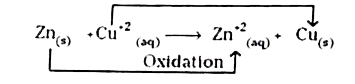
When a zinc rod is kept in copper sulphate solution then the following redox reaction takes place.

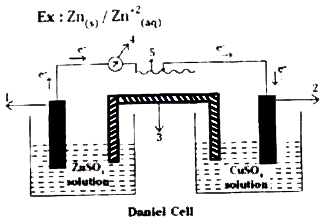
In this redox reaction the transfer of electrons from `Zn_((s))` to `Cu_((aq))^(+2)` takes place directly. The same transfer of clcctrons can also be done indirectly in a galvanic call (Daniel cell).
Cells in which chemical energy is converted into electrical energy are called galvanic cells. Daniel cell is a best example for a galvanic cell. The Daniel cell consists of two beakers containing zinc rod dipped in `ZnSO_(4(aq))` solution in one beaker and a copper rod dipped in `CuSO_(4(aq))` solution in a second beaker. The two beakers are connected by an inverted U-tube, known as salt bridge. The two rods are connected by means of wires to the terminals of an ammeter. Redox reaction takes place contains both oxidised and reduced forms of the respective species. The two types of species present together in each beaker is called a redox couple. Each beaker contains a redox couple. The oxidised and reduced forms are separated by a vertical line or a slash.
Ex : `Zn_((s))//Zn_((aq))^(+2)`

In the above arrangement the two redox couples are represented by `Zn^(+2)//ZnandCu^(+2)//Cu`. As the metal is in two different oxidation states at the interface (say `Zn//Zn^(+2)`), some potential is developed, which is called 'electrode potential'. These electrode potentials are very useful in metallurgy, electro-plating etc.
In this way redox reaction play an important role in galvanic cells.
Promotional Banner

Topper's Solved these Questions

  • STOICHIOMETRY

    VGS PUBLICATION-BRILLIANT|Exercise LONG ANSWER QUESTION|13 Videos
  • STOICHIOMETRY

    VGS PUBLICATION-BRILLIANT|Exercise ADDITIONAL QUESTIONS & ANSWERS|10 Videos
  • STOICHIOMETRY

    VGS PUBLICATION-BRILLIANT|Exercise ADDITIONAL QUESTIONS & ANSWERS|10 Videos
  • STATES OF MATTER : GASES AND LIQUIDS

    VGS PUBLICATION-BRILLIANT|Exercise ADDITIONAL QUESTION & ANSWERS|10 Videos
  • THE P-BLOCK ELEMENTS - GROUP 13

    VGS PUBLICATION-BRILLIANT|Exercise LONG ANSWER QUESTIONS|3 Videos

Similar Questions

Explore conceptually related problems

Explain the different types of redox reactions.

Explain the principle of a redox reaction used in the construction of galvanic cell ?

Explain redox reactions with an experiment.

Explain the role of sucrose in its hydrolysis.

Explain any two types of redox reactions with examples.

Which one is not a redox reaction?

Explain the role of stomata in photosynthesis.

The role of mercury in Castner-Kellner process is

Which of the following is redox reaction

VGS PUBLICATION-BRILLIANT-STOICHIOMETRY-SHORT ANSWER QUESTIONS
  1. Calculate the volume of oxygen gas required at STP conditions for the ...

    Text Solution

    |

  2. Calculate the volume of H(2) liberated at 27^(@)C and 760 mm of Hg pre...

    Text Solution

    |

  3. Explain the role of redox reactions in titrimetre processes and galvan...

    Text Solution

    |

  4. Define and explain molar mass.

    Text Solution

    |

  5. What are disproportionate reactions? Give example.

    Text Solution

    |

  6. What is comproportionation reactions? Give example.

    Text Solution

    |

  7. Determine the empirical formula of an oxide of iron which has 69.9% ir...

    Text Solution

    |

  8. Calculate the mass of sodium acetate (CH(3)COONa) required to make 500...

    Text Solution

    |

  9. What is the concentration of sugar (C(12)H(22)O(11)) in mol L^(-1) if ...

    Text Solution

    |

  10. How many significant figures are present in the following ? i) 0.002...

    Text Solution

    |

  11. Round up the following upto three significant figures : i) 34.216, i...

    Text Solution

    |

  12. Calculate the molarity of a solution of ethanol in water in which the ...

    Text Solution

    |

  13. A welding fuel gas contains carbon and hydrogen only. Burning a small ...

    Text Solution

    |

  14. Calcium Carbonate reacts with aqueous HCl to give CaCl(2)andCO(2) acco...

    Text Solution

    |

  15. Chlorine is prepared in the laboratory by treating manganese dioxide (...

    Text Solution

    |

  16. To 50 ml. of 0.1 N Na(2)CO(3) solution 150 ml. of H(2)O is added. Then...

    Text Solution

    |

  17. Calculate the volume of 0.1 N H(2)SO(4) required to neutralise 200 ml....

    Text Solution

    |

  18. Calculate normality of H(2)SO(4) solutions if 50 ml of it completely n...

    Text Solution

    |

  19. Calculate the volume of 0.1MKMnO(4) required to react with 100 ml. of ...

    Text Solution

    |

  20. Assign oxidation number to the underlined elements in each of the foll...

    Text Solution

    |