Home
Class 12
CHEMISTRY
Consider the reactions a) 6CO(2)(g)+6H...

Consider the reactions
a) `6CO_(2)(g)+6H_(2)O(I)toC_(6)H_(12)O_(6)(aq)+6O_(2)(g)`
b) `O_(3)(g)+H_(2)O_(2)(I)toH_(2)O(I)+2O_(2)(g)`
Why it is more appropriate to write these reaction as
a) `6CO_(2)(g)+12H_(2)O(I)toC_(6)H_(12)O_(6)+6H_(2)O(I)+6O_(2)(g)`
b) `O_(3)(g)+H_(2)O_(2)(I)toH_(2)O(I)+O_(2)(g)+O_(2)(g)`
Also suggest a technique to investigate the path of the above (a) and (b) redox reactions.

Text Solution

Verified by Experts
Plants absorb carbon dioxide from air, water from soil and convert them into carbohydrates in the presence of sunlight and Chlorophyll. This process is known as photosynthesis.
During photosynthesis plants liberate oxygen. The oxygen will be liberated from water but not from carbon dioxide. The following reaction cannot explain the liberation of oxygen from water because in this reaction from `6H_(2)O` molecules only `3O_(2)` can be liberated.
`6CO_(2)(g)+6H_(2)O(l)toC_(6)H_(12)O_(6)(aq)+6O_(2)(g)`
But the following reaction can explain the liberation `6O_(2)` molecules from water.
`6CO_(2)(g)+12H_(2)O(l)toC_(6)H_(12)O_(6)(aq)+6H_(2)O(l)+6CO_(2)(g)`
The path of the reaction can be traced by taking labile `""^(18)O` in `H_(2)O`. The liberated oxygen contain the total labile `""^(18)O` which indicates the oxygen is liberated from water.
`6CO_(2)(g)+12H_(2)""^(18)O(l)toC_(6)H_(12)O_(6)(aq)+6H_(2)O(l)+6""^(18)O_(2)(g)`
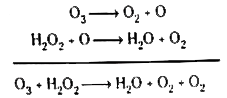
b) The reaction between `O_(3)andH_(2)O_(2)` can be written as follows :

So it is appropriate to the equation as above instead of
`O_(3)+H_(2)O_(2)toH_(2)O+2O_(2)`
In the reaction `O_(3)+H_(2)O_(2)toH_(2)O+O_(2)+O_(2)`
One of the `O_(2)` liberated from `O_(3)` and the another from `H_(2)O_(2)`. This can be traced by using `""^(18)O` isotope in `H_(2)O_(2)`.
Promotional Banner

Topper's Solved these Questions

  • STOICHIOMETRY

    VGS PUBLICATION-BRILLIANT|Exercise LONG ANSWER QUESTION|13 Videos
  • STOICHIOMETRY

    VGS PUBLICATION-BRILLIANT|Exercise ADDITIONAL QUESTIONS & ANSWERS|10 Videos
  • STOICHIOMETRY

    VGS PUBLICATION-BRILLIANT|Exercise ADDITIONAL QUESTIONS & ANSWERS|10 Videos
  • STATES OF MATTER : GASES AND LIQUIDS

    VGS PUBLICATION-BRILLIANT|Exercise ADDITIONAL QUESTION & ANSWERS|10 Videos
  • THE P-BLOCK ELEMENTS - GROUP 13

    VGS PUBLICATION-BRILLIANT|Exercise LONG ANSWER QUESTIONS|3 Videos

Similar Questions

Explore conceptually related problems

For the rate of the reaction 2H_(2)O_(2)to2H_(2)O+O_(2),r=K[H_(2)O_(2)] it is

(i) H_(2)O_(2)+O_(3)toH_(2)O+2O_(2) (ii) H_(2)O_(2)+Ag_(2)O to 2Ag+H_(2)O+O_(2) Role of hydrogen peroxide in the above reaction is respectively

In the redox reaction 2S_(2)O_(3)^(2-)+I_(2) rarrS_(4)O_(6)^(2-)+2I^(-)

In the following two reactions, (i) 2H_(2)O_(2) rarr 2H_(2)O + O_(2) (ii) H_(2)0_(2) + 2I^(-) + 2H^(+) rarr I_(2) + 2H_(2)O H_(2)O_(2) acts as

Which is a mutual reduction reaction ? A) KMnO_(4)+O_(3) B) H_(2)O_(2)+O_(3) 3) Ag_(2)O+O_(3) D) KI+H_(2)O+O_(3)

Write reaction equotient, Q, for each of the following reactions. a. 3O_(2)(g)hArr2O_(3)(g) b. 4NH_(3)(g)+7O_(2)(g)hArr 4NO_(2)(g)+6H_(2)O(g)

6CO_(2)+6H_(2)Orarr C_(6)H_(12)O_(6)+6O_(2) . The reaction is appreciable, because it gives us

Balance the following chemical equation. C_(2)H_(6)+O_(2)rarr CO_(2)+H_(2)O

Which is a mutual reduction reaction A) KMnO_(4) +O_(3)" "B) H_(2)O_(2)+O_(3) " "C) Ag_(2)O+O_(3)" "D) KI+H_(2)O+O_(3)

VGS PUBLICATION-BRILLIANT-STOICHIOMETRY-SHORT ANSWER QUESTIONS
  1. Suggest a list of the substances where carbon exhibit oxidation states...

    Text Solution

    |

  2. While sulphue dioxide and hydrogen peroxide and act as oxidising as we...

    Text Solution

    |

  3. Consider the reactions a) 6CO(2)(g)+6H(2)O(I)toC(6)H(12)O(6)(aq)+6O(...

    Text Solution

    |

  4. The compound AgF(2) is unstable compound. However, if formed, the comp...

    Text Solution

    |

  5. Whenever a reaction between an oxidising agent and a reducing agent is...

    Text Solution

    |

  6. How do you count the following observations? a) Though alkaline pota...

    Text Solution

    |

  7. Identify the substance oxidised, reduced, oxidising agent and reducing...

    Text Solution

    |

  8. Consider the reactions 2S(2)O(3)^(2-)(aq)+I(2)(s)toS(4)O(6)^(2-)(aq)...

    Text Solution

    |

  9. Justify giving reactions that among halogens, fluorine is the best oxi...

    Text Solution

    |

  10. Why does the following reaction occur ? XeO(6)^(4-)(aq)+2F^(-)(aq)+6...

    Text Solution

    |

  11. Consider the reactions : a) H(3)PO(2)(aq)+4AgNO(3)(aq)+2H(2)O(l)toH(...

    Text Solution

    |

  12. Balance the following redox reaction in basic medium by ion-electron m...

    Text Solution

    |

  13. Balance the following equations in basic medium by ion-electron method...

    Text Solution

    |

  14. What sorts of information can you draw from the following reaction ? ...

    Text Solution

    |

  15. The Mn^(3+) ion is unstable solution and undergoes disproportionation ...

    Text Solution

    |

  16. Consider the elements Cs, Ne, I and F. a) Identify the element that ...

    Text Solution

    |

  17. Chlorine is used to purify drinking water. Excess of Chlorine is harmf...

    Text Solution

    |

  18. Refer to the periodic table given in your book and now answer the foll...

    Text Solution

    |

  19. In Ostwal's process for the manufacture of nitric acid the first step ...

    Text Solution

    |

  20. i) Arrange the following metals in the order in which they displace ea...

    Text Solution

    |

