Home
Class 12
CHEMISTRY
Balance the following equations in basic...

Balance the following equations in basic medium by ion-electron method and oxidation number methods and identify the oxidising agent and the reducing agent.
(a) `P_(4)(s) + OH^(-) (aq) rarr PH_(3) (g) + HPO_(2)^(-) (aq)`
(b) `N_(2)H_(4)(I) + ClO_(3)^(-) (aq) rarr NO(g) + Cl^(-) (g)`
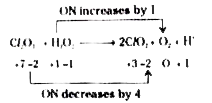
(c) `Cl_(2)O_(7) (g) + H_(2)O_(2) (aq) rarr ClO_(2)^(-) (aq) + O_(2)(g) + H^(+)`

Text Solution

Verified by Experts
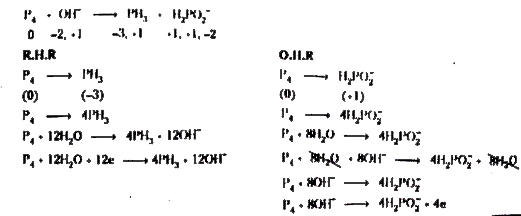
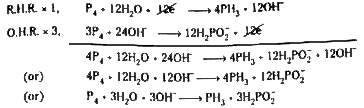
a) `P_(4)(s)+OH^(-)(aq)toPH_(3)(g)+H_(2)PO_(2)^(-)(aq)`
Ion electron method : `underset(0)(P_(4))+underset(-2,+1)(OH^(-))tounderset(-3, +1)(PH_(3))+underset(+1, +1, -2)(H_(2)PO_(2)^(-))`


Note : Here `P_(4)` acts both as oxidant and reductant.
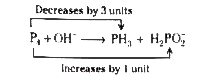
Oxidation number method :
`underset((0))(P_(4)(s))+OH^(-)(aq)tounderset((-3))(PH_(3)(g))+underset((+1))(H_(2)PO_(2)^(-)(aq))`

In order to balance the change in oxidation number `H_(2)PO_(2)^(-)` is to be multiplied by 3
`P_(4)+OH^(-)toPH^(3)+3H_(2)PO_(2)^(-)`
Since the reaction is taking place in basic medium, `H_(2)O` is to be added on the side which has ledder H atom and `OH^(-)` are to be added on the side which has lesser O atoms.
`P_(4)+3H_(2)O+3OH^(-)toPH_(3)+3H_(2)PO_(2)^(-)`
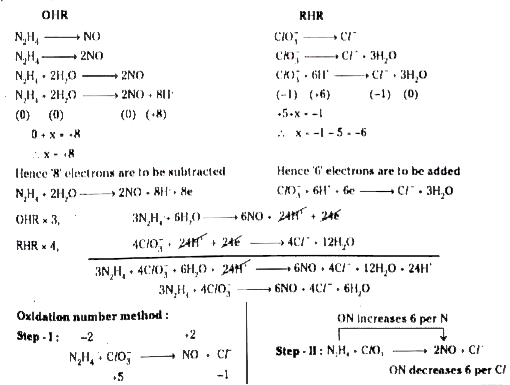
b) `N_(2)H_(4)(l)+ClO_(3)^(-)(aq)toNO(g)+Cl^(-)(g)`

Step - III : Equalise the increase and decrease in ON by multiplying `N_(2)O_(4)` with 3 and `ClO_(3)^(-)` with 4.
`3N_(2)O_(4)+4ClO_(3)^(-)to6NO+4Cl^(-)`
Step - IV : Balance the atoms except H and O. Here they are balanced.
Step - V : Balance O atoms by adding `OH^(-)` ions and H atoms by adding `H_(2)O` on the sides deficient of O and H atoms respectively
`3N_(2)O_(4)+4ClO_(3)^(-)to6NO+4Cl^(-)+12OH^(-)`
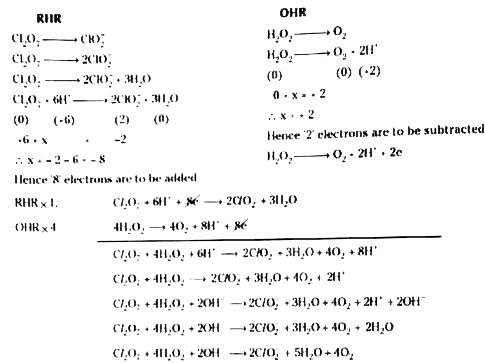
c) `Cl_(2)O_(7)(g)+H_(2)O_(2)(aq)toClO_(2)^(-)(aq)+O_(2)(g)+H^(+)`
Ion electron method :

Oxidation number method :
Step - I : Skeleton equation is
Step - II : Equalise the increases/decrease in ON by multipling `H_(2)O_(2)` with 4 since in each chlorine of `Cl_(2)O_(7)` decrease in ON is 4. For 2 Cl atoms it is 8. In `H_(2)O_(2)` increase in ON for each 0 is 1 and for two 0 atoms it is 2.
`Cl_(2)O_(7)+4H_(2)O_(2)to2ClO_(2)^(-)+4H_(2)O+2O_(2)`
Step - III : Balance the O atoms by adding `OH^(-)` and H atoms by adding `H_(2)O` to the sides deficient of O and H atoms respectively.
`Cl_(2)O_(7)+4H_(2)O_(2)+2OH^(-)to2ClO_(2)^(-)+4H_(2)O+2O_(2)`
Promotional Banner

Topper's Solved these Questions

  • STOICHIOMETRY

    VGS PUBLICATION-BRILLIANT|Exercise LONG ANSWER QUESTION|13 Videos
  • STOICHIOMETRY

    VGS PUBLICATION-BRILLIANT|Exercise ADDITIONAL QUESTIONS & ANSWERS|10 Videos
  • STOICHIOMETRY

    VGS PUBLICATION-BRILLIANT|Exercise ADDITIONAL QUESTIONS & ANSWERS|10 Videos
  • STATES OF MATTER : GASES AND LIQUIDS

    VGS PUBLICATION-BRILLIANT|Exercise ADDITIONAL QUESTION & ANSWERS|10 Videos
  • THE P-BLOCK ELEMENTS - GROUP 13

    VGS PUBLICATION-BRILLIANT|Exercise LONG ANSWER QUESTIONS|3 Videos

Similar Questions

Explore conceptually related problems

The coefficient of PH, in the following balanced equation will be: P_(4(s)) +OH^(-) rarr PH_(3_((g))) + HPO_(2(aq))^(-)

Balance the following redox reaction in basic medium by ion-electron method : MnO_(4(aq))^(-)+1_((aq))^(-) rarr MnO_(2(s))+1_(2(s))

Suggest a scheme of classification of the following redox reactions (a) N_(2) (g) + O_(2) (g) rarr 2 NO (g) (b) 2 Pb (NO_(3))_(2) (s) rarr 2 PbO (s) + 4 NO_(2) (g) + O_(2) (g) (c) NaH(s) + H_(2) O (l) rarr NaOH (aq) + H_(2) (g) (d) 2NO_(2) (g) + 2OH^(-) (aq) rarr NO_(2)^(-) (aq) + NO_(3)^(-) (aq) + H_(2) O (l)

Balance the following equation by oxidation number method. NaOH + Cl_(2) rarr NaCl + NaClO_(3) + H_(2)O

Balance the following equation by electron transfer method. NH_(3)(g) + O_(2)(g) rarr NO (g) + H_(2)O(l)

In the reactions given below, identify the species undergoing oxidation and reduction : (i) H_(2)S (g) + Cl_(2) (g) rarr HCl (g) + S (s) (ii) 3Fe_(3)O_(4) (s) + 8 Al (s) rarr 9 Fe(s) + 4Al_(2)O_(3) (s) (iii) 2Na (s) + H_(2) (g) rarr 2 NaH (s)

Balance the following equation in acid medium by Ion-electron method : Fe_("(aq)")^(+2) + Cr_(2) O_(7 "(aq)")^(2-) to Fe_("(aq") ^(3+)j + Cr_("(aq))^(+3)

Balance the following redox reactions by ion-electron method : H_(2)O_(2)(aq)+Fe^(2+)(aq)to Fe^(3+)(aq)+H_(2)O(I) (in acidic solution )

VGS PUBLICATION-BRILLIANT-STOICHIOMETRY-SHORT ANSWER QUESTIONS
  1. Suggest a list of the substances where carbon exhibit oxidation states...

    Text Solution

    |

  2. While sulphue dioxide and hydrogen peroxide and act as oxidising as we...

    Text Solution

    |

  3. Consider the reactions a) 6CO(2)(g)+6H(2)O(I)toC(6)H(12)O(6)(aq)+6O(...

    Text Solution

    |

  4. The compound AgF(2) is unstable compound. However, if formed, the comp...

    Text Solution

    |

  5. Whenever a reaction between an oxidising agent and a reducing agent is...

    Text Solution

    |

  6. How do you count the following observations? a) Though alkaline pota...

    Text Solution

    |

  7. Identify the substance oxidised, reduced, oxidising agent and reducing...

    Text Solution

    |

  8. Consider the reactions 2S(2)O(3)^(2-)(aq)+I(2)(s)toS(4)O(6)^(2-)(aq)...

    Text Solution

    |

  9. Justify giving reactions that among halogens, fluorine is the best oxi...

    Text Solution

    |

  10. Why does the following reaction occur ? XeO(6)^(4-)(aq)+2F^(-)(aq)+6...

    Text Solution

    |

  11. Consider the reactions : a) H(3)PO(2)(aq)+4AgNO(3)(aq)+2H(2)O(l)toH(...

    Text Solution

    |

  12. Balance the following redox reaction in basic medium by ion-electron m...

    Text Solution

    |

  13. Balance the following equations in basic medium by ion-electron method...

    Text Solution

    |

  14. What sorts of information can you draw from the following reaction ? ...

    Text Solution

    |

  15. The Mn^(3+) ion is unstable solution and undergoes disproportionation ...

    Text Solution

    |

  16. Consider the elements Cs, Ne, I and F. a) Identify the element that ...

    Text Solution

    |

  17. Chlorine is used to purify drinking water. Excess of Chlorine is harmf...

    Text Solution

    |

  18. Refer to the periodic table given in your book and now answer the foll...

    Text Solution

    |

  19. In Ostwal's process for the manufacture of nitric acid the first step ...

    Text Solution

    |

  20. i) Arrange the following metals in the order in which they displace ea...

    Text Solution

    |