

Home
Class 11
PHYSICS
Three metal rods made of copper, alumini...

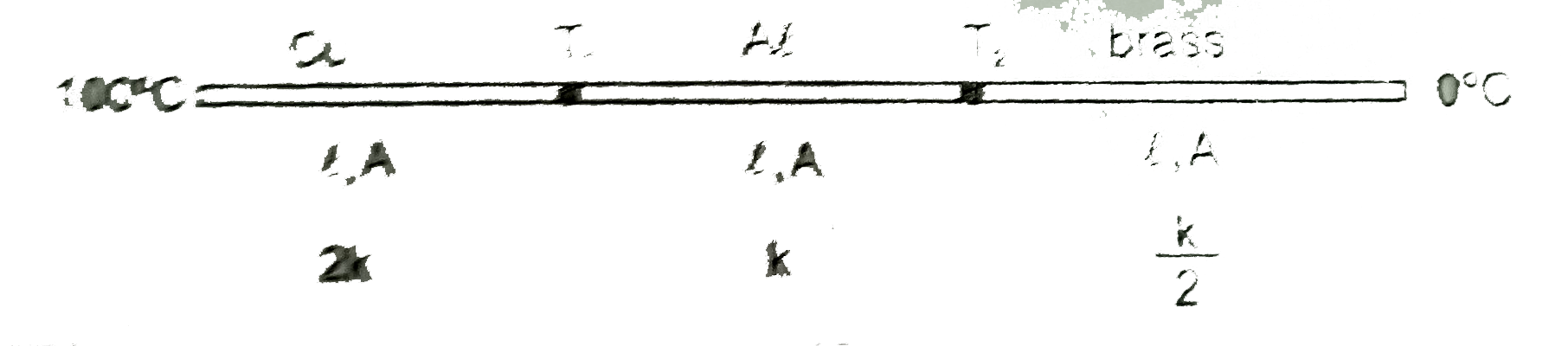
Three metal rods made of copper, aluminium and brass, each `20 cm` long `4cm` in diameter, are placed end to end with aluminium between the other two. The free ends of copper and brass are maintained at `100` and `0^(@)C` respectively. Assume that the thermal conductivity of copper is twice that of aluminium and four times that of brass. The approximately equilibrium temperatures of the copper-aluminiu and aluminium-brass junctions are respectively.

Promotional Banner

Similar Questions

Explore conceptually related problems

Assume that the thermal conductivity of copper is twice that of aluminium and four times that of brass. Three metal rods made of copper, aluminium and brass are each 15 cm long and 2 cm in diameter. These rods are placed end to end, with aluminium between the other two. The free ends of the copper and brass rods are maintained at 100^@C and 0^@C respectively. The system is allowed to reach the steady state condition. Assume there is no loss of heat anywhere. Under steady state condition the equilibrium temperature of the copper aluminium junction will be

Why are utensils made up of aluminium and brass?

Assume that the thermal conductivity of copper is twice that of aluminium and four times that of brass. Three metal rods made of copper, aluminium and brass are each 15 cm long and 2 cm in diameter. These rods are placed end to end, with aluminium between the other two. The free ends of the copper and brass rods are maintained at 100^@C and 0^@C respectively. The system is allowed to reach the steady state condition. Assume there is no loss of heat anywhere. When steady state condition is reached everywhere, which of the following statement is true?

Assume that the thermal conductivity of copper is twice that of aluminium and four times that of brass. Three metal rods made of copper, aluminium and brass are each 15 cm long and 2 cm in diameter. These rods are placed end to end, with aluminium between the other two. The free ends of the copper and brass rods are maintained at 100^@C and 0^@C respectively. The system is allowed to reach the steady state condition. Assume there is no loss of heat anywhere. When steady state condition is reached everywhere, which of the following statement is true?

Assume that the thermal conductivity of copper is twice that of aluminium and four times that of brass. Three metal rods made of copper, aluminium and brass are each 15 cm long and 2 cm in diameter. These rods are placed end to end, with aluminium between the other two. The free ends of the copper and brass rods are maintained at 100^@C and 0^@C respectively. The system is allowed to reach the steady state condition. Assume there is no loss of heat anywhere. When steady state condition is reached everywhere, which of the following statement is true?

The electrical conductivity of aluminium is twice that of copper on the basis of

Percentages of copper and zinc present in a alloy brass, are respectively

The outer faces of a rectangular slab made of equal thickness of iron and brass are maintained at 100^(@)C and 0^(@)C respectively. The temperature at the interface is (Thermal conductivity of iron and brass are 0.2 and 0.3 respectively)

The outer faces of a rectangular slab made of equal thickness of iron and brass are maintained at 100^(@)C and 0^(@)C respectively. The temperature at the interface is (Thermal conductivity of iron and brass are 0.2 and 0.3 respectively)