

Home
Class 12
BIOLOGY
Illustrate the design of a bioreactor. H...

Illustrate the design of a bioreactor. Highlight the difference between a flask in your laboratory and a bioreactor which allows cells to grow in a continous culture system.

Text Solution

Verified by Experts

Bioreactors are vessels of large volumes (100-1000L) in which raw materials are biological converted into specific products.
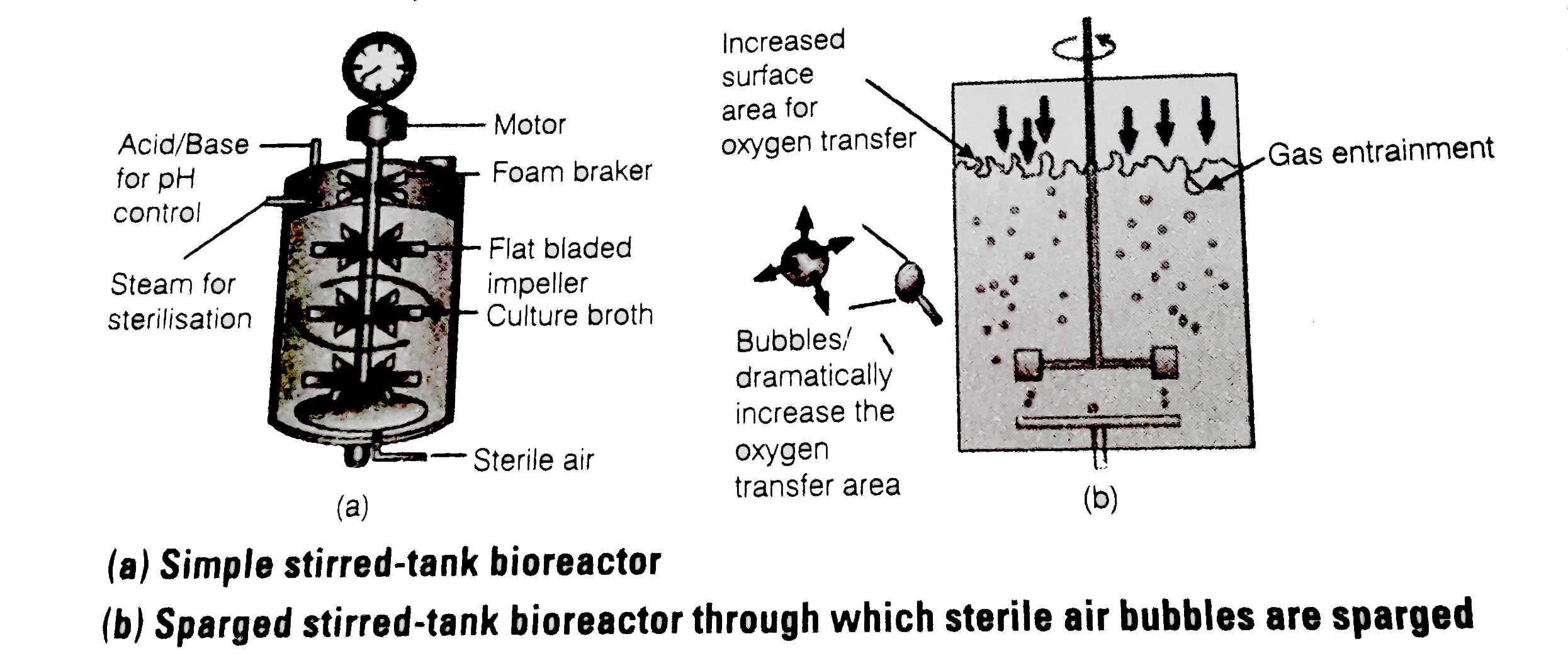
The most commonly used bioreactors are of stirring type, which are shown in figure.

A stirred tank reactor is usually cylindrical of with a curved base to facilate the mixing of the reactor contents. the stirrer facilitates even mixing an d ox ygen availability throughout the bioreactor. Alternatively air can be bubbled through the reactor.
If you look at the figure closely you will see that the bioreactor has an agitator system, an oxygen delivery system and a control systema temperature control system. pH control system and sampling ports so, that small volumes of the culture can be withdrawn periodically.
Small volume culutures are usually employed in laboratories in a flask for research and production of less quantities of produc ts? However, large scale production of the products is ca rried out in bioreactors.
Promotional Banner

Topper's Solved these Questions

  • BIOTECHNOLOGY AND ITS APPLICATIONS

    NCERT EXEMPLAR|Exercise Biotechnology And Its Applications|57 Videos
  • ECOSYSTEM

    NCERT EXEMPLAR|Exercise Ecosystem|67 Videos

Similar Questions

Explore conceptually related problems

Which of the following represents an advantage of growing cells in continuous culture as compared to a shake flask ?

NCERT EXEMPLAR-BIOTECHNOLOGY PRINCIPLES AND PROCESS-Biotechnology Principles And Process
  1. What is the significance of adding proteases at the time of isolation ...

    Text Solution

    |

  2. While doing a PCR, denaturation step is missed. What will be its effec...

    Text Solution

    |

  3. Name a recomblnant vaccine that is currently being used in vaccination...

    Text Solution

    |

  4. Do biomolecules (DNA and protein) exhibit biological activity in anhyd...

    Text Solution

    |

  5. What modification is done on the Ti-plasmid of Agrobacterium tumefacie...

    Text Solution

    |

  6. What is meant by gene cloning?

    Text Solution

    |

  7. Both a wire maker and a molecular biologist who had developed a recomb...

    Text Solution

    |

  8. A recombinant DNA molecule was created by ligating a gene to a plasmid...

    Text Solution

    |

  9. Restriction enzymes that are used in the construction of recombinant D...

    Text Solution

    |

  10. A plasmid DNA and linear DNA (both are of the same size) have one site...

    Text Solution

    |

  11. How does one visulaise DNA on an agarose gel?

    Text Solution

    |

  12. A plasmid without a selectable marker was choosen as vector for clonin...

    Text Solution

    |

  13. A mixture of fragmented DNA was electrophoresed in an agarose gel. Af...

    Text Solution

    |

  14. Describe the role of CaCl(2) in the preparation of competent cells?

    Text Solution

    |

  15. What would happen when one grows a recombinant bacterium in the biorea...

    Text Solution

    |

  16. Identify and explain A,B and C in the PCR diagram given below.

    Text Solution

    |

  17. Name the regions marked A,B and C

    Text Solution

    |

  18. For selection of recombinants, insertional inactivation of antibiotic ...

    Text Solution

    |

  19. Describe the role of agrobacterium in transforming a plant cell.

    Text Solution

    |

  20. Illustrate the design of a bioreactor. Highlight the difference betwee...

    Text Solution

    |