Home
Class 12
PHYSICS
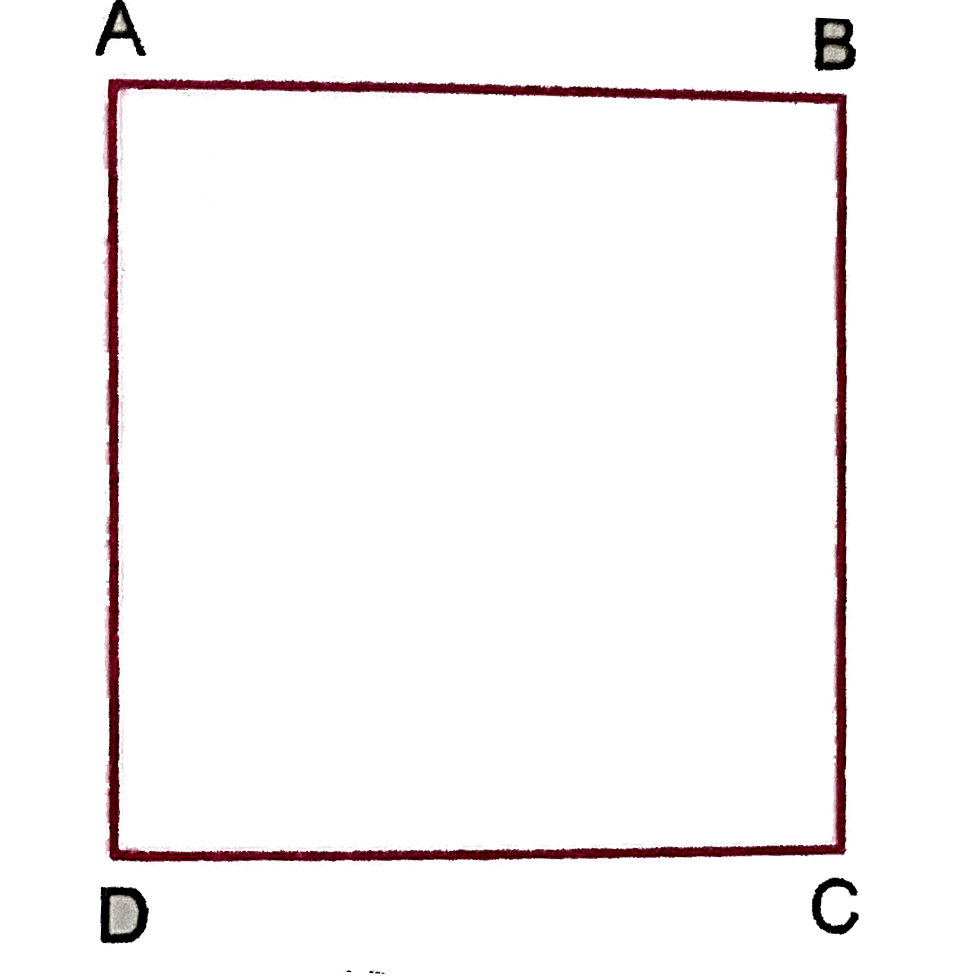
A rectangular block of glass ABCD has a ...

A rectangular block of glass `ABCD` has a refractive index `1.6`. A pin is placed midway on the face `AB`, Fig. When observed from the face `AD`, the pin shall.
.

A

appear to be near A

B

appear to be near D

C

appear to be near at the centre of AD

D

not be seen at all

Text Solution

Verified by Experts

The correct Answer is:

D

For `mu=1.6` the critical angle `mu=1//sin C,` we have C= `38.7^(@)` , when from AD, as long as angle of inidence on AD of the ray emanating from pin is greater than the critical angle, the light suffers from total internal reflection and cannot be seen through AD.
Promotional Banner

Topper's Solved these Questions

  • NUCLEI

    NCERT EXEMPLAR|Exercise Nuclei|40 Videos
  • SEMICONDUCTOR ELECTRONICS: MATERIAL,DEVICES AND SIMPLE CIRCUIT

    NCERT EXEMPLAR|Exercise Semiconductor Electronics: Material,Devices And Simple Circuit|26 Videos

Similar Questions

Explore conceptually related problems

A postal stamp is placed on a surface and a glass cube of refractive index 3/2 is placed over it. When observed through the glass slab, the stamp appears at a height of 1 .5 cm from the bottom. Another glass cube made of different material nad having the same thickness is placed over the first glass cube. When observed from the top, the stamp now appears to be at a height of 4 cm from the bottom. Determine the refractive index of the second galss cube.

A rectangular glass block of thickness 10 cm and refractive index 1.5 placed over a small coin. A beaker is filled with water of refractive index 4//3 to a height of 10 cm and is placed over the glass block. (a) Find the apparent position of the object when it is viewed at near normal incidence. (b) if the eye is slowly moves away from the normal at a certain position, the object is found to disappear, due to total internal reflection. At what surface does this happen and why ?

A ray of light the face AB of a glass prism of refractive index mu at an angle of incidence i . Find the value of i such that no ray emerges from the face AC of the prism. Given angle of prism is A .

A ray of light enters the face AB of a glass prism of refractive index mu at an angle of incidence i . Find the value of i such that no ray emerges from the face AC of the prism, given angle of prism is A .

A glass prism has a refractive angle of 90^(@) and a refractive index of 1.5. A ray is incident at an angle of 30^(@) . The ray emerges from an adjacent face at an angle of

A rectangular block of glass is placed on a mark made on the surface of the table and it is viewed from the vertical position of eye. If refractive index of glass be mu and its thickness d, then the mark will appear to be raised up by

A large rectangular glass block of refractive index mu is lying on a horizontal surface as shown in Figure. Find the minimum value of mu so that the spot S on the surface cannot be seen through top plane ‘ABCD’ of the block.

A cubical block of glass of refractive index n_1 is in contact with the surface of water of refractive index n_2. A beam of light is incident on vertical face of the block. After refraction a total internal reflection at the base and refraction at the opposite face take place. The ray emerges at angle theta as shown. The value of theta is given by

NCERT EXEMPLAR-RAY OPTICS AND OPTICAL INSTRUMENTS -Ray Optics And Optical Instruments
  1. There are certain materials developed in laboratories which have a neg...

    Text Solution

    |

  2. Consider an extended object immersed in water contained in a plane thr...

    Text Solution

    |

  3. A rectangular block of glass ABCD has a refractive index 1.6. A pin is...

    Text Solution

    |

  4. Between the primary and secondary rainbows, there is a dark band known...

    Text Solution

    |

  5. A magnifying glass is used, as the object to be viewed can be brought ...

    Text Solution

    |

  6. An astronomical refractive telescope has an objective of focal length ...

    Text Solution

    |

  7. Will the focal length of a lens for red light be more, same or less th...

    Text Solution

    |

  8. The near vision of an average person is 25 cm. To view an object with ...

    Text Solution

    |

  9. An unsymmeterical double convex thin lens forms the image of a point o...

    Text Solution

    |

  10. Three immiscible liquids of densities d1 gt d2 gt d3 and refractive in...

    Text Solution

    |

  11. The angle of minimum deviation for a glass prism with mu=sqrt3 equals ...

    Text Solution

    |

  12. A short object of length L is placed along the principal axis of a con...

    Text Solution

    |

  13. A circular disc of radius 'R' is placed co-axially and horizontally in...

    Text Solution

    |

  14. A thin convex lens of focal length 25 cm is cut into two pieces 0.5 cm...

    Text Solution

    |

  15. In many experimental set-ups the source and screen are fixed at a dist...

    Text Solution

    |

  16. A jar of height h is filled wih a transparent liquid of refractive ind...

    Text Solution

    |

  17. A myopic adult has a far point at 0.1 m. His power of accomodation is ...

    Text Solution

    |

  18. Show that for a material with refractive index mu ge sqrt(2), light in...

    Text Solution

    |

  19. The mixture of a pure liquid and a solution in a along vertical column...

    Text Solution

    |

  20. If light passes near a massive object, the gravitational interaction c...

    Text Solution

    |
