Home
Class 12
PHYSICS
If light passes near a massive object, t...

If light passes near a massive object, the gravitational interaction causes a bending of the ray. This can be thought of as happening due to a change in the effective refractive index of the medium given by `n( r) = 1+ 2 GM//rc^2`
where `r` is the distance of the point consideration from the centre of the mass of the massive body, `G` is the universal gravitational constant, `M` the mass of the body and `c` the speed of light in vacuum. Considering a spherical object, find the deviation of the ray from the original path as it grazes the object.

Text Solution

Verified by Experts
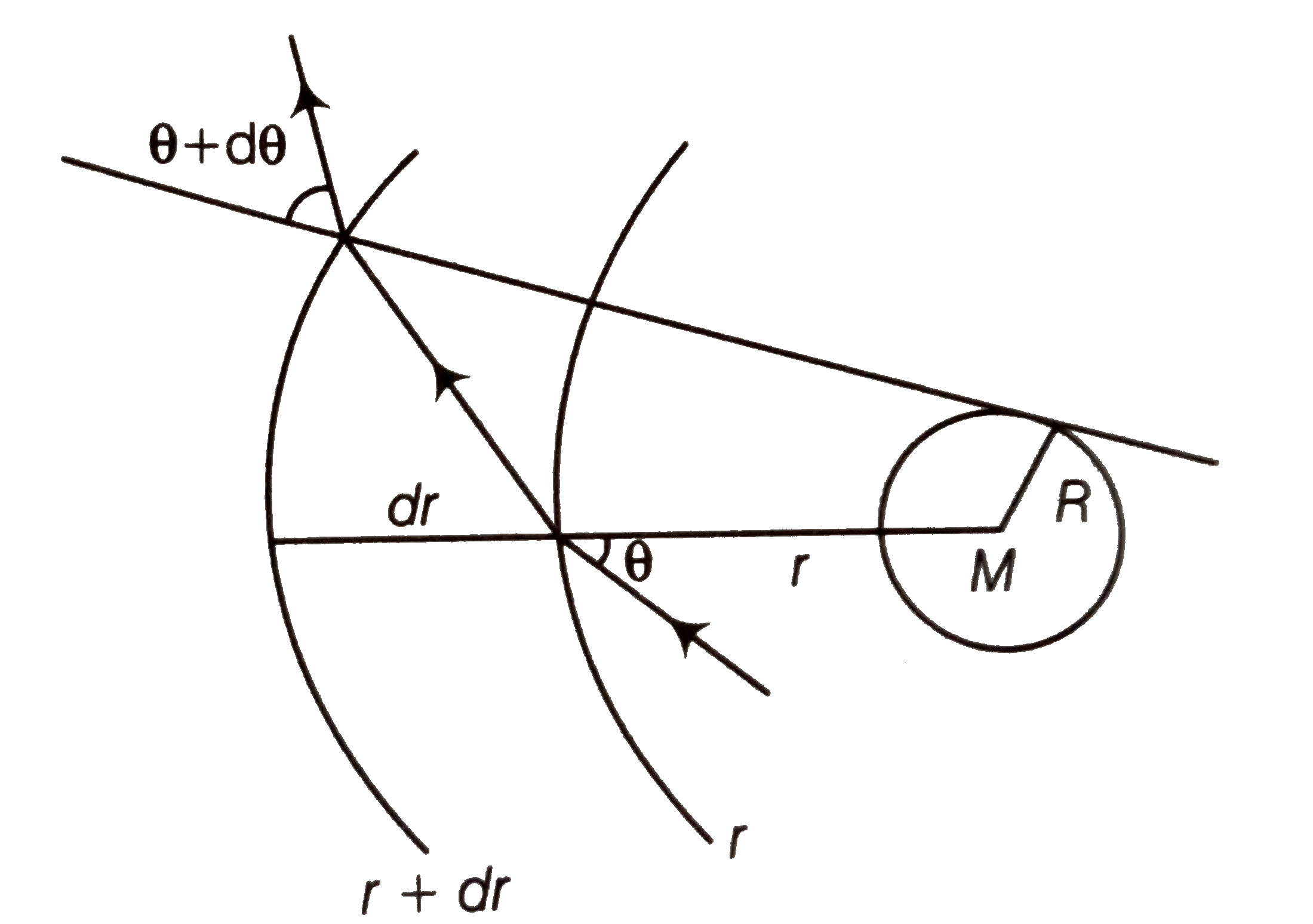
Let us consider two planes at r and r+dr . Let the light be incident at an angle `theta` at the plane at r and leave r +dr at an angle `theta +d theta`. Then from Snell's law

`" " n(r)sin theta =n (r+dr) sin (theta+d theta)`
`rArr" "n(r)sin theta,(n(r)+(dn)/(dr)dr)(sin theta cos d theta +cos theta sin d theta )(n(r)+(dn)/(dr)dr) (n(r)+(dn)/(dr)dr)(sin theta + cos theta d theta )`
Ignoring the product of differntials
`" "n(r) sin theta, n(r) sin theta +(dn)/(dr)dr sin theta+n(r) cos theta d theta `
or we have, `" "-(dn)/(dr)tan theta =n(r) (d theta)/(dr)`
`" " (2GM)/(r^(2)c^(2))tan theta=(1+(2GM)/(rc^(2)))(d theta)/(dr)~~(d theta)/(dr)`
`" " int_(0)^(theta_(0))d theta =(2GM)/(c^(2))int_(-oo)^ (oo)(tan thetadr)/(r^(2))`
Now substitution for integrals, we have
Now, `" " r^(2)=x^(2)+R^(2)and than theta =(R)/(x)`
`" " 2dr=2xdx`
`" " int_(-0)^(theta_(0))d theta=(2GM)/(c^(2))int_(-oo)^(oo)(R)/(x)(xdx)/((x^(2)+R^(2))^((3)/(2)))`
Put `" " x=R tanphi`
`" " dx=R sec^(2)phidphi`
`:. " " theta_(0)=(2GMR)/(c^(2))int_(-pi//2)^(pi//2)(Rsec^(2)phid phi)/(R^(3)sec^(3)phi)`
`" " =(2GM)/(Rc^(2))int_(-pi//2)^(pi//2)cosphid phi=(4GM)/(Rc^(2))`
Promotional Banner

Topper's Solved these Questions

  • NUCLEI

    NCERT EXEMPLAR|Exercise Nuclei|40 Videos
  • SEMICONDUCTOR ELECTRONICS: MATERIAL,DEVICES AND SIMPLE CIRCUIT

    NCERT EXEMPLAR|Exercise Semiconductor Electronics: Material,Devices And Simple Circuit|26 Videos

Similar Questions

Explore conceptually related problems

Define G (universal gravitational constant).

The acceleration due to gravity'g' for objects on or near the surface of earth is related to the universal gravitational constant 'G' as ('M' is the mass of the earth and 'R' is its radius):

When a ray of light passes from air medium to denser medium then the refractive index is

If E is energy M is mass, J is angular momentum and G is universal gravitational constant ,then dimensions of x=EJ^2/G^2M^5 can be that of

P is a point at a distance r from the centre of a spherical shell of mass M and radius a, where r lt a . The gravitational potential at P is

If the energy, E = G^p h^q c^r, where G is the universal gravitational constant, h is the Planck's constant and c is the velocity of light, then the values of p are q and r are, respectively

NCERT EXEMPLAR-RAY OPTICS AND OPTICAL INSTRUMENTS -Ray Optics And Optical Instruments
  1. A rectangular block of glass ABCD has a refractive index 1.6. A pin is...

    Text Solution

    |

  2. Between the primary and secondary rainbows, there is a dark band known...

    Text Solution

    |

  3. A magnifying glass is used, as the object to be viewed can be brought ...

    Text Solution

    |

  4. An astronomical refractive telescope has an objective of focal length ...

    Text Solution

    |

  5. Will the focal length of a lens for red light be more, same or less th...

    Text Solution

    |

  6. The near vision of an average person is 25 cm. To view an object with ...

    Text Solution

    |

  7. An unsymmeterical double convex thin lens forms the image of a point o...

    Text Solution

    |

  8. Three immiscible liquids of densities d1 gt d2 gt d3 and refractive in...

    Text Solution

    |

  9. The angle of minimum deviation for a glass prism with mu=sqrt3 equals ...

    Text Solution

    |

  10. A short object of length L is placed along the principal axis of a con...

    Text Solution

    |

  11. A circular disc of radius 'R' is placed co-axially and horizontally in...

    Text Solution

    |

  12. A thin convex lens of focal length 25 cm is cut into two pieces 0.5 cm...

    Text Solution

    |

  13. In many experimental set-ups the source and screen are fixed at a dist...

    Text Solution

    |

  14. A jar of height h is filled wih a transparent liquid of refractive ind...

    Text Solution

    |

  15. A myopic adult has a far point at 0.1 m. His power of accomodation is ...

    Text Solution

    |

  16. Show that for a material with refractive index mu ge sqrt(2), light in...

    Text Solution

    |

  17. The mixture of a pure liquid and a solution in a along vertical column...

    Text Solution

    |

  18. If light passes near a massive object, the gravitational interaction c...

    Text Solution

    |

  19. An infinitely long cylinder of radius R is made of an unusual exotic m...

    Text Solution

    |

  20. (i) Consider a thin lens placed between a source (S) and an observer (...

    Text Solution

    |

