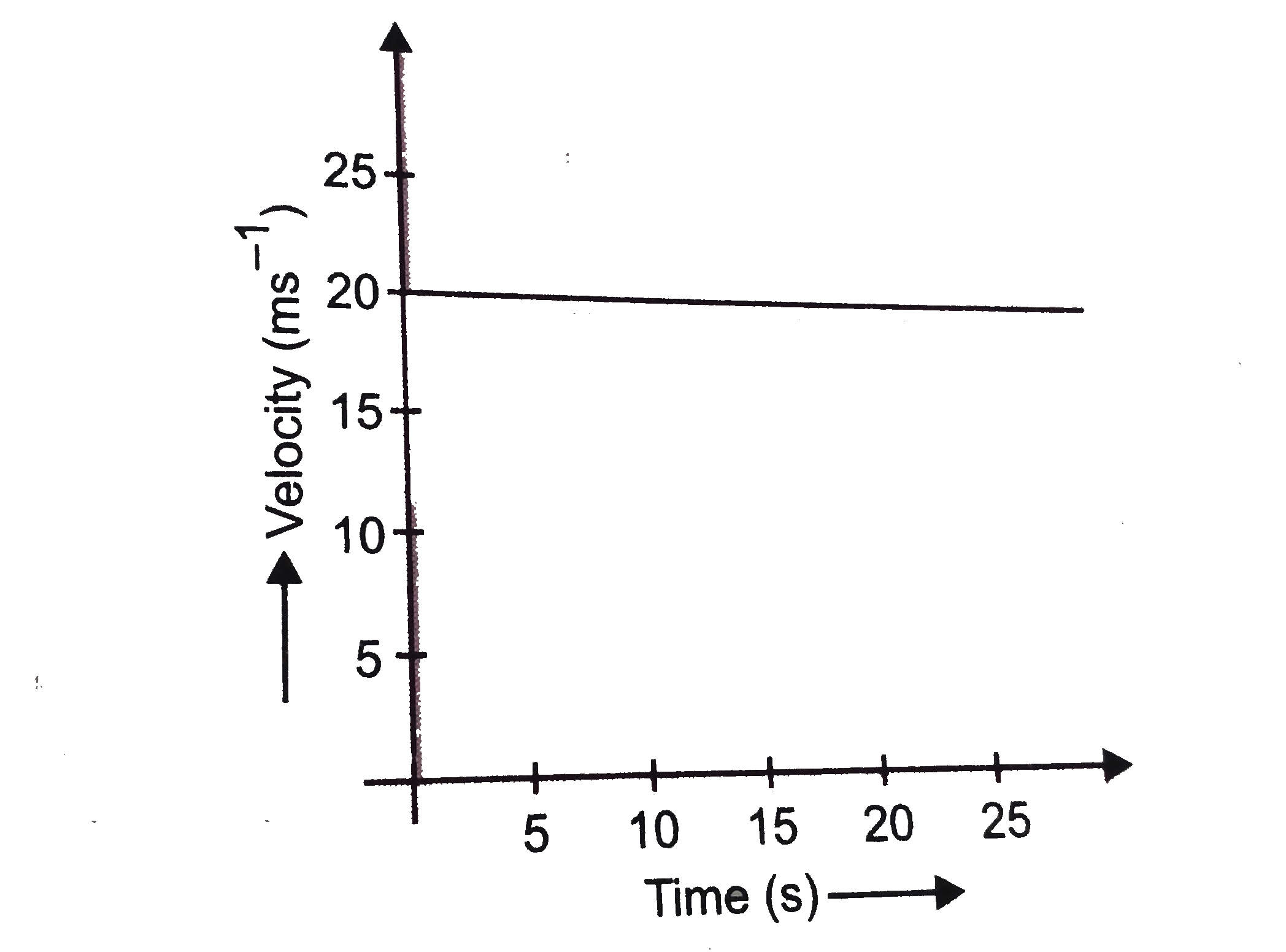
The velocity-time graph shows the motion of a cyclist. Find (i) its acceleration (ii) its velocity and (iii) the distance covered by the cyclist in `15` seconds.
Text Solution
Verified by Experts
(i) From the graph , it is clear that velocity is not changing with time i.e., acceleration is zero. (as a = `(dv)/(dt)+dv= 0`) (ii) Again from the graph , we can see that there is no change in the velocity with time so, velocity after 15 s will remain same as `20ms^(-1)` (iii) Distance covered in 15s = `"Velocity" xx "Time"= 20xx15 = 300m [because "Time"=("Distance")/("Speed")]`
Topper's Solved these Questions
MOTION
NCERT EXEMPLAR|Exercise Short Answer Type Questions|1 Videos
GRAVITATION
NCERT EXEMPLAR|Exercise Gravitation|26 Videos
SOUND
NCERT EXEMPLAR|Exercise Sound|20 Videos
Similar Questions
Explore conceptually related problems
(a) Write the three equations of uniformly accelerated motion. Give the meaning of each symbol which occurs in them (b) A car acquires a velocity of 72 km per hour in 10 seconds starting from rest. Find (i) the acceleration, (ii) the average velocity, and (iii) the distance travelled in the time.
Show that area under the velocity-time graph of an object moving with constant acceleration in a straight line in certain time interval is equal to the distance covered by the object in the interval.
Show that the area under the velocity-time graph of an object moving with constant acceleration in a straight line in certain time interval is equal to the distance covered by the object in that interval.
A body is moving with an initial velocity u and a uniform acceleration a. Find the distance covered by the body in nth second.
An object is given an initial velocity of 11m/s towards the north and a constant acceleration of 2m//s^(2) towards the south. What will be the distance covered by the object in the sixth second of its motion
Represent the velocity-time graph for a uniformly accelerated motion when acceleration is positive.
The initial velocity of a body moving along a straight lines is 7m//s . It has a uniform acceleration of 4 m//s^(2) the distance covered by the body in the 5^(th) second of its motion is-
From the velocity-time graph of uniformaccelerated motion deduce the equations of motion in (i) velocity and time (ii) distance and time (iii) disstance and velocity.
The velocity - time graph of a body is given in figure below . The acceleration-time graph of the motion of the body is