Home
Class 10
CHEMISTRY
An element X of group 15 exists as diato...

An element X of group 15 exists as diatomic molecule and combines with hydrogen at 773 K in presence of the catalyst to form a compound, ammonia which has a characteristic pungent smell
(a) Identify the element X. How many valence electrons does it have ?
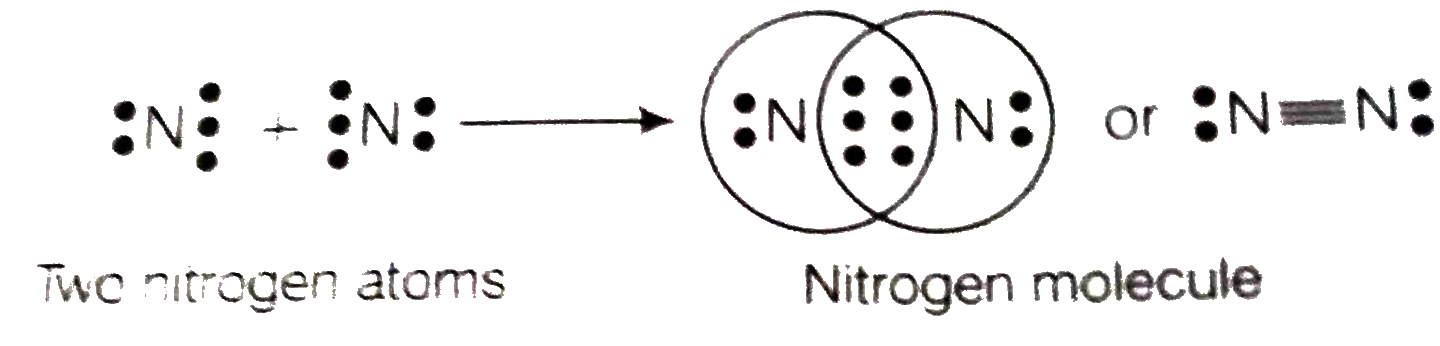
(b) Draw the electron dot structure of the diatomic molecule of X. What type of bond is formed in it ?
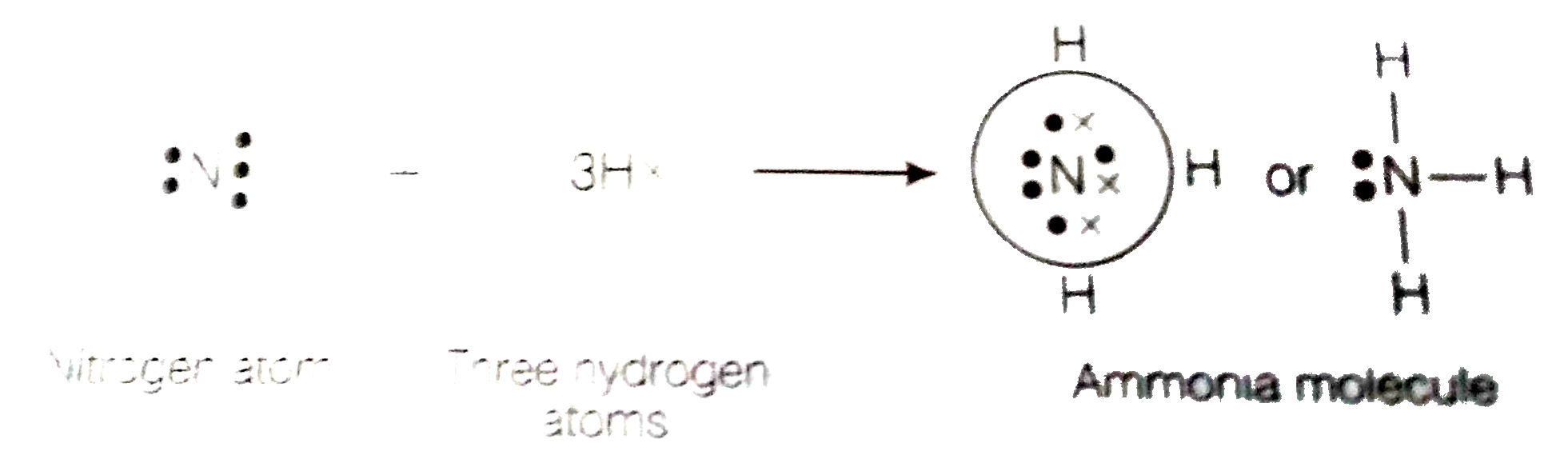
(c) Draw the electron dot structure for ammonia and what type of bond is formed in it ?

Text Solution

Verified by Experts
Since, the element 'X' of group 15 exists as a diatomic molecule and combines with hydrogen at 773 K in presence of a catalyst to form ammonia which has a characteristic smell, therefore, the element 'X' is nitrogen (N)
`underset(underset(("diatomic molecule"))("Nitrogen"))(N_(2))+underset("Hydrogen")(3H_(2))underset("Catalyst")overset(773K)(rarr)underset(underset(("Pungent smell"))("Ammonia"))(2NH_(3))`
(a) The atomic number of nitrogen is 7. So, its electronic configuration is 2,5. Thus, it has five valence electrons
(b) Nitrogen has 5 valence electrons. Therefore, it needs 3 more electrons to complete its octet. To do so, it shares three of its electrons with three electrons of the other nitrogen atom to form a diatomic molecule of `N_(2)` gas
Thus, three covalent bonds are formed between two nitrogen atoms adn each nitrogen atom is left with one lone pair of electrons

(c) Electron dot structure for ammonia is as follows

In `NH_(3)` molecule, there are three N-H single covalent bonds and one lone pair of electrons on the nitrogen atom.
Promotional Banner

Topper's Solved these Questions

  • METALS AND NON- METALS

    NCERT EXEMPLAR|Exercise Metals And Non- Metals|65 Videos

Similar Questions

Explore conceptually related problems

An element X of group 15 exists as diatomic molecule and combines with hydrogen at 773 K in presence of the catalyst to form a compound, ammonia which has a characteristic pungent smell. Identify the element X. How many valence electrons does it have?

An element X of group 15 exists as diatomic molecule and combines with hydrogen at 773 K in presence of the catalyst to form a compound, ammonia which has a characteristic pungent smell. Draw the electron dot structure for ammonia and what type of bond is formed in it?

An element X of group 15 exists as diatomic molecule and combines with hydrogen at 773 K in presence of the catalyst to form a compound, ammonia which has a characteristic pungent smell. Draw the electron dot structure of the diatomic molecule of X. What type of bond is formed in it?

In electron dot structure ,the valence shell electrons represented by crosses or dots. Draw the electron dot structure of chlorine molecule.

Which diatomic molecule has the shortest bond length?

NCERT EXEMPLAR-PERIODIC CLASSIFICATION OF ELEMENTS-Periodic Classification Of Elements
  1. Three elements A, B and C have 3,4 and 2 electrons respectively in the...

    Text Solution

    |

  2. If an element X is placed in group 14, what will be the formula and th...

    Text Solution

    |

  3. Compare the radii of two species X and Y. Give reasons for your answer...

    Text Solution

    |

  4. Arrangement the following elements in increasing order of their atomic...

    Text Solution

    |

  5. Identify and name the metal out of the following elements whose electr...

    Text Solution

    |

  6. Write the formula of the product formed when the element A (atomic num...

    Text Solution

    |

  7. Arrange the following elements in the increasing order of their metall...

    Text Solution

    |

  8. Identify, the elements with the following property and arrange them in...

    Text Solution

    |

  9. Properties of the elements are given below. Where would you locate the...

    Text Solution

    |

  10. An element is placed in 2^("nd") group and 3^("rd") period of the peri...

    Text Solution

    |

  11. An element X (atomic number 17) reacts with an element Y (atomic numbe...

    Text Solution

    |

  12. Atomic number of few elements are given below 10, 20, 7, 14 (a) Iden...

    Text Solution

    |

  13. Complete the following crossword puzzle (Figure) Across (1) An ele...

    Text Solution

    |

  14. (a) In this ladder (Figure) symbols of elements are jumbled up. Rearra...

    Text Solution

    |

  15. Mendeleev predicted the existence of certain elements not known at tha...

    Text Solution

    |

  16. (a) Electropositive nature of the element(s) increases down the group ...

    Text Solution

    |

  17. An element X which is a yellow solid at room temperature shows catenat...

    Text Solution

    |

  18. An element X of group 15 exists as diatomic molecule and combines with...

    Text Solution

    |

  19. Which group of elements could be placed in mendeleev's periodic table ...

    Text Solution

    |

  20. Give an account of the process adopted by Mendeleev for the classifica...

    Text Solution

    |