Home
Class 11
CHEMISTRY
Ionisation enthalpies of elements of sec...

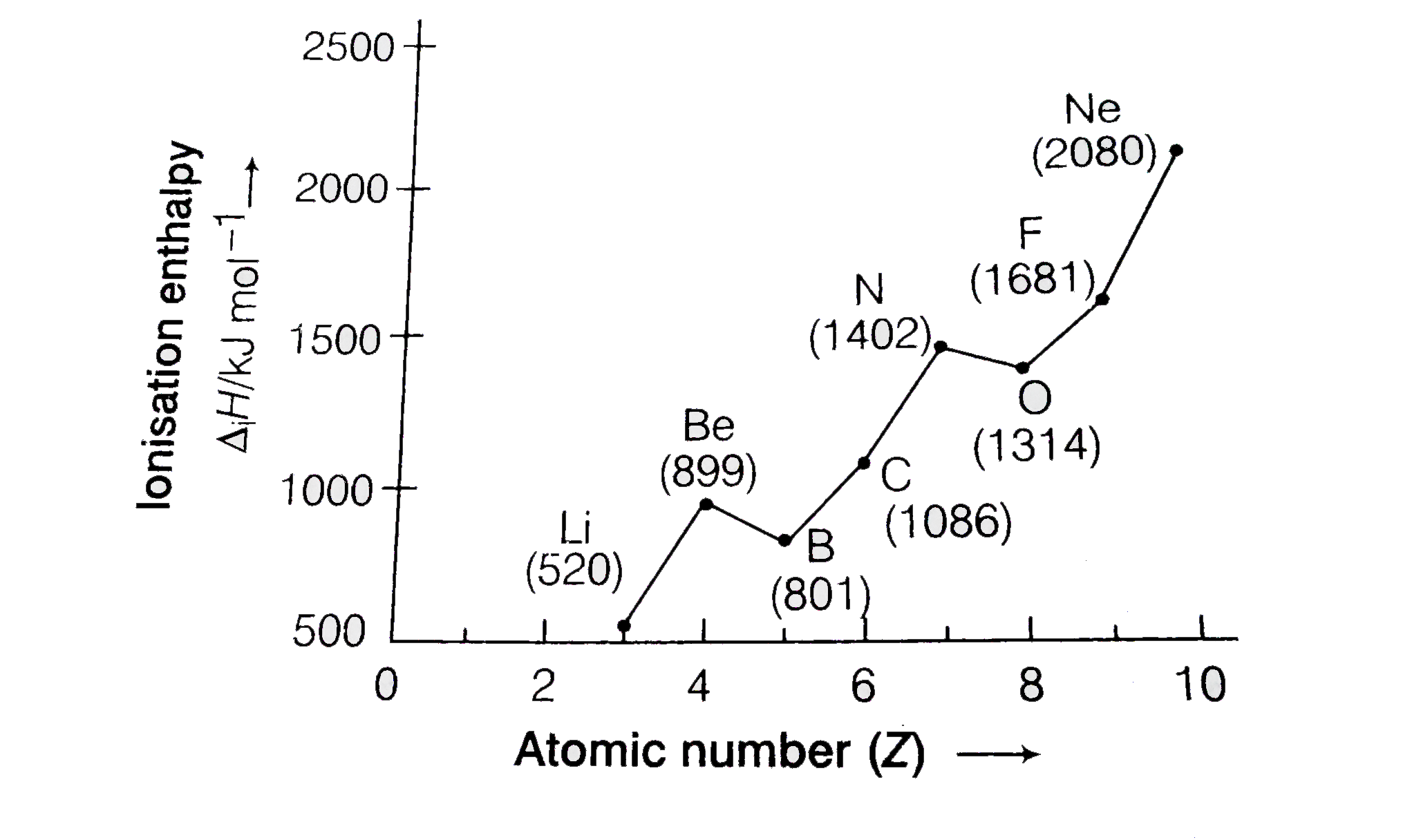
Ionisation enthalpies of elements of second period are given below Ionisation enthalpy/k cal `mol^(-1)`, 520,899,801,1086,1402,1314, 1681, 2080. Match the correct enthalpy with the elements and complete the graph given in the figure. Also write symbols of elements with their atomic number.

Text Solution

Verified by Experts

The correct Answer is:
A

To match the correct answer with the elements and to complete the graphs the following points are taken into consideration. As we move from left to right across a period, the ionisation enthalpy keeps on increasing due to increased nuclear charge and simultaneous decreases in atomic radius.
However, there are some exceptions given below.
a) In split of increased nuclear charge, the first ionisation enthalpy of B is lower than that of Be. This is due to the presence of fully filled 2s orbital of Be`[1s^(2) 2s^(2)]` which is a stable full filled 2s orbitals. While B `[1s^(2) 2s^(2) 2P^(2)]` contains valence electrons in 2s and 2p orbitals. It can easily lose its one `e^(-)` from 2p orbitals in order to achieve noble gas configuration. Thus, first ionisation enthalpy of B is lower than that of Be.
Since, the electrons in 2s-orbital are more tightly held by the nucleus than these present in 2p-orbital, therefore, ionisation enthalpy of B is lower than that of Be.
b) the first ionisation enthalpy of N is higher than that of O through the nuclear charge of O is higher than that of N. This is due to the reason that in case of N, the electron is to be removed from a more stable exactly half-filled electronic configuration `(1s^(2), 2s^(2), 2p_(x)^(1), 2p_(y)^(1), 2p_(z)^(1))` which is not present in O `(1s^(2), 2s^(2), 2p_(x)^(2), 2p_(y)^(1), 2p_(z)^(1))`
Therefore, the first ionisation enthalpy of N is higher than that of O. The symbols of elements along with their atomic number are given in the following graph.
Promotional Banner

Topper's Solved these Questions

  • CLASSIFICATION OF ELEMENTS AND PERIODICITY IN PROPERTIES.

    NCERT EXEMPLAR|Exercise Matching the Columns|3 Videos
  • CLASSIFICATION OF ELEMENTS AND PERIODICITY IN PROPERTIES.

    NCERT EXEMPLAR|Exercise Assertion and Reason|3 Videos
  • CLASSIFICATION OF ELEMENTS AND PERIODICITY IN PROPERTIES.

    NCERT EXEMPLAR|Exercise Long answer types question|7 Videos
  • CHEMICAL BONDING AND MOLECULAR STRUCTURE

    NCERT EXEMPLAR|Exercise Long Answer type questions|9 Videos
  • ENVIRONMENTAL CHEMISTRY

    NCERT EXEMPLAR|Exercise Long Answer Type|5 Videos

Similar Questions

Explore conceptually related problems

Match the correct ionisation enthalpies and electron gain enthalpies of the following elements.

Match the correct ionisation enthalpies electron gain enthalpies of the following elements.

Select correct graph, which is plotted between ionisation energy of 2nd period elements and their atomic number.

The correct decreasing order of first ionisation enthalpies of five elements of second period is

The second ionisation enthalpy of the elements of group 1 are higher than those of elements of group 2 . Explain.

Match the values of 1st and 2nd ionisation energy and electron gain enthalpy given in the column-I with types of elements/compounds given in column-II

Ionisation enthalpy (Delta_(i)"H kJ mol"^(-1)) for the elements of group 13 follows the order.

In this ladder (Given figure) symbols of elements are jumbled up. Rearrange these symbols of elements in the increasing order of their atomic number in the Periodic Table.

NCERT EXEMPLAR-CLASSIFICATION OF ELEMENTS AND PERIODICITY IN PROPERTIES.-Short answer types questions
  1. The negative value of electron gain enthalpy is less for fluorine than...

    Text Solution

    |

  2. All transition elements are d-block elements, but all d-block elements...

    Text Solution

    |

  3. Identify the group nad valency of the elements having atomic number 11...

    Text Solution

    |

  4. Ionisation enthalpies of elements of second period are given below Ion...

    Text Solution

    |

  5. Among the elements, B, Al, C and Si, a) which element has the highes...

    Text Solution

    |

  6. Describe the main characteristic properties of s, p, d and f-block ele...

    Text Solution

    |

  7. Choose the correct order of atomic radii of fluorine and neon (in pm) ...

    Text Solution

    |

  8. Illustrate by taking examples of transition elements and non-transitio...

    Text Solution

    |

  9. Nitrogen has positive electron gain enthalpy whereas oxygen has negati...

    Text Solution

    |

  10. First member of each group of representative elements (i.e., s and p-b...

    Text Solution

    |

  11. p-block elements form acidic, basic and amphoteric oxides. Explanin ea...

    Text Solution

    |

  12. How would you explain the fact that the first ionisation enthalpy of s...

    Text Solution

    |

  13. What do you undestand by exothermic reaction and endothermic reaction?...

    Text Solution

    |

  14. Arrange the elements N, P, O and S in the order of i) increasing fir...

    Text Solution

    |

  15. Explain the deviation in ionsation enthalpy of some elements from the ...

    Text Solution

    |

  16. Explain the following a) Electronegatively of elements increase on m...

    Text Solution

    |

  17. How does the metallic and non-metalic character vary on moving from le...

    Text Solution

    |

  18. The radius of Na^(+) cation is less than that of Na atom. Give reason.

    Text Solution

    |

  19. Among alkali metals which element do you expect to be least electroneg...

    Text Solution

    |

