Text Solution
Verified by Experts
The correct Answer is:



Topper's Solved these Questions
CLASSIFICATION OF ELEMENTS AND PERIODICITY IN PROPERTIES.
NCERT EXEMPLAR|Exercise Matching the Columns|3 VideosCLASSIFICATION OF ELEMENTS AND PERIODICITY IN PROPERTIES.
NCERT EXEMPLAR|Exercise Assertion and Reason|3 VideosCLASSIFICATION OF ELEMENTS AND PERIODICITY IN PROPERTIES.
NCERT EXEMPLAR|Exercise Long answer types question|7 VideosCHEMICAL BONDING AND MOLECULAR STRUCTURE
NCERT EXEMPLAR|Exercise Long Answer type questions|9 VideosENVIRONMENTAL CHEMISTRY
NCERT EXEMPLAR|Exercise Long Answer Type|5 Videos
Similar Questions
Explore conceptually related problems
NCERT EXEMPLAR-CLASSIFICATION OF ELEMENTS AND PERIODICITY IN PROPERTIES.-Short answer types questions
- The negative value of electron gain enthalpy is less for fluorine than...
Text Solution
|
- All transition elements are d-block elements, but all d-block elements...
Text Solution
|
- Identify the group nad valency of the elements having atomic number 11...
Text Solution
|
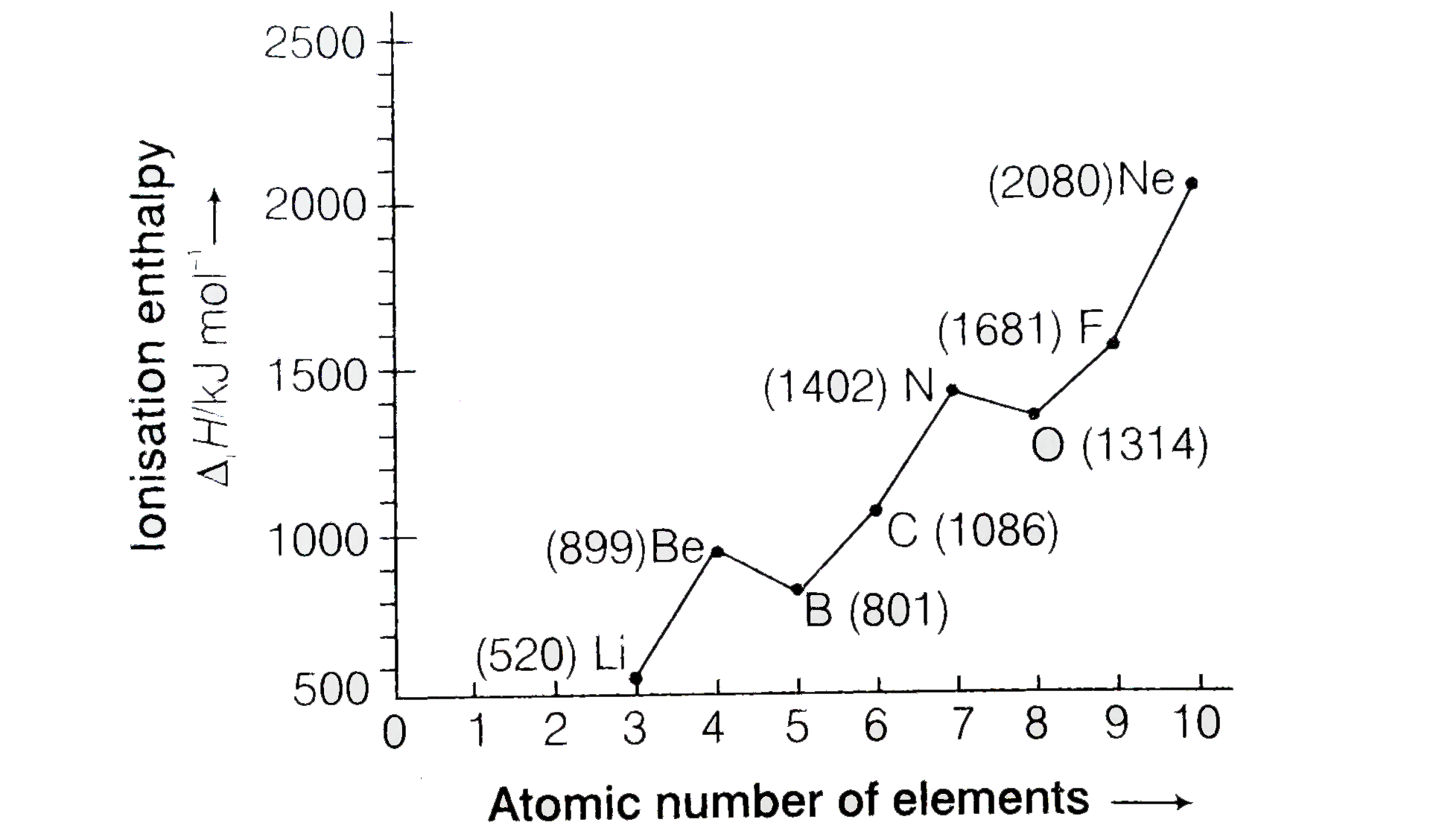
- Ionisation enthalpies of elements of second period are given below Ion...
Text Solution
|
- Among the elements, B, Al, C and Si, a) which element has the highes...
Text Solution
|
- Describe the main characteristic properties of s, p, d and f-block ele...
Text Solution
|
- Choose the correct order of atomic radii of fluorine and neon (in pm) ...
Text Solution
|
- Illustrate by taking examples of transition elements and non-transitio...
Text Solution
|
- Nitrogen has positive electron gain enthalpy whereas oxygen has negati...
Text Solution
|
- First member of each group of representative elements (i.e., s and p-b...
Text Solution
|
- p-block elements form acidic, basic and amphoteric oxides. Explanin ea...
Text Solution
|
- How would you explain the fact that the first ionisation enthalpy of s...
Text Solution
|
- What do you undestand by exothermic reaction and endothermic reaction?...
Text Solution
|
- Arrange the elements N, P, O and S in the order of i) increasing fir...
Text Solution
|
- Explain the deviation in ionsation enthalpy of some elements from the ...
Text Solution
|
- Explain the following a) Electronegatively of elements increase on m...
Text Solution
|
- How does the metallic and non-metalic character vary on moving from le...
Text Solution
|
- The radius of Na^(+) cation is less than that of Na atom. Give reason.
Text Solution
|
- Among alkali metals which element do you expect to be least electroneg...
Text Solution
|