Home
Class 12
CHEMISTRY
Write down functional isomers of a carbo...

Write down functional isomers of a carbonlyl compound with molecular formula `C_(3)H_(6)O`. Which isomer will react faster with HCN and why ? Explain the mechanism of the reaction also. Will the reaction lead to the completion with the conversion of whole reactant into product under reaction conditions ? If a strong acid is added to the reaction mixture, what will be the effect on concentration of the product and why?

Text Solution

Verified by Experts
Functional isomers of `C_(3)H_(6)O` containing carbonyl group are `underset("Propanal")(CH_(3)CH_(2)CHO)" and "underset("Propanone")(CH_(3)COCH_(3))`
(a) Propanal, `CH_(3)CH_(2)CHO` will react faster with HCN because there is less steric hindrance and electronic factors, which increases its electrophilicity.
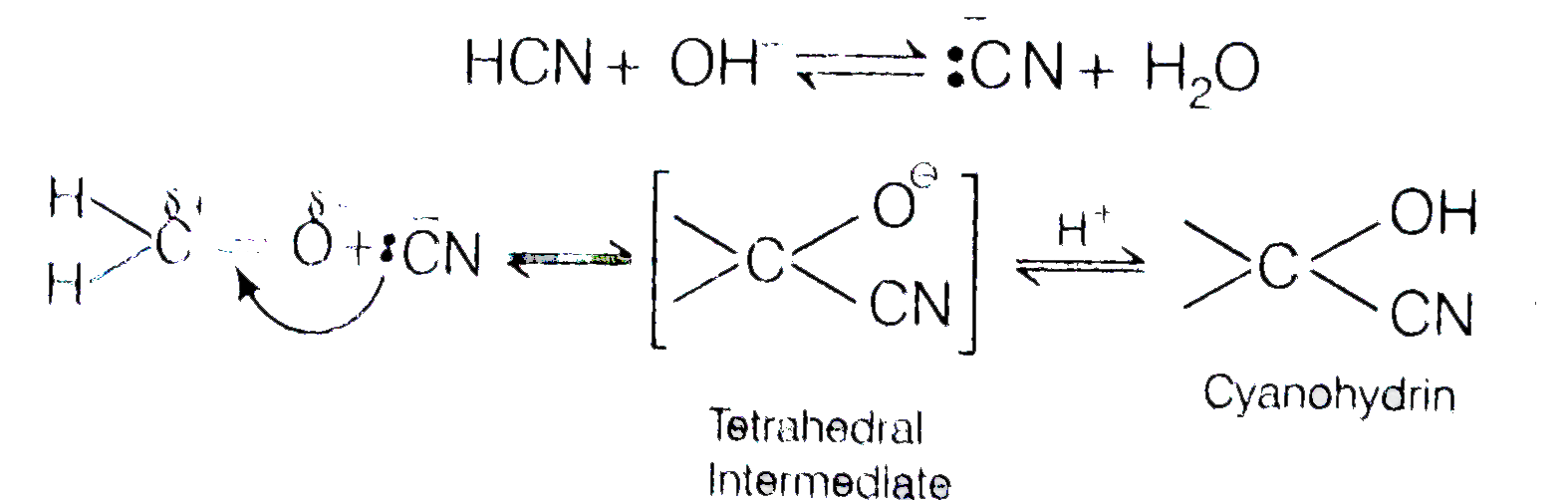
(b) The reaction mechanism is as follow
The reaction does not lead to completion because it is a reversible reaction, Equilibrium is established,

(c) If A strong acid is added to the reaction mixture, the reaction is inhibited because production of `overset(-)CN` ions prevented.
Promotional Banner

Topper's Solved these Questions

  • ALCOHOLS, PHENOLS AND ETHERS

    NCERT EXEMPLAR|Exercise Alcohols, Phenols And Ethers|74 Videos
  • AMINES

    NCERT EXEMPLAR|Exercise Amines|77 Videos

Similar Questions

Explore conceptually related problems

An optically active compound having molecular formula C_(7)H_(15)Br reacts with aqueous KOH to give a racemic mixture of products write the mechanism involved in the reaction.

A compound has molecular formula C_2H_6O .lt can be used as a fuel. Identify the name of the compound and functional group present in it. Write the reaction involved in the conversion of this compound into Ethanoic Acid.

A compound X of the formula C_(2)H_(6)O on reaction with Na metal gave Y, X also reacts with PC1_(5) to give Z the product obtained in the reaction between Y and Z is

An aromatic compound 'A' of molecular formula C_(7)H_(6)O_(2) undergoes a series of reactions as shown below. Write the structures of A, B, C, D and E in the following reactions:

Two carbon compound X and Y have the molecular formula C_(3)H_6 and C_(4)H_(10) respectively which one is most likely to show addition reaction? Justify your answer, also give the chemical equation to explain the process of addition reaction in this case.

NCERT EXEMPLAR-ALDEHYDE, KETONES AND CARBOXYLIC ACIDS-Aldehyde, Ketones And Carboxylic Acids
  1. Alkenes and carbonyl compounds both contain a pi bond but alkenes sh...

    Text Solution

    |

  2. Carboxylic acids contain carbonyl group but do not show the nucleophil...

    Text Solution

    |

  3. Identify the compounds A, B and C in the following reaction : CH(3)-...

    Text Solution

    |

  4. Why are carboxylic acids more acidic than alcohols or phenols although...

    Text Solution

    |

  5. Complete the following reaction sequence : CH(3)-overset(O)overset(|...

    Text Solution

    |

  6. Ethylbenzene is generally prepared by acetylation of benzene followed ...

    Text Solution

    |

  7. Can Gattermann-Koch reaction be considered similar to Friedel Craft's ...

    Text Solution

    |

  8. Match the common names given in Column I with the IUPAC names given in...

    Text Solution

    |

  9. Match the acids given in Column I with their correct IUPAC names given...

    Text Solution

    |

  10. Match the reactions given in Column I with the suitable reagents given...

    Text Solution

    |

  11. Match the example given in Column I with the name of the reaction in C...

    Text Solution

    |

  12. Assertion (A) Formaldehyde is a planar molecule. Reason (R) It conta...

    Text Solution

    |

  13. Assertion (A) compound containing -CHO group are easily oxidised to co...

    Text Solution

    |

  14. Assertion (A) The alpha-hydrogen atom in carbonyl compounds is less ac...

    Text Solution

    |

  15. Assertion : Aromatic aldehydes and formaldehyde undergo Cannizzaro rea...

    Text Solution

    |

  16. Assertion (A) Aldehydes and ketones, both react with Tollen's reagent ...

    Text Solution

    |

  17. An alkene 'A' (molecular formula C(5)H(10)) on ozonolysis gives a mixt...

    Text Solution

    |

  18. An aromatic compound 'A' (Molecular formula C(8)H(8)O)) gives positive...

    Text Solution

    |

  19. Write down functional isomers of a carbonlyl compound with molecular f...

    Text Solution

    |

  20. When liquid 'A' is treated with a freshly prepared ammoniacal silver n...

    Text Solution

    |
