Home
Class 12
CHEMISTRY
Aryl halides are extermely less reactive...

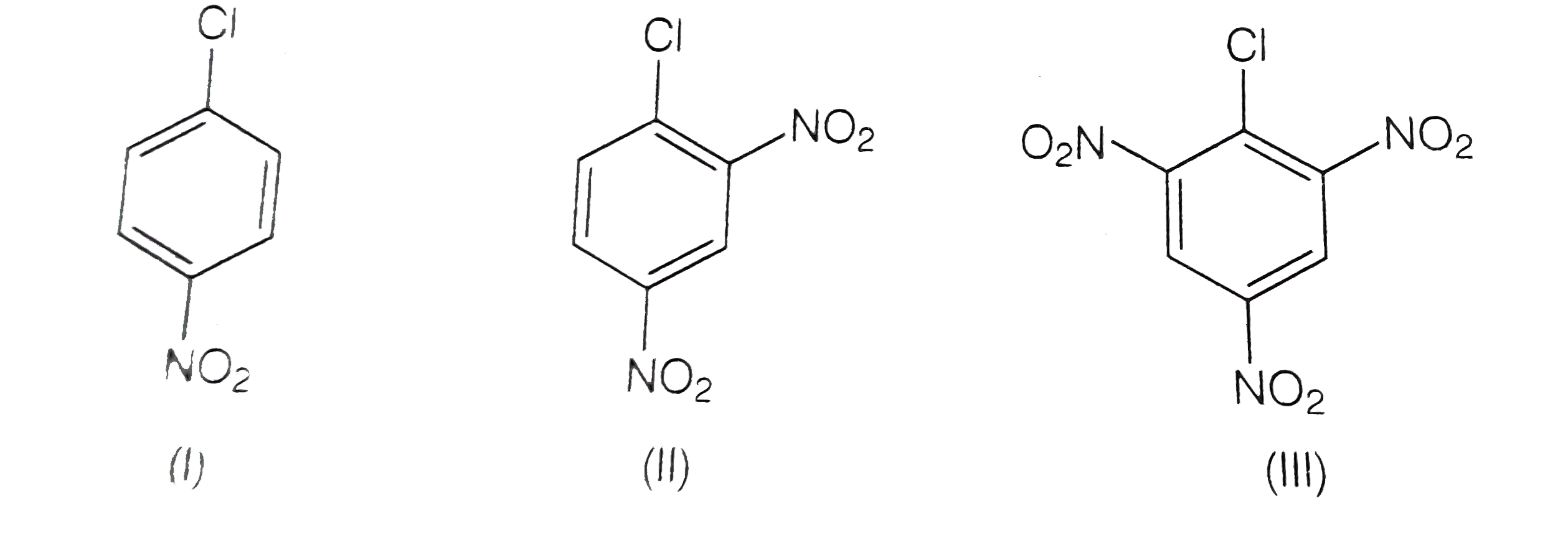
Aryl halides are extermely less reactive towards nucleophilic substitution. Predictand explain the order of reactivity of the compounds towards nucleophilic substitution.

Text Solution

Verified by Experts

Aryl halides are less reactive towards nucleophilic substitution reaction. Presence of electron withdrawing group at ortho and para position increases the stability of intermediates and hence increases the reactivity of aryl halides towards nucleophilic substitution reaction
Now, more the number of EWG at ortho and para position, higher will be the reactivity of aryl halide. Compound (III) has three EWG so, it is most reactive and compound (I) has only one EWG So, it is least reactive. S0, the order af reactivity is `(I)lt(II)lt(II)`
Promotional Banner

Topper's Solved these Questions

  • GENERAL PRINCIPLE AND PROCESSES OF ISOLATION OF ELEMENTS

    NCERT EXEMPLAR|Exercise General Principle And Processes Of Isolation Of Elements|55 Videos
  • P-BLOCK ELEMENTS

    NCERT EXEMPLAR|Exercise P-Block Elements|72 Videos

Similar Questions

Explore conceptually related problems

Aryl halides are extremely less reactive towards nucleophilie substitution. Predict and explain the order of reactivity of the following compounds towards nucleophilic substitution:

Aryl halides are extremely less reactive towards nucleophilie substitution. Predict and explain the order of reactivity of the following compounds towards nucleophilic substitution:

What is the order of reactivity of the following compounds towards nucleophilic substitution?

The decreasing order of reactivity of the following compound towards nucleophilic substitution (S_N 2) is

Least reactive towards nucleophilic additon is

Aryl halide is less reactive than halide towards nucleophilic substitution because

NCERT EXEMPLAR-HALOALKANES AND HALOARENES-Haloalkanes And Haloarenes
  1. Elimination reaction (especially beta - elimination) are as common as ...

    Text Solution

    |

  2. How will you obtain monobromobenzene from aniline ?

    Text Solution

    |

  3. Aryl halides are extermely less reactive towards nucleophilic substitu...

    Text Solution

    |

  4. tert-Butylbromide reacts with aq. NaOH by S(N)1 mechanism while n-buty...

    Text Solution

    |

  5. Predict the major product formed when HCl is added to isobutylene, Exp...

    Text Solution

    |

  6. Discuss the nature of C-X bond in the haloarenes.

    Text Solution

    |

  7. How can you obtain iodoethane from ethanol when no other iodine contai...

    Text Solution

    |

  8. Cyanide ion acts as an ambident nucleophille. From which end it acts a...

    Text Solution

    |

  9. Match the compounds given in column I with the effects given in Column...

    Text Solution

    |

  10. Match the items of Column I and Column II

    Text Solution

    |

  11. Match the structures of compounds given in Column I with the classes o...

    Text Solution

    |

  12. Match the reactions given in Column I with the types of reactions give...

    Text Solution

    |

  13. Match the structures given in Column I with the names in Column II

    Text Solution

    |

  14. Match the reactions given in Column I with the names givn in Column II...

    Text Solution

    |

  15. Assertion ( A) Phosphorus chlorides ( tri and penta) are preferred ove...

    Text Solution

    |

  16. Assertion( A) The boiling points of alkyl halides decrease in the orde...

    Text Solution

    |

  17. Assertion( A) KCN reacts with methyl chloride to give methyl isocyanid...

    Text Solution

    |

  18. Assertion (A) tert-butyl bromide undergoes Wurtz reaction to give 2,2,...

    Text Solution

    |

  19. Assertion (A) Presence of a nitro group at ortho or para position incr...

    Text Solution

    |

  20. Assertion: In monohaloarenes, further electrophilic substitution occur...

    Text Solution

    |
