Home
Class 12
CHEMISTRY
Some alkyl halides undergo substitutionn...

Some alkyl halides undergo substitutionn whereas some undergo elimination reaction on treatment with bases. Discuss the structural features of alkyl halides with the help of examples which are responsible for this difference.

Text Solution

Verified by Experts

Primary alkyl halides follow `S_(N)2` mechanism in which a nucleophile attacks at `180^(@)` to the halogen atom. A transition state is formed in which carbon is bonded to two nucleophiles and finally halogen atom is pushed out. In `S_(N)2` mechanism, substitution of nucleophile takes place as follows

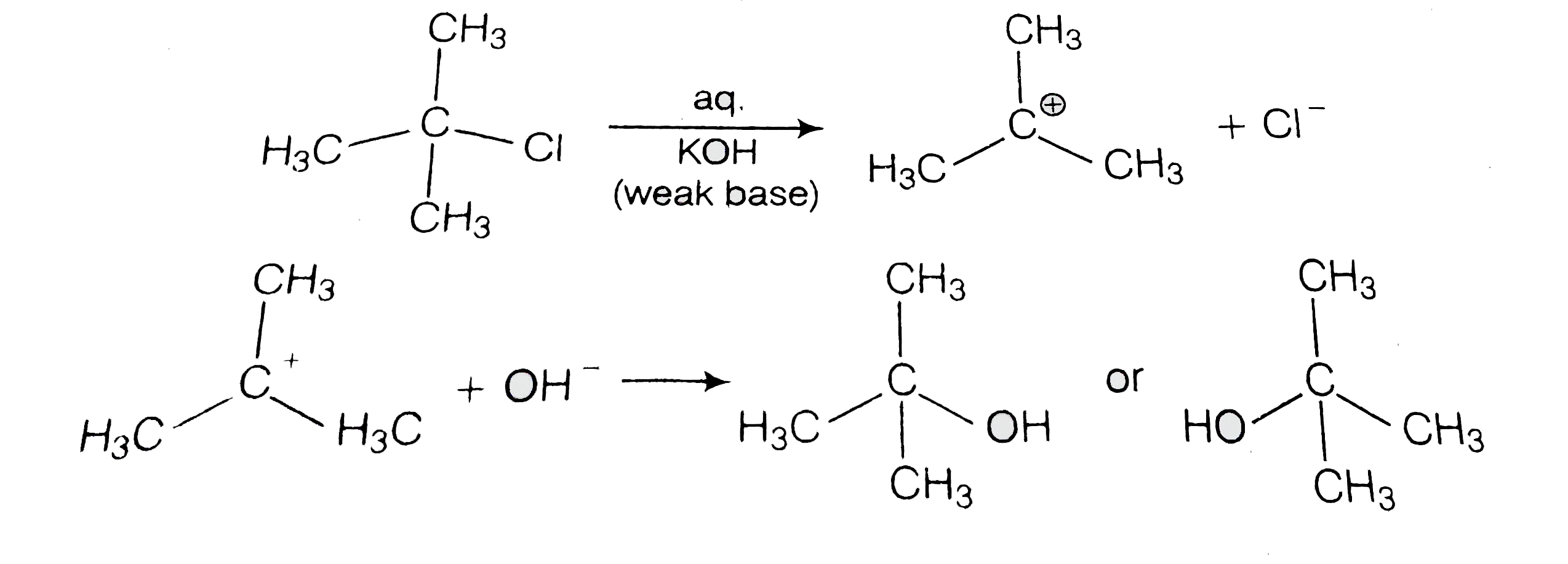
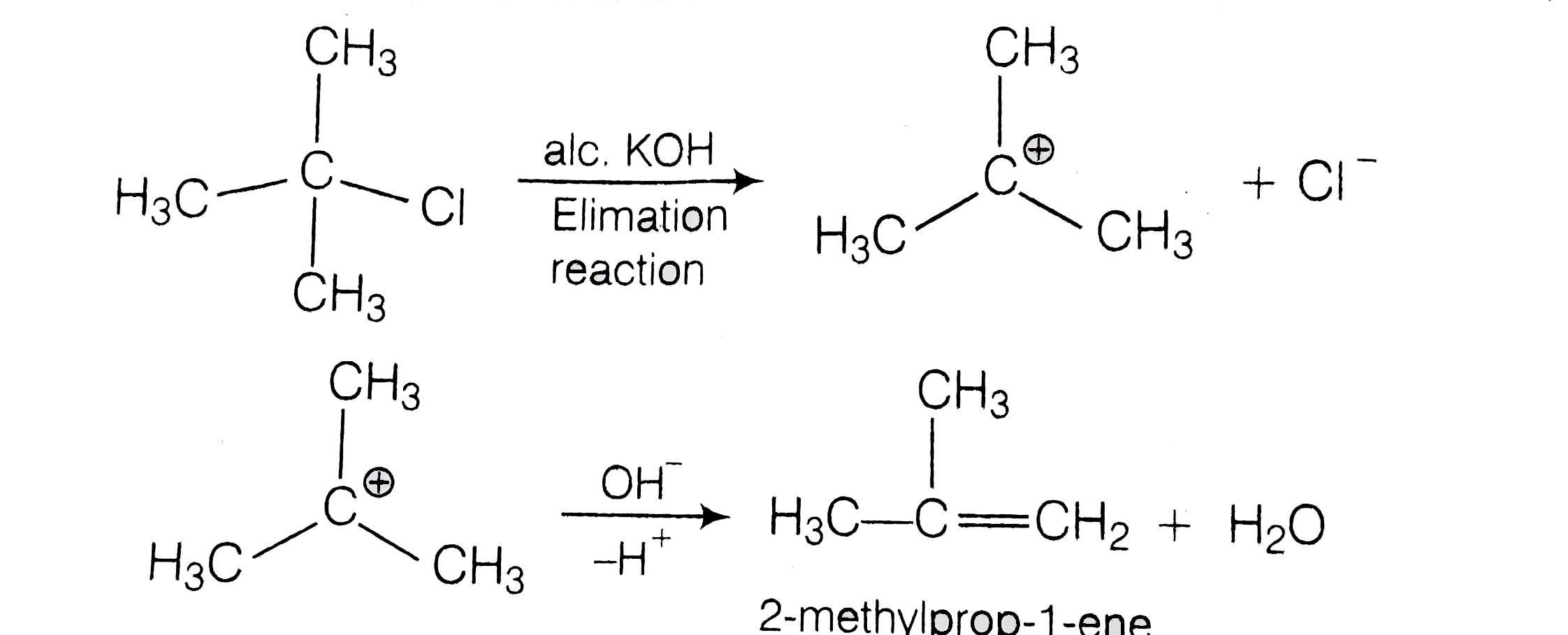
Thus, in `S_(N)2` mechanism, substitution takes place. Tertiary alkyl halides follow `S_(N)1` mechanism. In this case, tert alkyl halides form `3^(@)` carbocations. Now, if the reagent used is a weak base then substitution occur while if it is a strong base than instead of substitution elimination occur.

here the reagent used is aq. KOH. It is a weak base so, substitution takes place.

As alc. KOH is a strong base, so elimination competes over substitution and alkene is formed
Promotional Banner

Topper's Solved these Questions

  • GENERAL PRINCIPLE AND PROCESSES OF ISOLATION OF ELEMENTS

    NCERT EXEMPLAR|Exercise General Principle And Processes Of Isolation Of Elements|55 Videos
  • P-BLOCK ELEMENTS

    NCERT EXEMPLAR|Exercise P-Block Elements|72 Videos

Similar Questions

Explore conceptually related problems

All alkyl halides undergo reduction process except

In the elimination of reactions, that is, in the formation of alkenes, the reactivity of halogens in alkyl halides in the the order-

Which of the reaction are most common in alkyl halides

Give an example of beta -elimination reaction of alkyl halides.

Give an example of beta -elimination reaction of alkyl halides.

The alkyl halide that undergoes S_(N)1 reaction more readily is

NCERT EXEMPLAR-HALOALKANES AND HALOARENES-Haloalkanes And Haloarenes
  1. Cyanide ion acts as an ambident nucleophille. From which end it acts a...

    Text Solution

    |

  2. Match the compounds given in column I with the effects given in Column...

    Text Solution

    |

  3. Match the items of Column I and Column II

    Text Solution

    |

  4. Match the structures of compounds given in Column I with the classes o...

    Text Solution

    |

  5. Match the reactions given in Column I with the types of reactions give...

    Text Solution

    |

  6. Match the structures given in Column I with the names in Column II

    Text Solution

    |

  7. Match the reactions given in Column I with the names givn in Column II...

    Text Solution

    |

  8. Assertion ( A) Phosphorus chlorides ( tri and penta) are preferred ove...

    Text Solution

    |

  9. Assertion( A) The boiling points of alkyl halides decrease in the orde...

    Text Solution

    |

  10. Assertion( A) KCN reacts with methyl chloride to give methyl isocyanid...

    Text Solution

    |

  11. Assertion (A) tert-butyl bromide undergoes Wurtz reaction to give 2,2,...

    Text Solution

    |

  12. Assertion (A) Presence of a nitro group at ortho or para position incr...

    Text Solution

    |

  13. Assertion: In monohaloarenes, further electrophilic substitution occur...

    Text Solution

    |

  14. Assertion: Aryl iodides can be prepared by reaction of arenes with iod...

    Text Solution

    |

  15. Assertion: It is difficult to replace chlorine by -OH in chlorobenzene...

    Text Solution

    |

  16. Assertion (A) Hydrolysis of (-)-2-bromooctane proceeds with inversion ...

    Text Solution

    |

  17. Assertion (A) Nitration of chlorobenzene leads to the formation of m-n...

    Text Solution

    |

  18. Some alkyl halides undergo substitutionn whereas some undergo eliminat...

    Text Solution

    |

  19. Some halogen containing compounds are useful in daily life. Some compo...

    Text Solution

    |

  20. Aryl halides are less reactive towards nucleophilic substitution react...

    Text Solution

    |