Home
Class 11
PHYSICS
Consider a pair of identical pendulums, ...

Consider a pair of identical pendulums, which oscillate with equal amplitude independently such that when one pendulum is at its exatreme position making an angle of `2^(@)` to the right with the vertrcal, the other pendulum makes an angle of `1^(@)` to the left of the vertical. What is the left of the vertical. What is the phase difference between the pendulums?

Text Solution

Verified by Experts
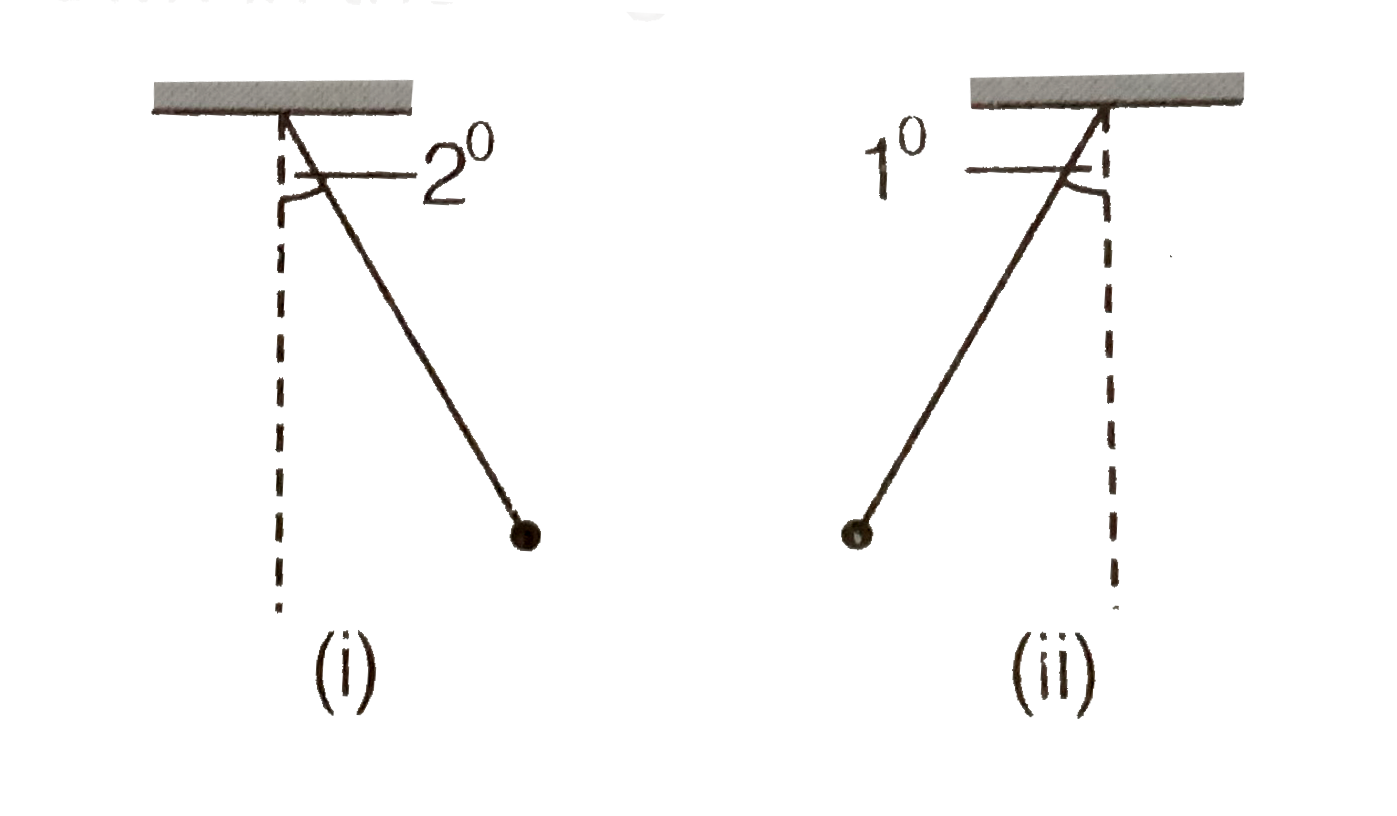
Consider the situations shown in the diagram (i) and (ii)

Assuming the two pendulums follows the following functions of their angular displacements
`theta_(1)=0_(0)sin(omegat+phi_(1))" " .....(i)`
and `theta_(2)=theta_(0)sin(omegat+phi_(2))" " .....(ii)`
As it is given that amplitude and time period being equal but phases being different. Now, for first pendulum at any time t
`theta_(1)=+theta_(0)` [Right extreme]
Form Eq. (i), we get
`rArrtheta_(0)=theta_(0)sin(omegat+phi_(1))" ro "1=sin(omegat+phi_(1))`
`rArrsin""(pi)/(2)=sin(omegat+phi_(1))`
or `(omegat+phi_(1))=(pi)/(2)`
Similary, at the same instant t for pendulum second, we have
`theta_(2)=-(theta_(0))/(2)`
where `theta_(2)=2^(@)` is the angular amplitude of first pendulum. For the second pendulum, the angular displacement is one degree. therefore `theta_(2)=(theta_(0))/(2)` and negative sign i s taken to show
for being left to mean position.
From Eqs. (ii), then `(theta_(0))/(2)=theta_(0)sin(omegat+phi_(2))`
`rArrsin(omegat+phi_(2))=-(1)/(2)rArr(omegat+phi_(2))=-(pi)/(6)or(7pi)/(6)`
or `(omegat+phi_(2))=-(pi)/(6)or(7pi)/(6)" ".....(iv)`
From Eqs. (iv) and (iii), the difference in phases
`(omegat+phi_(2))-(omegat+phi_(1))=(7pi)/(6)-(pi)/(2)=(7pi-3pi)/(6)=(4pi)/(6)`
or `(phi_(2)-phi_(2))=(4pi)/(6)=(2pi)/(3)=120^(@)`
Promotional Banner

Topper's Solved these Questions

  • MOTION IN A STRAIGHT LINE

    NCERT EXEMPLAR|Exercise Very Short Answer Type Qns|14 Videos
  • SYSTEM OF PARTICLES AND ROTATIONAL MOTION

    NCERT EXEMPLAR|Exercise very short answer type questions|18 Videos

Similar Questions

Explore conceptually related problems

Consider a pair of identical pendulums, which oscillate with equal amplitude independently such that when one pendulum is at its extreme position making an angle os 2^(@) to the right with the vertical , the other pendulum makes an angle of 1^(@) to the left of the vertical. What is the phase difference between the pendulums?

A conical pendulum of length L makes an angle theta with the vertical. The time period will be

Bob of the simple pendulum is at rest at its lowest position , Sharp hit imparts a speed of sqrt(9gl) to the pendium bob. Calculate tension of the thread when it makes an angle 60^(@) with the vertical .

A simple pendulum is set up in a trolley which moves to the right with an acceleration a on a horizontal plane. Then the thread of the pendulum in the mean position makes an angle theta with the vertical

When the string of a conical pendulum makes an angle of 45^(@) with the vertical , its time is T_(1) when the string makes an angle of 60^(@) with the vertical , its time period is T_(2) then T_(1)^(2) // T_(2)^(2) is

The bob of a pendulum is moving with a speed of 5 m/s while passing through mean position . Calculate its speed at the position when it makes an angle of 30^(@) with the vertical . The length of pendulum is 0.6 m / Use g = 10 m//s^(2)

A simple pendulum has a bob of mass m and swings with an angular amplitude phi . The tension in thread is T . At a certain time the string makes an angle theta with the vertical (theta le phi)

The bob A of a simple pendulum is released when the string makes an angle of 45^(@) with the vertical. It hits another bob B of the same meterial and same mass kept at rest on the table. If the collision is elastic, then

NCERT EXEMPLAR-OSCILLATIONS-MULTIPLE CHOICE QUESTIONS (MCQs)
  1. What are the two basic characteristics of a simple harmonic motion?

    Text Solution

    |

  2. When will the motion of a simple pendulum be simple harmonic?

    Text Solution

    |

  3. What is the ration of maximum acceleration to the maximum velocity of ...

    Text Solution

    |

  4. What is the ration between the distance travelled by the oscillator in...

    Text Solution

    |

  5. In figure, what be the sign of the velocity of the point P', which is ...

    Text Solution

    |

  6. Show that for a particle executing SHM, velocity and dispacement have ...

    Text Solution

    |

  7. Draw a graph to show the variation of PE, KE and total energy of a sim...

    Text Solution

    |

  8. The length of a second's pendulum on the surface of earth is 1 m. What...

    Text Solution

    |

  9. Find the time period of mass M when displaced from its equilibrium pos...

    Text Solution

    |

  10. Show that the motion of a particle represented by y=sinomegat-cosomega...

    Text Solution

    |

  11. Find the displacement of a simple harmonic oscillator at which its PE ...

    Text Solution

    |

  12. A body of mass m is situated in potential field U(x)=U(o)(1-cospropx) ...

    Text Solution

    |

  13. A mass of 2kg is attached to the spring of spring constant 50Nm^(-1). ...

    Text Solution

    |

  14. Consider a pair of identical pendulums, which oscillate with equal amp...

    Text Solution

    |

  15. A person normally weighing 50 kg stands on a massless platform which o...

    Text Solution

    |

  16. A body of mass m is attached ot one end of a massless spring which is ...

    Text Solution

    |

  17. A cylindrical log of wood of height h and area of cross-section A floa...

    Text Solution

    |

  18. One end of a V-tube containing mercury is connected ot a suction pump ...

    Text Solution

    |

  19. A tunnel is dug through the centre of the earth. Shwo that a body of m...

    Text Solution

    |

  20. A simple pendulum of time period 1s and length l is hung from a fixed ...

    Text Solution

    |

