Home
Class 11
PHYSICS
One end of a V-tube containing mercury i...

One end of a V-tube containing mercury is connected ot a suction pump and the other end to atmosphere. The two arms of the tube are inclined to horizontal at an angle of `45^(@)` each. A small pressure difference is created between two columns when the suction pump is removed. Will Neglect capillary and viscous forces. Find the time period of oscillation.

Text Solution

Verified by Experts
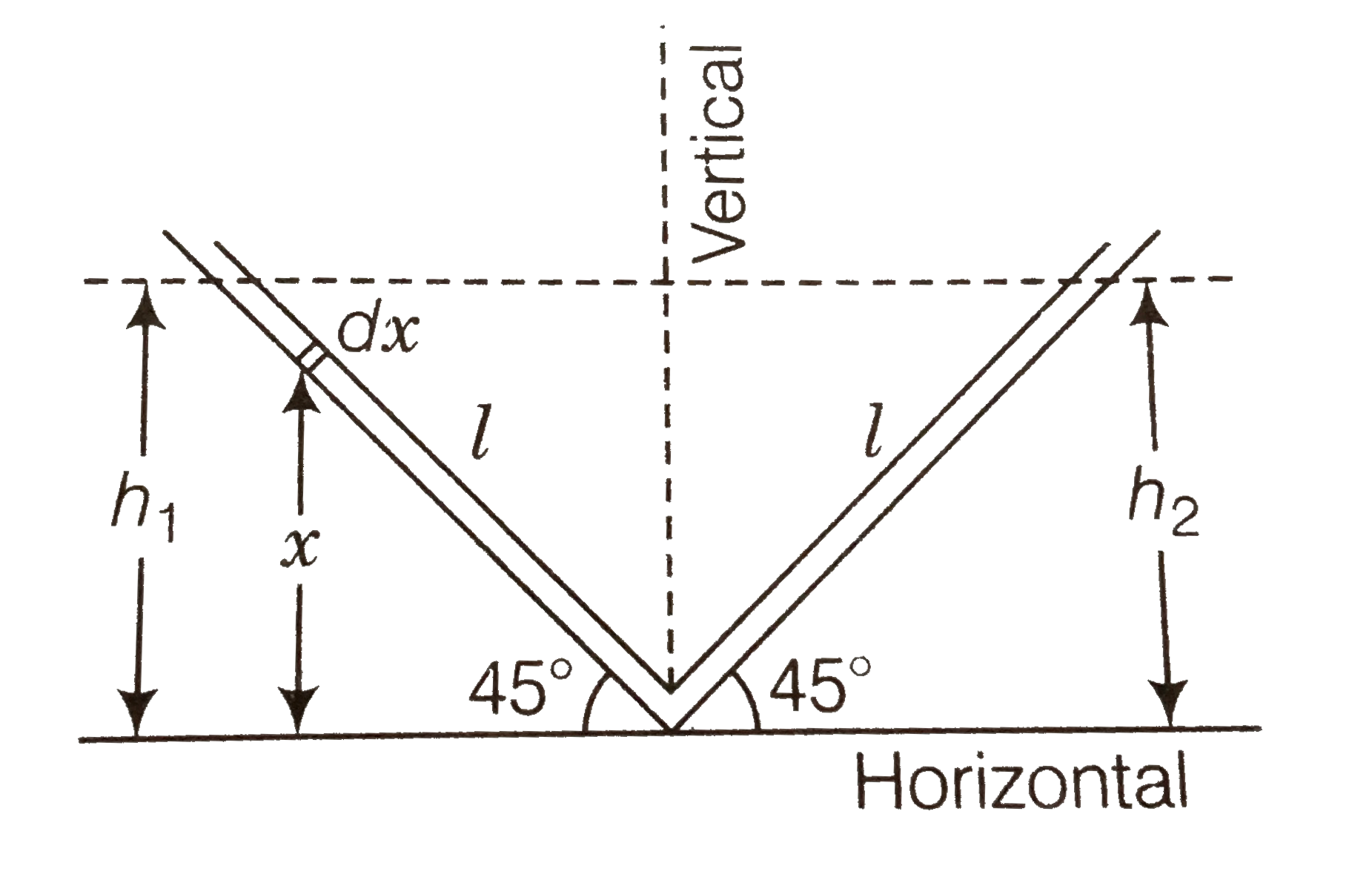
Consider the diagram shown below

Let us consider an infinitesimal liquid column of length dx at a height x from the horizontal line.
If p = density of the liquid
A= cross-sectional area of V-tube
PE of element dx will be given as
`PE=dmgx=(Apdx)gx" " [:.dm=pv=pAdx]`
where Apdx=dm=mass of element dx
Total PE of the left column
`underset(o)overset(h_(1))intApgdx`
`=Apgunderset(o)overset(h_(1))intxdx`
`=Apg|(x^(2))/(2)|^(h_(1))=Apgh_(1)^(2)/(2)`
But, `h_(1)=lsin45^(@)`
`:.PE=(Apg)/(2)l^(2)sin^(2)45^(@)" .....(i)`
In a similar way,
`"PE of right column"=(Apg)/(2)l^(2)sin^(2)45^(@)" ".....(ii)`
Total `PE=(Apg)/(2)l^(2)sin^(2)45^(@)+(Apg)/(2)l^(2)sin^(2)45^(@)`
`=2xx(1)/(2)Apgl^(2)((1)/(sqrt2))^(2)=(Apgl^(2))/(2)" " ....(iii)`
If due to pressure difference created y element of left side moves on the side, then
liquid present in the left arm=l-y
liquid present in the right arm=l+y
`:."Total PE"=Apg(l-y)^(2)sin^(2)45^(@)+Apg(l+y)^(2)sin^(2)45^(@)`
`"Changes in PE"=(PE)_("final")-(PE)_("initial")`
or `DeltaPE=(Apg)/(g)[(l-y)^(2)+(l+y)^(2)-l^(2)]`
`=(Apg)/(2)[l^(2)+y^(2)-2ly+l^(2)+y^(2)+2ly-l^(2)]`
`=(Apg)/(2)[2(l^(2)+y^(2))]`
`=Apg(l^(2)+y^(2))" " ....(iv)`
If v is the change in velocity of the total liquid column, then change in KE
`DeltaKE=(1)/(2)mv^(2)`
But `m=Ap(2l)`
`DeltaKE=(1)/(2)Apg2lv^(2)=Aplv^(2)" ".....(v)`
From Eqs. (iv)and (v),
`DeltaPE+KP=Apg(l^(2)+y^(2))+Aplv^(2)" ".....(vi)`
Sytem being conservative.
:. Change in total enregy =0
From Eq.(vi)
`Apg(l^(2)+y^(2))+Aplv^(2)=0`
Differentiating both sides with respect to time (t), we get
`Apg[0+2y(dy)/(dt)]+Apl(2v)(dv)/(dt)=0`
But `(dy)/(dt)=vand (dv)/(dt)=a" "["accelecration"]`
`rArrApg(2u=yv)+Ap(2v)=0`
`rArr(gy+la)2Apv=0`
`"2Apv=constant" and 2Apvne0`
`:.la+gy=0`
`a+((g)/(l))y=0`
or `(d^(2)y)/(dt^(2))+((g)/(l))y=0`
This is the standard differential equation for SHM of the form
`(d^(2)y)/(dt^(2))+omega^(2)y=0`
`:.omega=sqrt((g)/(l))`
`:.T =(2pi)/(omega)=2pisqrt((l)/(g))`
Promotional Banner

Topper's Solved these Questions

  • MOTION IN A STRAIGHT LINE

    NCERT EXEMPLAR|Exercise Very Short Answer Type Qns|14 Videos
  • SYSTEM OF PARTICLES AND ROTATIONAL MOTION

    NCERT EXEMPLAR|Exercise very short answer type questions|18 Videos

Similar Questions

Explore conceptually related problems

One end of V-tube containing mercury is connected to a suction grouup and the other end to atmosphere. The two arms of the tube are inclined to horizontal at an angle of 45^(@) each. A small pressure difference is created between two columns when the ssuction pump is removed. Will the column of mercuty in V-tube execute simple harmonic motion? Neglect capillary and viscous forces. Fing the time period of oscillation.

One end of a U-tube containing mercury is connected to a suction pump and the other end is connected to the atmosphere. A small pressure difference is maintained between the two columns. Show that when the suction pump is removed, the liquid in the U-tube executes SHM.

One end of a U-tube containing mercury is connected to a suction pump and the other end to atmosphere. A small pressure difference is maintained between the two columns. Show that, when the suction pump is removed, the column of mercury in the U-tube executes simple harmonic motion.

one end of a U-tube of uniform bore (area A) containing mercury is connected to a suction pump. Because of it the level of liquid of density rho falls in one limb. When the pump is removed, the restoring force in the other limb is:

One end a U-tube of unifrom bore (area A) cpmtaining mercury is connected to sunction pump . Because of it the level of liquid of density rho falls in one limb. When the pump is removed, the restoring force in the other limb is

A horizontal thin tube of length 2L completely filled with a liquid of density delta rotates about a vertical axis passing through one of its end and along the diameter of its side face with an constant angular velocity omega . Two vertical thin long tubes are fitted with the horizontal tube to measure the pressure difference between points A and B which are at same horizontal level as shown. Neglect viscous forces and surfaces tension of liquid. The difference in the heights (h) of the liquid column in the two vertical thin tubes is :

Two spherical soap bubbles of diameters 10 cm and 6 cm are formed, one at each end of a narrow horizontal glass tube. If the surface tension of the soap solution is 0.03 Nm^(-1) , then the pressure difference in pascal between the two ends of the tube is

A horizontal thin tube of length 2L completely filled with a liquid of density delta rotates about a vertical axis passing through one of its end and along the diameter of its side face with an constant angular velocity omega . Two vertical thin long tubes are fitted with the horizontal tube to measure the pressure difference between points A and B which are at same horizontal level as shown. Neglect viscous forces and surfaces tension of liquid. The graph of the pressure gradient ((dP)/(dx)) with the distance x meaured from the axis of rotation is :

An equilateral prism of mass m is kept on a smooth table between two identical springs each having a force constant of k. The two springs have their lengths perpendicular to the inclined faces of the prism and are constrained to remain straight. The ends of the springs have light pads aligned parallel to the faces of the prism, and distance between pads and the incline faces is d. The prism is imparted a velocity v to the right. Find time period of its oscillation.

NCERT EXEMPLAR-OSCILLATIONS-MULTIPLE CHOICE QUESTIONS (MCQs)
  1. What are the two basic characteristics of a simple harmonic motion?

    Text Solution

    |

  2. When will the motion of a simple pendulum be simple harmonic?

    Text Solution

    |

  3. What is the ration of maximum acceleration to the maximum velocity of ...

    Text Solution

    |

  4. What is the ration between the distance travelled by the oscillator in...

    Text Solution

    |

  5. In figure, what be the sign of the velocity of the point P', which is ...

    Text Solution

    |

  6. Show that for a particle executing SHM, velocity and dispacement have ...

    Text Solution

    |

  7. Draw a graph to show the variation of PE, KE and total energy of a sim...

    Text Solution

    |

  8. The length of a second's pendulum on the surface of earth is 1 m. What...

    Text Solution

    |

  9. Find the time period of mass M when displaced from its equilibrium pos...

    Text Solution

    |

  10. Show that the motion of a particle represented by y=sinomegat-cosomega...

    Text Solution

    |

  11. Find the displacement of a simple harmonic oscillator at which its PE ...

    Text Solution

    |

  12. A body of mass m is situated in potential field U(x)=U(o)(1-cospropx) ...

    Text Solution

    |

  13. A mass of 2kg is attached to the spring of spring constant 50Nm^(-1). ...

    Text Solution

    |

  14. Consider a pair of identical pendulums, which oscillate with equal amp...

    Text Solution

    |

  15. A person normally weighing 50 kg stands on a massless platform which o...

    Text Solution

    |

  16. A body of mass m is attached ot one end of a massless spring which is ...

    Text Solution

    |

  17. A cylindrical log of wood of height h and area of cross-section A floa...

    Text Solution

    |

  18. One end of a V-tube containing mercury is connected ot a suction pump ...

    Text Solution

    |

  19. A tunnel is dug through the centre of the earth. Shwo that a body of m...

    Text Solution

    |

  20. A simple pendulum of time period 1s and length l is hung from a fixed ...

    Text Solution

    |

