Home
Class 11
PHYSICS
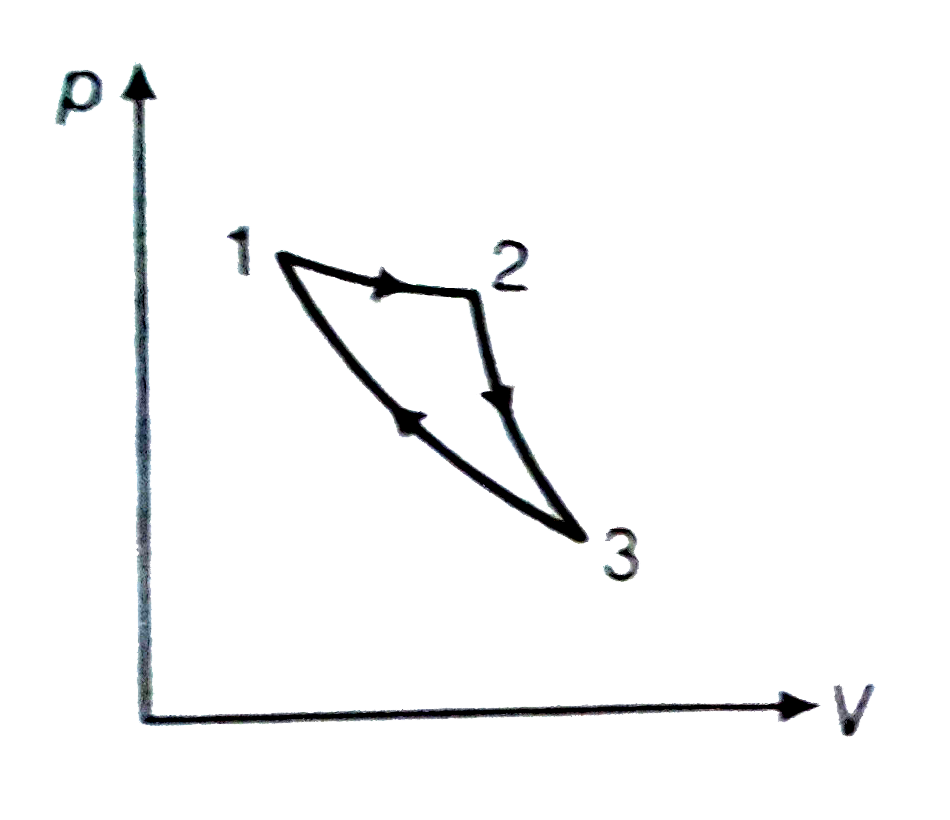
Consider a cycle followed by an engine (...

Consider a cycle followed by an engine (figure.)

1 or 2 is isothermal
2 to 3 is adiabatic
3 to 1 is adiabatic
Such a process does not exist, because

A

heart is completely converted to mechanical energy in such a process, which is not possible

B

mechanical energy is completely converted to heart in this process, which is not possible

C

curves representing two adiabatic processes don't intersect

D

curves representing an adiabatic process and an isothermal process don't intersect

Text Solution

Verified by Experts

The correct Answer is:

A, C

(a) The given process in a cyclic process i.e., it returns to the orignal state 1.
Hence, change in internal energy dU = 0
`rArr" "dQ=dU+dW=0+dW=dW`
Hence, total heat supplied is converted to work done by the gas (mechanical energy) which is not possible by second law of thermodynamics.
(c ) When the gas expands adiabatically form 2 to 3. It is not possible to return to the same state without being heat supplied, hence the process 3 to 1 cannot be adiabatic.
Promotional Banner

Topper's Solved these Questions

  • THERMODYNAMICS

    NCERT EXEMPLAR|Exercise VERY SHORT ANSWER TYPE QUESTIONS|5 Videos
  • THERMODYNAMICS

    NCERT EXEMPLAR|Exercise SHORT ANSWER TYPE QUESTIONS|6 Videos
  • THERMODYNAMICS

    NCERT EXEMPLAR|Exercise LONG ANSWER TYPE QUESTIONS|5 Videos
  • THERMAL PROPERTIES OF MATTER

    NCERT EXEMPLAR|Exercise Very short Answer type Questions|15 Videos
  • UNITS AND MEASUREMENTS

    NCERT EXEMPLAR|Exercise Long Answer Type Questions|9 Videos

Similar Questions

Explore conceptually related problems

Consider a cycle followed by an engine, (figure) 1 to 2 is isothermal 2 to 3 is adiabatic 3 to 1 is adiabatic such a process does not exist because

The three processes in a thermodynamic cycle shown in the figure are : Process 1 to 2 is isothermal, Process 2 to 3 is isochoric (volume remains constant), Process 3 to 1 is adiabatic. The total work done by the ideal gas in this cycle is 10 J. The internal energy decreases by 20 J in the isochoric process. The work done by the gas in the adiabatic process is -20 J. The heat added to the system in the isothermal process is

Find work in the given cycle, If AB is isothermal process and CA is adiabatic.

One mole of an ideal gas is carried through a thermodynamics cycle as shown in the figure. The cycle consists of an isochoric, an isothermal and an adiabatic process. Find the adiabatic exponent of the gas.

Identify isothermal and adiabatic process in the following diagram

The curves A and B in the figure shown P-V graphs for an isothermal and an adiabatic process for an idea gas. The isothermal process is represented by the curve A.

An ideal gas undergoes a cyclic process, in which one process is isochoric, one process is isothermal and one process is adiabatic. During the isothermal process, 40 J heat is released by the gas, and during the isochoric process, 80 J heat is absorbed by the gas. if work done by the gas during adiabatic process is W_(1) and during isothermal process is W_(2) then the magnitude of (W_(1))/(W_(2)) will be equal to:

Define the following terms : (i) System (ii) Isothermal and adiabatic process

An ideal gas expands from V to 2V in 4 separate processes. Where process 1 is isothermal process 2 is adiabatic, process 3 is free expansion and process 4 is isobaric. If E_(1),E_(2),E_(3) and E_(4) are the changes in average kinetic energy of the molecules in the isothermal, adiabatic free expansion and isobaric process respectively then choose the correct options.

Thermodynamics - 1St Law Of Td In Adiabatic Process
