Home
Class 11
PHYSICS
A cycle followed by an engine (made o...

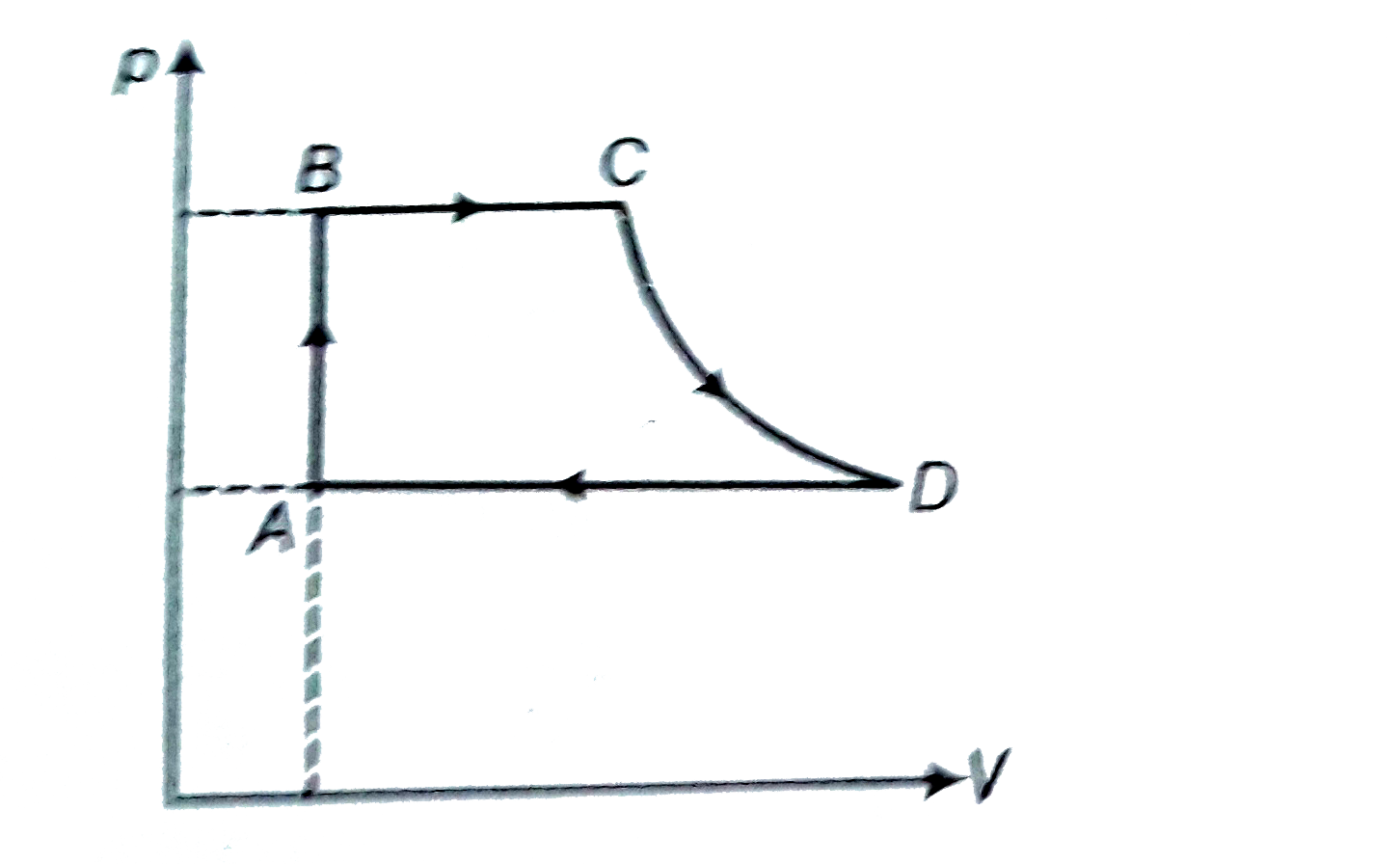
A cycle followed by an engine (made of one mole of an ideal gas in a cyclinder with a piston ) is shown if figure . Find heat exchanged by the enigen, with the surrodings for each section of the cycle . `[C_(V) = (3//2) R]`

Text Solution

Verified by Experts

(a) For process AB,
Volume is constant, hence work done dW = 0
Now, by first law of thermodynamics,
`" "dQ =dU+dW=dU+0=dU`
`" "=nC_(v)dT=nC_(v)(T_(B)-T_(A))`
`" "=(3)/(2)R(T_(B)-T_(A))" "(becausen=1)`
`" "=(3)/(2)(RT_(B)-RT_(A))=(3)/(2)(p_(B)V_(B)-p_(A)V_(A))`
Heat exchanged = `(3)/(2)(p_(B)V_(B)-p_(A)V_(A))`
(b) For process BC, `" "p` = constant
`" "dQ=dU+dW=(3)/(2)R(T_(C)-T_(B))+p_(B)(V_(C)-V_(B))`
`" "=(3)/(2)(p_(C)V_(C)-p_(B)V_(B))+p_(B)(V_(C)-V_(B))=(5)/(2)p_(B)(V_(C)-V_(B))`
Heat exchanged = `=(5)/(2)p_(B)(V_(C)-V_(A))" "(becausep_(B)=p_(C)andp_(B)=V_(A))`
( c ) For process CD, Because CD is adiabatic, dQ = Heat exchanged = 0
(d) DA involes compression of gas from `V_(D)` to `V_(A)` at constant pressure `p_(A)`.
`therefore` Heat exchanged can be calculated by similar way as `BC_(1)`,
Hence, `" "dQ=(5)/(2)p_(A)(V_(A)-V_(D)).`
Promotional Banner

Topper's Solved these Questions

  • THERMODYNAMICS

    NCERT EXEMPLAR|Exercise SHORT ANSWER TYPE QUESTIONS|6 Videos
  • THERMAL PROPERTIES OF MATTER

    NCERT EXEMPLAR|Exercise Very short Answer type Questions|15 Videos
  • UNITS AND MEASUREMENTS

    NCERT EXEMPLAR|Exercise Long Answer Type Questions|9 Videos

Similar Questions

Explore conceptually related problems

A cycle followed by an engine (made of one mole of an ideal gas in a cyclinder with a piston) is shown in (figure). Find heat exchanged by the engine, with the surrounding for each section of the cycle. [C_(V)= (3//2)R] AB : constant volume BC : constant pressure CD : adiabatic DA : constant pressure.

A cycle followed an engine (made of one mole of an ideal gas in a cylinder with a piston) is shown in figure The heat exchanged by the engine with the surroundings at consttn ovluem is (Take C_(V)=(3)/(2)R)

The cycle in the figure followed by an engine made of an ideal gas in ca cylinder with a piston, the heat exchanged by the engine with the surroundings for adiabatic section AB of cycle is (C_(V)=(3)/(2)R)

A cycle followed by an engine (made of one mole of perfect gas in a cylinder with a piston) is shown in figure. A to B volume constant, B to C adiabatic, C to D volume constant and D to A adiabatic " "V_(C)=V_(D)=2V_(A) = 2V_(B) (a) In which part of the cycle heat is supplied to the engine form outside? (b) In which part of the cycle heat is being given to the surrounding by the engine ? (c ) What is the work done by the engine in one cycle ? Write your answer in term of p_(A),p_(B),V_(A) ? (d) What is the efficiency of the engine ? " "(gamma=(5)/(3) for the gas ) , (C_(V)= (3)/(2)R for one mole )

A cycle followed by an engine (made of one mole of perfect gas in a cyclinder with a piston) is shown in (figure) A to B: volume constant B to C: adiabatic C to D: volume constant D to A: adiabatic V_(c)=V_(D)= 2V_(A)= 2V_(B) (a) In which part of the cycle heat is supplied to the engine fron outside? (b) In which part of the cycle heat is being given to the surrounding by the engine? (c ) What is the work done by the engine in one cycle? Write your answer in term of P_(A), P_(B), V_(A) . (d) What is the efficiency of the engine? (gamma= 5//3 "for the gas") , (C_(v)=3/2R "for one mole")

One mole of an ideal monoatomic gas undergoes a process as shown in the figure. Find the molar specific heat of the gas in the process. R is a gas constant.

One mole of a monatomic ideal gas is taken along the cycle ABCA as shown in the diagram. The net heat absorbed by the gas in the given cycle is

A heat engine carries one mole of an ideal monoatomic gas around the cycle as shown in the figure, the amount of heat added in the process AB and heat removed in the process CA are :

Two moles of a monatomic ideal gas undergo a cyclic process ABCDA as shown in figure. BCD is a semicircle. Find the efficiency of the cycle.
