Home
Class 11
ECONOMICS
The following headline appeared in the H...

The following headline appeared in the Hindustan Times on `2^(nd)` August, 2014. "Crop damaged in Himachal sent tomato prices roaring in Delhi". Use a diagram and economic theory to analyse the statement.

Text Solution

Verified by Experts
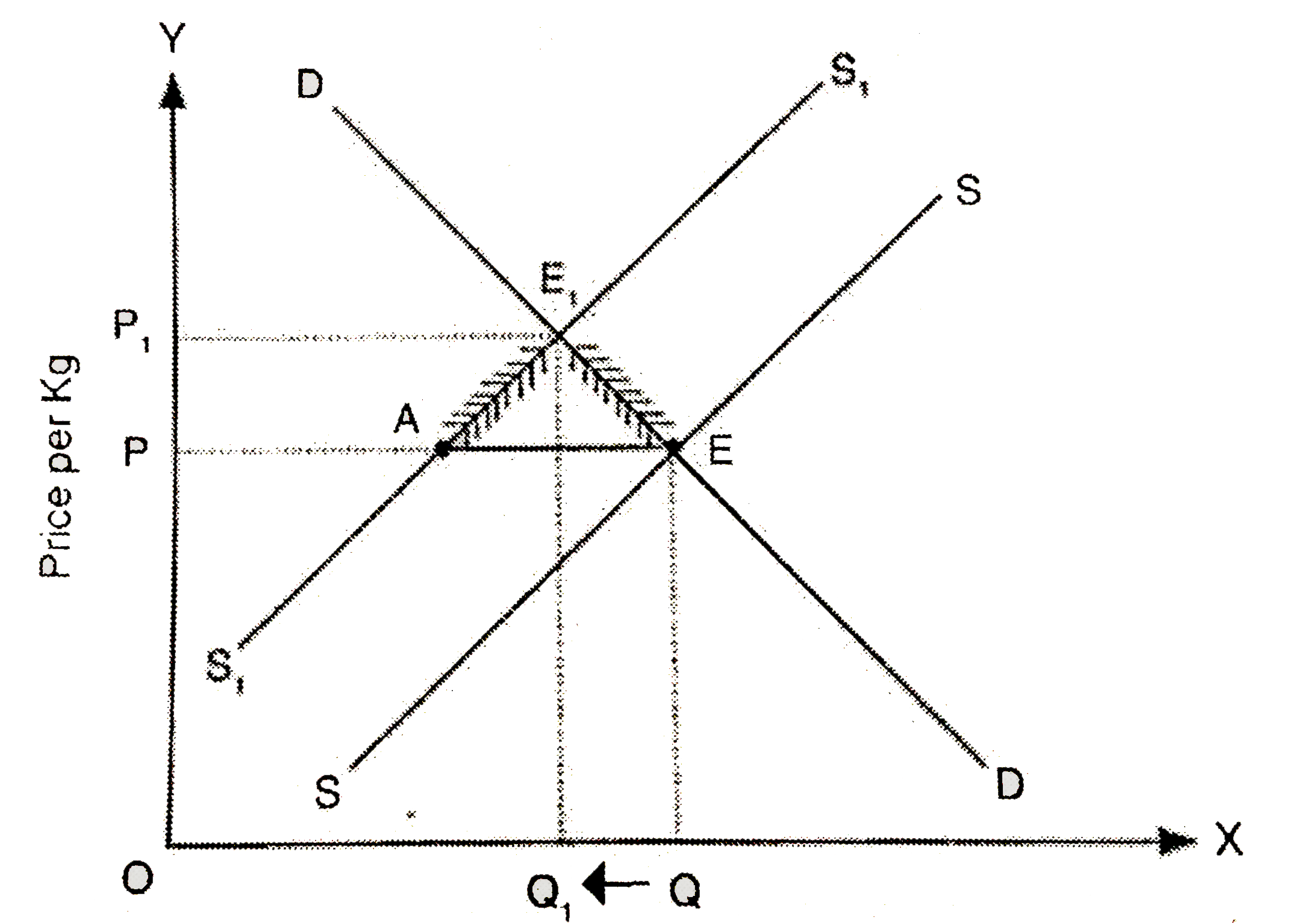

When the tomato crop was damaged in Himachal the supply of tomato decreases. This means that the supply curve shifts leftward to `S_(1)S_(1)`. At the prevalling market price (OP), there was an excess demand of AE. In this situation, buyers would competed to raise the market price. As market price would have risen, quantity demanded to tomatoes would have contracted and the quantity supplied would have expanded. This process would have continued till a new equilibrium price was reached at `OP_(1)`, where market demand is equal to market supply. `OP_(1)` is higher thanthe old price to tomatoes. This explains how prices in Delhi rose when the tomato crop got damaged in Himachal.
Promotional Banner

Topper's Solved these Questions

  • DEMAND AND ITS DETERMINANTS

    SANDEEP GARG|Exercise Model test paper 1|12 Videos
  • DEMAND AND ITS DETERMINANTS

    SANDEEP GARG|Exercise Model test paper 2|12 Videos
  • DEMAND

    SANDEEP GARG|Exercise Unsolved particles|4 Videos
  • ELASTICITY OF DEMAND

    SANDEEP GARG|Exercise Unsolved practicals|79 Videos

Similar Questions

Explore conceptually related problems

The immediate challenge is on the food front. Shortfalls in production have been allowed to affect supplies and hence prices. The Government is planning to focus on investment in irrigation and even revival of agricultural extension system. What is probably needed is a fresh dose of Green Revolution strategy. It appears that the Green Revolution instruments to encourage farmers to invest are no longer effective. The Green Revolution strategy was based on the state taking out the risk of collapse in prices. Farmers were offered remunerative prices and a guaranteed procurement of their produce in case the open market could not absorb it Farmers could then borrow from banks, acquire the Green Revolution Technology and produce as much as they could. The pressure on the food subsidy was manageable as long as there was a food shortage. Prices in the open market then tended to be above the procurement prices. But with the food surpluses the situation has changed. The situation was unsustainable not merely because of the magnitude of this subsidy. It was also inefficient. It meant farmers were being led to produce crops based just on the prices Government fixed and not in relation to any real demand. In these circumstances, the Government was reluctant to keep increasing procurement prices at the pace that used to be the norm in earlier years. Inference : As the open market prices are lower, all the burden of procurement of crops is on the Government. 1) If the inference is definitely true' i.e. it properly follows from the statement of facts given. 2) if the inference is probably true though not definitely true' in the light of the facts given. 3) If the data are inadequate, le from the facts given you cannot say whether the inference is likely to be true or false 4) If the inference is probably false", though not definitely false' in the light of the facts given.

