Home
Class 9
MATHS
If bisectors of angleA and angleB of a ...

If bisectors of `angleA and angleB ` of a quadrilateral ABCD intersect each other at P, of `angleB and angleC` at Q, of `angleC and angleD` at R and of `angleD and angleA` at S, then PQRS is a

A

rectangle

B

rhombus

C

parallelogram

D

quadrilateral whose opposite angles are supplementary

Text Solution

Verified by Experts

The correct Answer is:
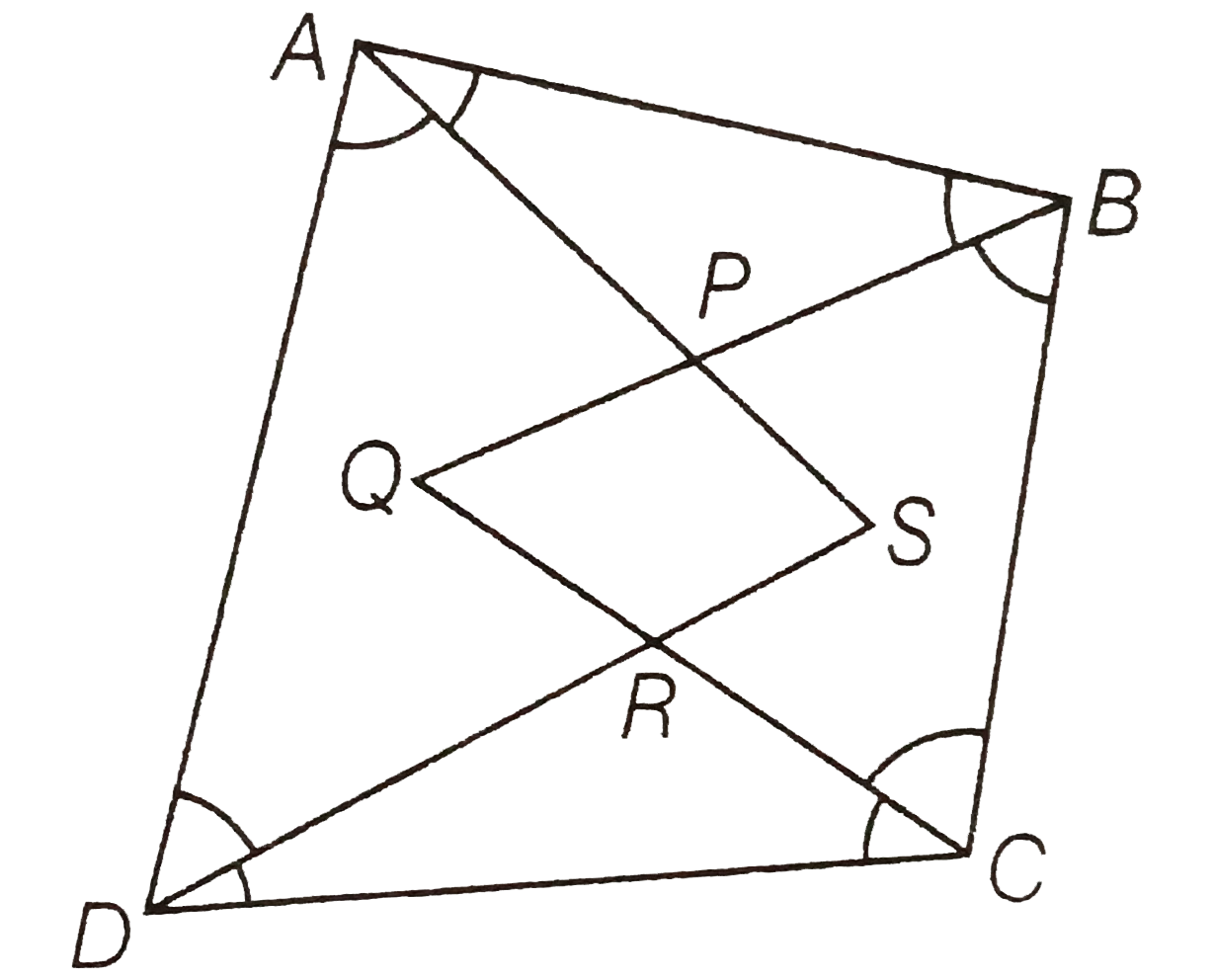
D

Given, ABCD is a quadrilateral and all angles bisectors form a quadrilateral PQRS.
ltBrgt We know that, sum of all angles in a quadrilateral is `360^(@)`.

`therefore" "angleA+angleB+angleC+angleD=360^(@)`
On dividing both sides by 2, we get
`(1)/(2)(angleA+angleB+angleC+angleD)=(360^(@))/(2)` ltBrgt `rArr" "anglePAB+anglePBA+angleRCD+angleRDC=180^(@)" "...(i)`
[since, AP and PB are the bisectors of `angleA and angleB` respectively also RC and RD are the bisectors of `angleC and angleD` respectively]
Now, in `Delta`APB, ltBrgt `" "anglePAB+angleABP+angleBPA=180^(@)`
`" "` [by angle sum properly of a triangle]
`rArr" "anglePAB+angleABP=180^(@)-angleBPA" "...(ii)`
Similarly in `Delta`RDC, ltBrgt `angleRDC+angleDCR+angleCRD=180^(@)` ltBrgt `" "` [by angle sum property of a triangle]
`rArr" "angleRDC+angleDCR=180^(@)-angleCRD" "...(iii)`
On substituting the value Eqs. (ii) and (iii) in Eq. (i), we get ltBrgt `180^(@)-angleBPA+180^(@)-angleDRC=180^(@)`
`rArr" "angleBPA+angleDRC=180^(@)` ltBrgt `rArr" " angleSPQ+angleSRQ=180^(@)`
`" "[becauseangleBPA=angleSPQandangleDRC=angleSRQ` vertically opposite angles]
Hence, PQRS is a quadrilateral whose opposite angles are suppolementary.
Promotional Banner

Topper's Solved these Questions

  • POLYNOMIALS

    NCERT EXEMPLAR|Exercise Polynomials|72 Videos
  • STATISTICS AND PROBABILITY

    NCERT EXEMPLAR|Exercise LONG ANSWER TYPE QUESTIONS|5 Videos

Similar Questions

Explore conceptually related problems

If bisectors of angle A and angle B of a quadrilateral ABCD intersect each other at P, of angle B and angle C " at " Q, " of " angle C and angle D " at R and of " angle D and angle A at S then PQRS is a

Bisectors of angles A and D of a quadrilateral ABCD meet at P. Prove that angleAPD=(1)/(2)(angleB+angleC)

Diagonals of a quadrilateral ABCD bisect each other. If angleA=35^(@), determine angleB .

In a quadrilateral ABCD the linesegment bisecting angleC and angleD meet at E. Prove that angleA+angleB=2angleCED.

BO and CO are external bisector of angleB and angleC of triangle ABC intersecting at O. If internal bisector of angleB and angleC intersect at P, prove that anglePBO=90^@ and angleBOC+angleBPC=180^@

AB and CD are respectively the smallest and largest sides of a quadrilateral ABCD. Show that angleA gt angleC and angleB gt angleC .

In a triangleABC ,if 2angleA=3angleB=6angleC calculate angleA,angleB and angleC

BO and CO are external bisector of angleB and angleC of triangle ABC intersecting at O. If angleA=60^@, angleABC=70^@ , Find angleBOC

BO and CO are external bisector of angleB and angleC of triangle ABC intersecting at O. If angleA=60^@, angleABC=70^@ , Find angleBOC

If angleA and angleB are supplementary angles. If 4angleA=5angleB , then find angleA and angleB .

NCERT EXEMPLAR-QUADRILATERALS -Quadrilaterals
  1. The quadrilateral formed by joining the mid-points of the side for qu...

    Text Solution

    |

  2. If angles A, B, C and D of the quadrilateral ABCD, taken in order are ...

    Text Solution

    |

  3. If bisectors of angleA and angleB of a quadrilateral ABCD intersect e...

    Text Solution

    |

  4. If APB and CQD are two parallel lines, then the bisectors of the angl...

    Text Solution

    |

  5. The figure obtained by joining the mid-points of the sides of a rhombu...

    Text Solution

    |

  6. D and E are the mid-points of the sides AB and AC of DeltaABC and O is...

    Text Solution

    |

  7. The figure formed by joining the mid-points of the sides of a quadrila...

    Text Solution

    |

  8. The diagonals AC and BD of a parallelogram ABCD intersect each other a...

    Text Solution

    |

  9. Which of the following is not true for a parallelogram ?

    Text Solution

    |

  10. D and E are the mid-points of the side AB and AC, respectively, of Del...

    Text Solution

    |

  11. Diagonals AC and BD of a parallelogram ABCD intersect each other at O....

    Text Solution

    |

  12. Diagonals of a parallelogram are perpendicular to each other. Is this ...

    Text Solution

    |

  13. Can the angles 110^(@), 80^(@), 70^(@) and 95^(@) be the angles of a q...

    Text Solution

    |

  14. In quadrilateral ABCD, angleA+angleD= 180^(@). What special name can b...

    Text Solution

    |

  15. All the angles of a quadrilateral are equal. What special name is give...

    Text Solution

    |

  16. Diagonals of a rectangle are equal and perpendicular. Is this statemen...

    Text Solution

    |

  17. Can all the four angles of a quadrilateral be obtuse angles ? Give rea...

    Text Solution

    |

  18. In DeltaABC, AB = 5cm , BC = 8 cm and CA = 7cm. If D and E are respect...

    Text Solution

    |

  19. In the figure, it is given that BDEF and FDCE are parallelogram. Can y...

    Text Solution

    |

  20. In figure, ABCD and AEFG are two parallelograms. If angleC = 55^(@), ...

    Text Solution

    |
