

Home
Class 9
MATHS
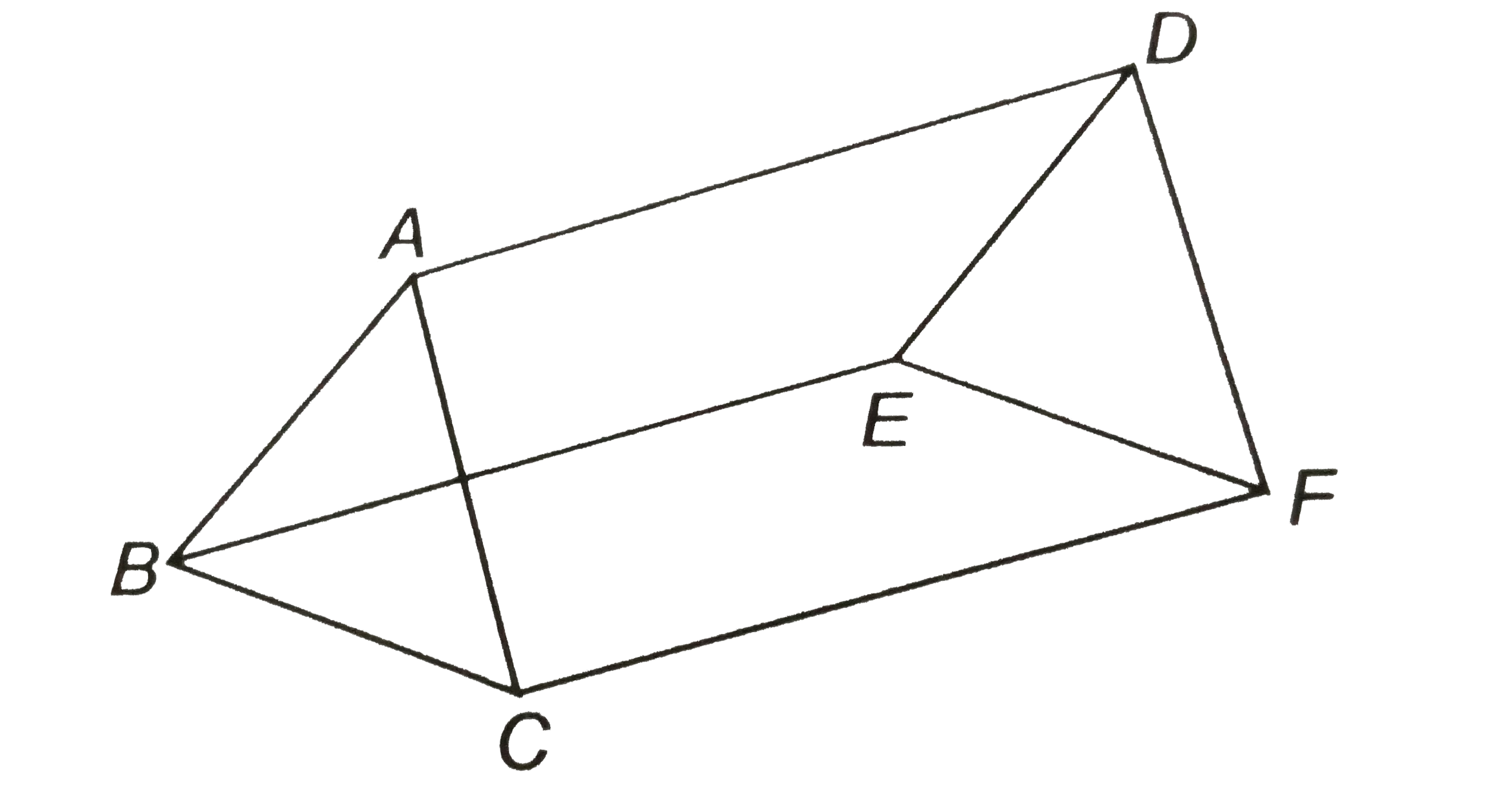
In figure, AB||DE, AB=DE, AC||DF and AC=...

In figure, AB||DE, AB=DE, AC||DF and AC=DF. Prove that BC||EF and BC=EF.

Text Solution

Verified by Experts

Given In figure AB||DE and AC||DF, also AB=DE and AC=DF
To prove `" "BC||EF and BC=EF`
Proof In quadrilateral ABED,
`" "AB||DE and AB=DE`
So, ABED is a parallelogram.
`therefore" "AD||BE and AD=BE" "...(i)`
Now, in quadrilateral ACFD,
`" "AC||FD and AC=FD`
Thus, ACFD is a parallelogram.
`therefore" "AD||CF and AD=CF" "...(ii)`
From Eqs. (i) and (ii),
`" "AD=BE=CF and CF||BE" "...(iii)`
Now, in quadrilateral BCFE,
`" "BE=CF" "`
and `" "BE||CF" "` [from Eq. (iii)]
So, BCFE is a parallelogram.
`therefore" " BC=EF and BC||EF " "` Hence proved.
Promotional Banner

Topper's Solved these Questions

  • POLYNOMIALS

    NCERT EXEMPLAR|Exercise Polynomials|72 Videos
  • STATISTICS AND PROBABILITY

    NCERT EXEMPLAR|Exercise LONG ANSWER TYPE QUESTIONS|5 Videos

Similar Questions

Explore conceptually related problems

In Figure,AC=AE,AB=AD and /_BAD=/_EAC Prove that BC=DE

In the given figure. AB"||"DE , AB=DE , AC"||"DF and AC=DF .Then which of the following is correct.

In the given figure, if DE||AQ and DF||AR. Prove that EF||QR.

It is given figure, AB||DE|| and BD||EF . Prove that DC^(2)=CFxxAC .

In the given figure, AC=AE, AB=AD and angleBAD=angleEAC . Prove that BC=DE .

In Figure DE|BC and CD|EF. Prove that AD^(2)=ABxAF.

In figure, DE || AC and DF || AE. Prove that (B F)/(F E)=(B E)/(E C) .

In the adjoining figure, AB=EF, BC=DE, angleABC=angleFED=90^(@) , prove that AD = CF .

In the given figure DE || AC and (BE)/(EC)=(BC)/(CP) . Prove that DC || AP.

In Figure DE|AC and DC| ap.Prove that (BE)/(EC)=(BC)/(CP)

NCERT EXEMPLAR-QUADRILATERALS -Quadrilaterals
  1. Points P and Q have been taken on opposite sides AB and CD, respective...

    Text Solution

    |

  2. In figure, P is the mid-point of side BC of a parallelogram ABCD such ...

    Text Solution

    |

  3. A square is incribed in an isoceles right triangle, so that the square...

    Text Solution

    |

  4. In a parallelogram ABCD, AB = 10 cm and AD = 6 cm. The bisector of ang...

    Text Solution

    |

  5. P, Q , R and S are respectively the mid-points of the sides AB, BC, C...

    Text Solution

    |

  6. ABCD is a rhombus and P, Q, R and S are wthe mid-points of the sides A...

    Text Solution

    |

  7. P, Q, R and S are respectively the mid-points of sides AB, BC, CD and ...

    Text Solution

    |

  8. If diagonal of a parallelogram bisects one of the angles of the parall...

    Text Solution

    |

  9. ABCD is a parallelogram in which P and Q are mid-points of opposite...

    Text Solution

    |

  10. ABCD is a quadrilateral in which AB||DC and AD = BC. Prove that angleA...

    Text Solution

    |

  11. In figure, AB||DE, AB=DE, AC||DF and AC=DF. Prove that BC||EF and BC=E...

    Text Solution

    |

  12. In A B C ,A D is the median through A and E is the mid-point of A D. ...

    Text Solution

    |

  13. The quadrilateral, formed by joining the mid-points of the sides of a ...

    Text Solution

    |

  14. In Figure, A B C D isa trapezium in which side A B is a parallel to si...

    Text Solution

    |

  15. The quadrilateral formed by the bisectors of the angles of a parallelo...

    Text Solution

    |

  16. P and Q are points on opposite sides AD and BC of a parallelogram ABCD...

    Text Solution

    |

  17. ABCD is a rectangle in which diagonal BD bisects angle B. then ABCD is...

    Text Solution

    |

  18. In DeltaA B C, D, E and F are respectively the mid-points of sides AB...

    Text Solution

    |

  19. Prove that the line segment joining the mid-points of the diagonals of...

    Text Solution

    |

  20. P is the mid-point of the side CD of a parallelogram ABCD. A line thro...

    Text Solution

    |