

Home
Class 11
PHYSICS
A penguin of mass m stands at the right ...

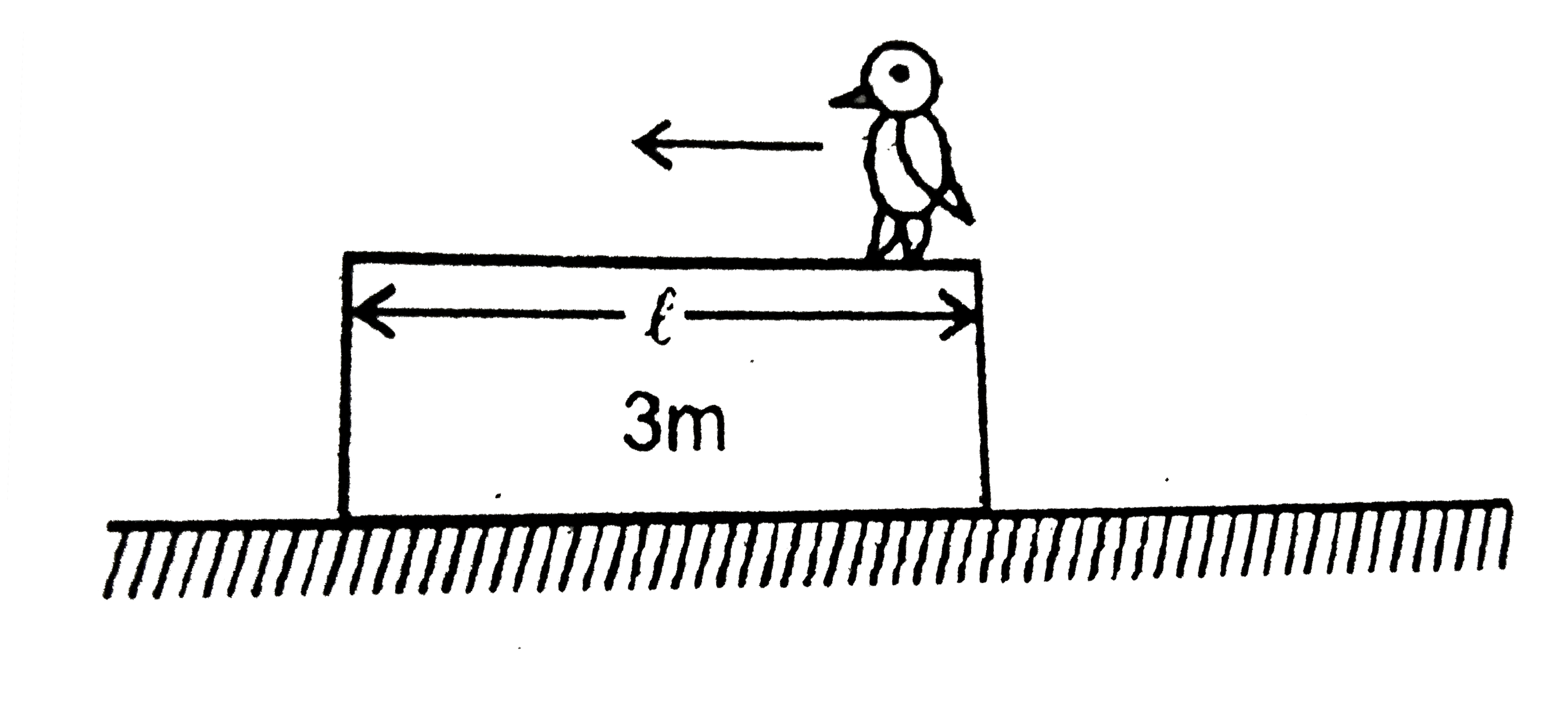
A penguin of mass `m` stands at the right edge of a sled of mass `3m` and length `l`. The sled lies on frictionless ice. The penguin starts moving towards left,reaches the left end and jumps with a velocity `u` and at an angle `theta` relative to ground. `(` Neglect the height of the sled `)`

Promotional Banner

Similar Questions

Explore conceptually related problems

A man of mass m is standing at one end of a trolley of mass M and length L placed at rest on a smooth horizontal surface. The man starts moving towards the other end and covers distance L, then distance moved by man w.r.t ground is

A man of mass m is standing at one end of a trolley of mass Mand length L placed at rest on a smooth horizontal surface. The man starts moving towards the other end and covers distance L, then distance moved by man w.r.t ground is

A man of mass M stands at one end of a plank of length L which lies at rest on a frictionless surface. The man walks to the other end of the planck. If the mass of the planck is M/2 , then the distance that the man moves relative to the ground is

A man of mass m is standing at one end of of a plank of mass M. The length of the plank is L and it rests on a frictionless horizontal ground. The man walks to the other end of the plank. Find displacement of the plank and man relative to the ground.

A man of mass M stands at one end of a plank of length L Which lies at rest on a frictionless surface . The man walks to the other end of the plank. If the mass of the plank is 3M, the distance that the man moves relative to the ground is

A man of mass M stands at one end of a plank of length L Which lies at rest on a frictionless surface . The man walks to the other end of the plank. If the mass of the plank is 3M, the distance that the man moves relative to the ground is

A man of mass m stands at the left end of a uniform plank of length L and mass M, which lies on a frictionaless surface of ice. If the man walks to the other end of the plank, then by what distance does the plank slide on the ice?

A man of mass m stands at the left end of a uniform plank of length L and mass M, which lies on a frictionaless surface of ice. If the man walks to the other end of the plank, then by what distance does the plank slide on the ice?

A man of mass m stands at the left end of a uniform plank of length L and mass M, which lies on a frictionaless surface of ice. If the man walks to the other end of the plank, then by what distance does the plank slide on the ice?