

Home
Class 12
PHYSICS
Two identical thin isosceles prims of re...

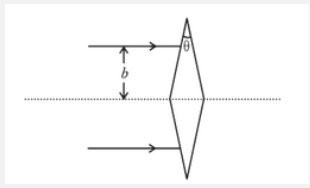
Two identical thin isosceles prims of refracting angle `theta` and refractive index `mu` are placed with their bases touching each other. A parallel beam , of width 2b, is incident on this system , as shown. The distance of the point of convergence from the prism is

Promotional Banner

Similar Questions

Explore conceptually related problems

Two identical thin isosceles prisms of refracting angle A and refractive index mu are placed with their bases touching each other and this system can collectively act as a crude converging lens. A parallel beam of light is incident on this system as shown in Figure. Find the focal length of this so called converging lens.

Two isosceles prism of prism angle A and refractive index mu are placed with their bases touching each other. This system can act as a crude converging lens. The focal length of the lens for A=10^(@),mu=1.5 and a ray of light incident on a prims at a height of 1 cm from its base, is approximately.

An isosceles prism of angle 120degree has a refractive index 1.44. Two parallel monochromatic rays enter the prism parallel to each other in air as shown. The rays emerge from the opposite faces

A clear transparent glass sphere (mu=1.5) of radius R is immersed in a liquid of refractive index 1.25. A parallel beam of light incident on it will converge to a point. The distance of this point from the center will be

A prism having refractive index sqrt2 and refractive angle 30^@ has one of the refractive surfaces polished. A beam of light incident on the other surfaces will trace its path if the angle of incidence is

For an angle of incidence theta on an equilateral prism of refractive index sqrt(3) , the ray refracted is parallel to the base inside the prism. The value of theta is

A prism having refractive index sqrt(2) and refracting angle 30^(@) , has one of the refracting surfaces polished. A beam of monochromatic light incident on the other refracting surface will retrace its path if the angle of incidence is

A thin prism of refracting angle 2^@ deviates an incident ray through an angle of 1^@ .Find the value of refractive index of material of prism.

A prism of apex angle A=60^@ has the refractive index mu=sqrt2. The angle of incidence for minimum deviation is

The refractive index of a prism is mu . Find the maximum angle of the prism for which a ray incident on it will be transmitted through other face without total internal reflection.