Home
Class 12
PHYSICS
Shown in the figure is a prism of angle...

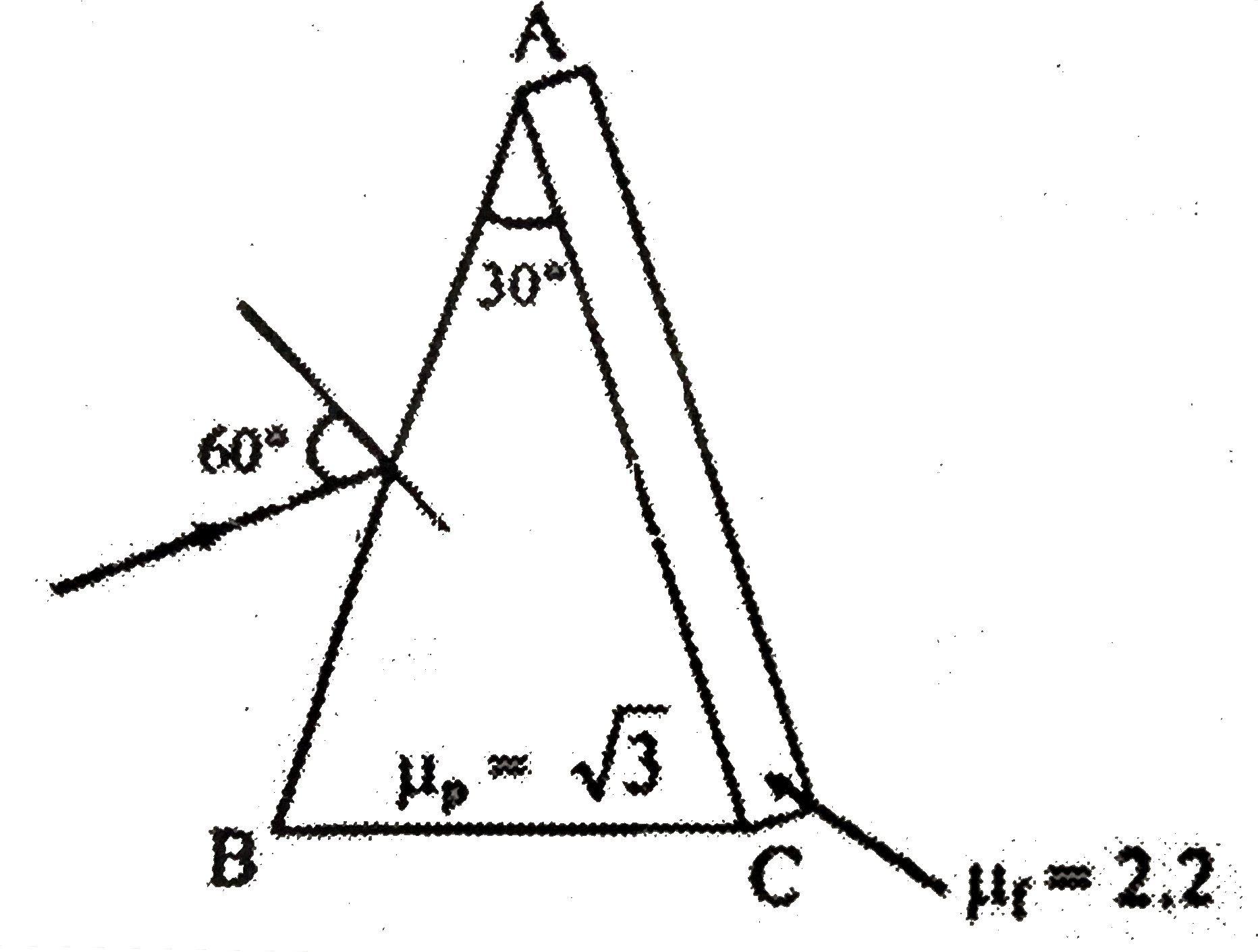
Shown in the figure is a prism of angle `30^(@)` and refractive index `mu_(p)=sqrt(3)`. Face AC of the prism is covered with a thin film of refractive index `mu_(f)=2.2 ` A monochromatic light of wavelength `lambda` =550 nm fall on the face AB at an angle of incidence of `60^(@)` Calculate angle of emergence

A

`0^(@)`

B

`30^(@)`

C

`45^(@)`

D

Not emerge

Text Solution

Verified by Experts

The correct Answer is:

1

"From snell's on AB"
`sin 60^(@) =musinr_(1)rArr(sqrt(3))/(2) = sqrt(3) sin r_(1) or r_(1) = 30 ^(@)`
`therefore r_(2)=A-r_(1)=0`
"therefore ray incident normally on AC and passes normally"
Promotional Banner

Topper's Solved these Questions

  • MOCK TEST 9

    CAREER POINT|Exercise CHEMISTRY|30 Videos
  • MOCK TEST 8

    CAREER POINT|Exercise Part (B) -CHEMISTRY|28 Videos
  • PRACTICE TEST - 5

    CAREER POINT|Exercise PHYSICS|45 Videos

Similar Questions

Explore conceptually related problems

A prism of apex angle A=60^@ has the refractive index mu=sqrt2. The angle of incidence for minimum deviation is

Light ray is incident on a prism of angle A=60^(@) and refractive index mu=sqrt(2) .the angle of incidence at which the emergent ray grazes the surface is given by

Light ray is incident on a prism of angle A=60^(@) are refractive index mu=sqrt(2) . The angle of incidence which the emergent rays grazes the surface is given

A prism is shown in the figure with prism angle 75^(@) and refractive index sqrt(3) . A light ray incidents on a surface at incident angle theta . Other face is coated with a medium of refractive index n. for theta le 60^(@) ray suffers total internal reflection find value of n^(2) .

A ray of light is incident normally on one of the faces of a prism of apex angle 30^(@) and refractive index sqrt(2) . The angle of deviation through prism is

The refracting angle of the prism is 60^@ and the refractive index of the material of the prism is sqrt(3) . Calculate the angle of minimum deviation in degree.

The angle of prism is 60^(@) and its refractive index is 1.5. There will be no emergent light if the angle of incidence on the first face is

A prism of a refracting angle 60^(@) is made with a material of refractive index mu . For a certain wavelength of light, the angle of minimum deviation is 30^(@) . For this wavelength, the value of mu of material is

ACB is right-angled prism with other angles as 60^(@) and 30^(@) . Refractive index of the prism is 1.5. AB has thin layer of liquid on it as shown. Light falls normally on the face Ac. For total internal reflection, maximum refractive index of the liquid is

CAREER POINT-MOCK TEST 9-CHEMISTRY
  1. Shown in the figure is a prism of angle 30^(@) and refractive index m...

    Text Solution

    |

  2. If uncertainty in position and momentum are equal then uncertainty in ...

    Text Solution

    |

  3. Hydrolysis of one mole of peroxodisulphuric acid produces

    Text Solution

    |

  4. Which one of the following is an inner orbital complec as well as diam...

    Text Solution

    |

  5. In which of the following compound is hydroxylic proton the most acidi...

    Text Solution

    |

  6. The correct name of the structure

    Text Solution

    |

  7. The gold numbers of protective colloids A,B,C and D are 0.04, 0.004 , ...

    Text Solution

    |

  8. In a solid, oxide ions are arranged in ccp, cations 'A' occupy one six...

    Text Solution

    |

  9. Delta(r)U^(@) of formation of CH(4) (g) at certain temperature is - 3...

    Text Solution

    |

  10. Which of the following statements is incorrect ? Standard Gibbs free e...

    Text Solution

    |

  11. Calculate Osmotic Pressure of a solution obtained on mixing 100 mL of ...

    Text Solution

    |

  12. Monomer related to Nylon 26 is

    Text Solution

    |

  13. Arrange in increasing order of solubility of AgBr in solutions given ...

    Text Solution

    |

  14. Green house gases are-

    Text Solution

    |

  15. In which process maximum energy is released ?

    Text Solution

    |

  16. M(g)rarrM(g)^(+)+e^(-),DeltaH1=100 KJ//mol M(g)rarrM(g)^(+2)+2e^(-),...

    Text Solution

    |

  17. Which of the following in non linear

    Text Solution

    |

  18. The quantity [PV/kT] represent

    Text Solution

    |

  19. When the concentration of alkyl halide is triple and concentration of ...

    Text Solution

    |

  20. Product:

    Text Solution

    |

  21. Which of the following reaction is possible ?

    Text Solution

    |
