Home
Class 12
MATHS
Through the centriod of an equilateral t...

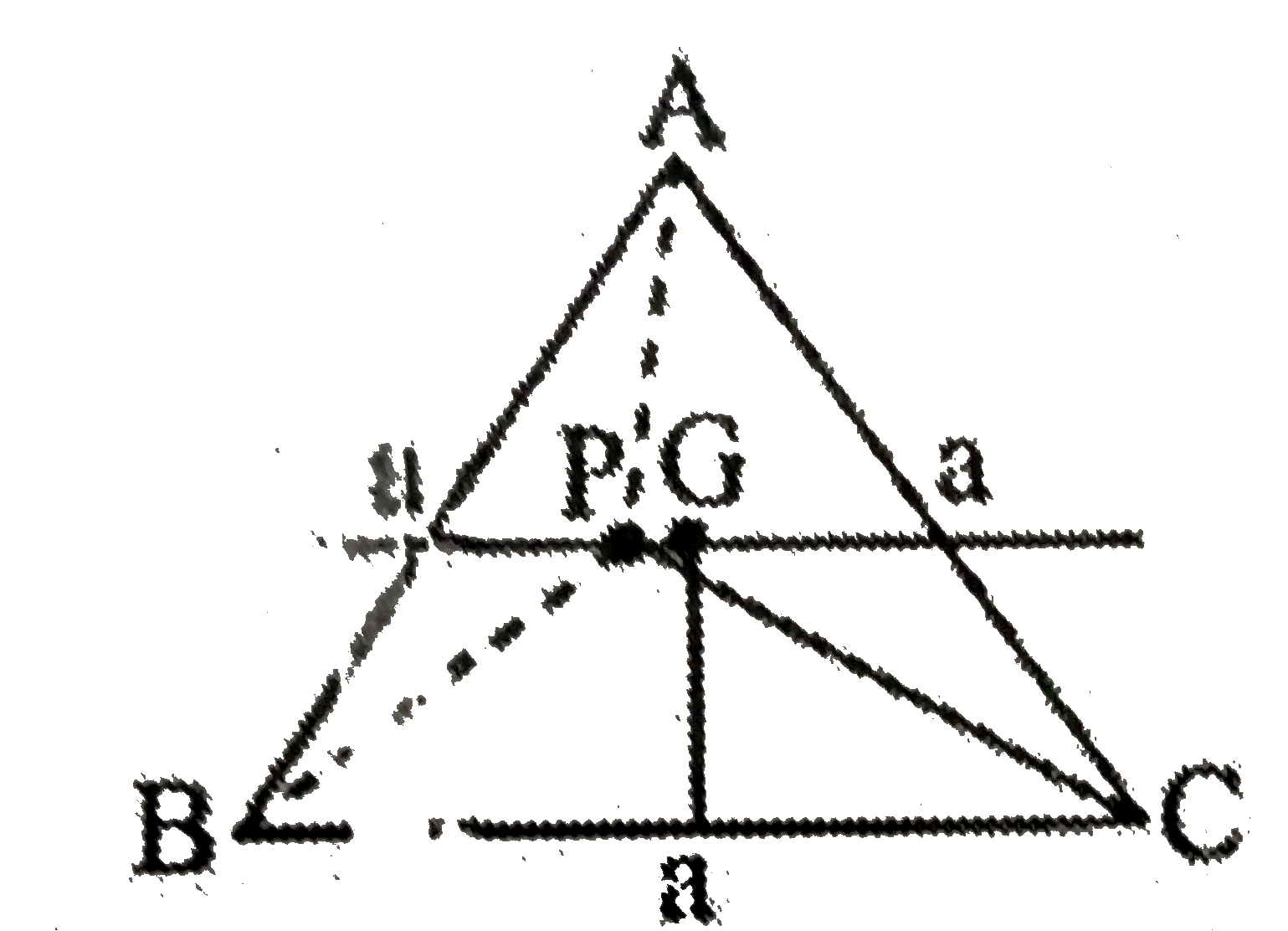
Through the centriod of an equilateral triangle a line parallel to the base is drawn. On this line, an arbitary point P is taken inside the triangle. Let h denote the distahce of P from the base of the triangle. Let `h_(1) and h_(2)` be the distance of P from the other two sides of the triangle, then

A

h is the H.M of `h_(1), h_(2)`

B

h is the G.M of `h_(1), h_(2)`

C

h is the A.M of `h_(1), h_(2)`

D

None of these

Text Solution

Verified by Experts

The correct Answer is:
3


`Delta ABC = Delta PAB +Delta PBC + DeltaPAC`
`(1)/(2)xxaxx(3h)=(1)/(2)ah_(1)+(1)/(2)ah+(1)/(2)ah_(2)`
`rArr h = (h_(1)+h_(2))/(2)`
Promotional Banner

Topper's Solved these Questions

  • MOCK TEST 8

    CAREER POINT|Exercise PART (C ) - MATHS|30 Videos

Similar Questions

Explore conceptually related problems

Through the centroid of an equilateral triangle, a line parallel to the base is drawn. On this line, an arbitrary point P is taken inside the triangle. Let h denote the perpendicular distance of P from the base of the triangle. Let h_(1) and h_(2) be the perpendicular distance of P from the other two sides of the triangle . Then :

A point P is inside an equilateral triangle if the distance of P from sides 8,10,12 then the length of the side of the triangle is

If the base of an isosceles triangle is of length 2a and the length of altitude dropped to the base is h then the distance from the midpoint of the base to the side of the triangle is

Prove that a line drawn from the vertex of a triangle to its base is bisected by the line joining the mid points of the remaining two sides of the triangle.

If the base of an Isosceles triangle is of length 2P and the length of the altitude dropped to the base is q .Then the distance from the midpoint of the base to the side of the triangle is

A point 'P' is an arbitrary interior point of an equilateral triangle of side 4. If x, y, z are the distances of 'P' from sides of the triangle then the value of (x+y+z)^(2) is equal to -

CAREER POINT-MOCK TEST 9-MATHS
  1. Find the greatest value of the term independent of x in the expansion ...

    Text Solution

    |

  2. The polynomial f(x)=x^4+a x^3+b x^3+c x+d has real coefficients and f(...

    Text Solution

    |

  3. If b^(2) -ac lt 0 and a gt 0 then the value of the determinant is

    Text Solution

    |

  4. The probability that sin^(-1)(sin x)+cos^(-1)(cos y) is an integer x, ...

    Text Solution

    |

  5. If the points P(alpha,0) and Q(0,beta) always lies inside sthe Delta f...

    Text Solution

    |

  6. The equation of the hyperbola whose foci are (6.5), (-4,5) and eccentr...

    Text Solution

    |

  7. The value of the definite integral int(0)^(3pi//4)(1+x)sin x+(1-x) cos...

    Text Solution

    |

  8. The value of the constant 'm' and 'c' for which y = mx + c is a soluti...

    Text Solution

    |

  9. Through the centriod of an equilateral triangle a line parallel to the...

    Text Solution

    |

  10. If the number of ways of selecting 3 numbers out of 1, 2, 3, ……., 2n+1...

    Text Solution

    |

  11. If alpha and beta "are the roots of the quadratic equation" ax^(2) ...

    Text Solution

    |

  12. If log(2)(5.2^(x)+1),log(4)(2^(1-x)+1) and 1 are in A.P,then x equals

    Text Solution

    |

  13. The matrix A={:[((1)/(sqrt(2)),(1)/(sqrt(2))),((-1)/(sqrt(2)),(-1)/(sq...

    Text Solution

    |

  14. In Delta ABC with usual notation r1/(bc)+r2/(ca)+r3/(ab) is

    Text Solution

    |

  15. If bar(OA)= hat(i) +3hat(J)-2hat(K), "then" bar(OC) which bisects the ...

    Text Solution

    |

  16. The tangent to the curve y=e^x drawn at the point (c,e^c) intersects t...

    Text Solution

    |

  17. The system of equation |z+2-2i|=4 and |z|=1 has -

    Text Solution

    |

  18. The sides of a triangle ABC lie on the lines 3x + 4y = 0, 4x +3y =0 a...

    Text Solution

    |

  19. y=f(x) is a function which satisfies f(0)=0, f"''(x)=f'(x) and f'(0)=1...

    Text Solution

    |

  20. The function f(x) = alphax^(2) -beta(x) -4x^(3)+(gamma) " where" alpha...

    Text Solution

    |

