Home
Class 12
MATHS
The tangent to the curve y=e^x drawn at ...

The tangent to the curve `y=e^x` drawn at the point `(c,e^c)` intersects the line joining `(c-1,e^(c-1)) and (c+1,e^(c+1))` (a) on the left of `n=c` (b) on the right of `n=c` (c) at no points (d) at all points

A

on the left of x= c

B

on the right of x=c

C

at no point

D

at all points

Text Solution

Verified by Experts

The correct Answer is:
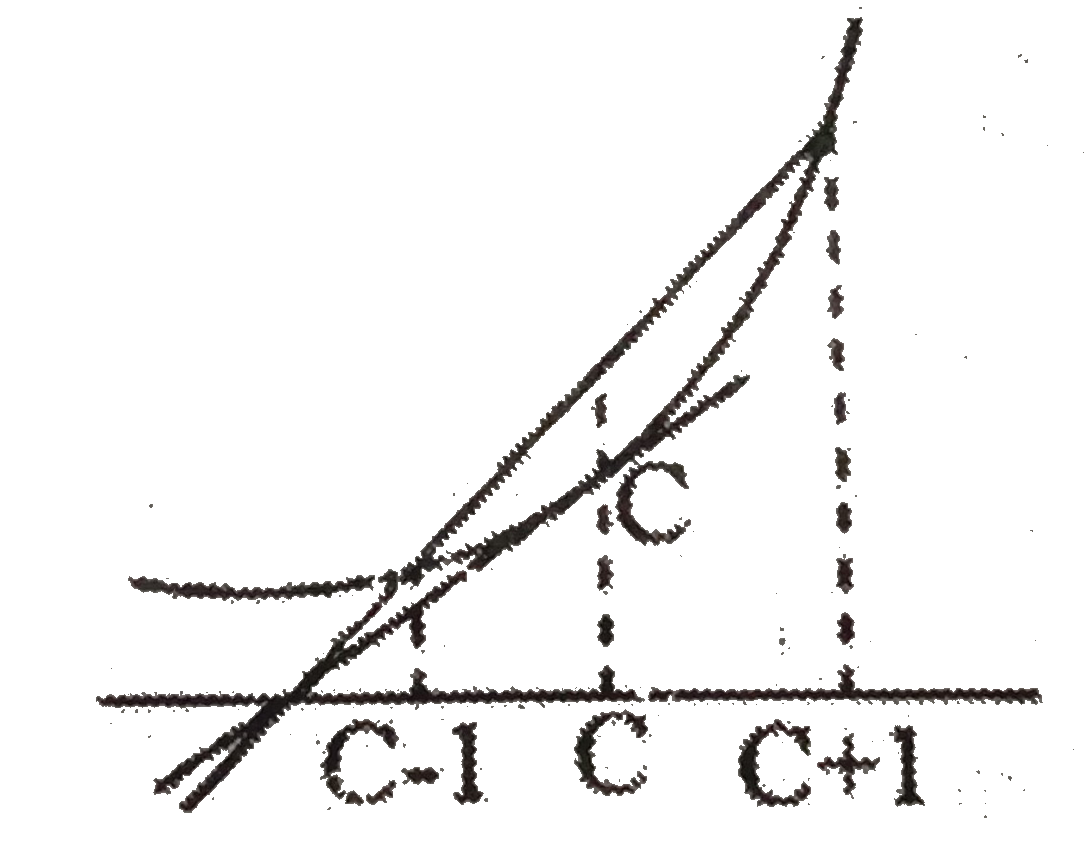
1

`y=e^(x) rArr (dy)/(dx) = e^(x)`
`therefore "Tangent at" A(c,e^(c )) is `
`y-e^(c ) = e^(c )(x-c)`
`i.e, y = xe^(c )+e^(c )-ce^(c )`
Line PQ is
`y-e^(c-1)=(e^(c+1)-e^(c-1))/((c+1)-(c-1))(x-c-1))`
soliving (i) and (ii)
`x=c+(e^(2)-2e+1)/(-e^(2)+2e+1) lt c`
"therefore Tangent metts the line PQ on the left of" x=c
"A litter: From the graph"
Promotional Banner

Topper's Solved these Questions

  • MOCK TEST 8

    CAREER POINT|Exercise PART (C ) - MATHS|30 Videos

Similar Questions

Explore conceptually related problems

If the tangent to the curve , y =f (x)= x log_(e)x, ( x gt 0) at a point (c, f(c)) is parallel to the line - segment joining the point (1,0) and (e,e) then c is equal to :

If the tangent to the curve y= e^x at a point (c, e^c) and the normal to the parabola, y^2 = 4x at the point (1,2) intersect at the same point on the x-axis then the value of c is ____________.

The line joining the points (0,3) and (5,-2) becomes tangent to the curve y=c/(x+1) then c=

When the tangent to the curve y=xlogx is parallel to the chord joining the points (1, 0) and (e ,\ e) , the value of x is e^(1//1-e) (b) e^((e-1)(2e-1)) (c) e^((2e-1)/(e-1)) (d) (e-1)/e

If the line joining the points (0,3) and (5,-2) is a tangent to the curve y=(C)/(x+1), then the value of c is 1(b)-2(c)4(d) none of these

Find value of c such that line joining the points (0, 3) and (5, -2) is a tangent to curve y=c/(x+1)

Five boys A, B, C, D, E are in a row. A is on the right of B, E is on the left of B but on the right of C and A is on the left of D. Who is second from the left?

If the line y=x touches the curve y=x^2+b x+c at a point (1,\ 1) then b=1,\ c=2 (b) b=-1,\ c=1 (c) b=2,\ c=1 (d) b=-2,\ c=1

CAREER POINT-MOCK TEST 9-MATHS
  1. Find the greatest value of the term independent of x in the expansion ...

    Text Solution

    |

  2. The polynomial f(x)=x^4+a x^3+b x^3+c x+d has real coefficients and f(...

    Text Solution

    |

  3. If b^(2) -ac lt 0 and a gt 0 then the value of the determinant is

    Text Solution

    |

  4. The probability that sin^(-1)(sin x)+cos^(-1)(cos y) is an integer x, ...

    Text Solution

    |

  5. If the points P(alpha,0) and Q(0,beta) always lies inside sthe Delta f...

    Text Solution

    |

  6. The equation of the hyperbola whose foci are (6.5), (-4,5) and eccentr...

    Text Solution

    |

  7. The value of the definite integral int(0)^(3pi//4)(1+x)sin x+(1-x) cos...

    Text Solution

    |

  8. The value of the constant 'm' and 'c' for which y = mx + c is a soluti...

    Text Solution

    |

  9. Through the centriod of an equilateral triangle a line parallel to the...

    Text Solution

    |

  10. If the number of ways of selecting 3 numbers out of 1, 2, 3, ……., 2n+1...

    Text Solution

    |

  11. If alpha and beta "are the roots of the quadratic equation" ax^(2) ...

    Text Solution

    |

  12. If log(2)(5.2^(x)+1),log(4)(2^(1-x)+1) and 1 are in A.P,then x equals

    Text Solution

    |

  13. The matrix A={:[((1)/(sqrt(2)),(1)/(sqrt(2))),((-1)/(sqrt(2)),(-1)/(sq...

    Text Solution

    |

  14. In Delta ABC with usual notation r1/(bc)+r2/(ca)+r3/(ab) is

    Text Solution

    |

  15. If bar(OA)= hat(i) +3hat(J)-2hat(K), "then" bar(OC) which bisects the ...

    Text Solution

    |

  16. The tangent to the curve y=e^x drawn at the point (c,e^c) intersects t...

    Text Solution

    |

  17. The system of equation |z+2-2i|=4 and |z|=1 has -

    Text Solution

    |

  18. The sides of a triangle ABC lie on the lines 3x + 4y = 0, 4x +3y =0 a...

    Text Solution

    |

  19. y=f(x) is a function which satisfies f(0)=0, f"''(x)=f'(x) and f'(0)=1...

    Text Solution

    |

  20. The function f(x) = alphax^(2) -beta(x) -4x^(3)+(gamma) " where" alpha...

    Text Solution

    |

