Home
Class 12
PHYSICS
A body of mass m(1) moving at a constant...

A body of mass `m_(1)` moving at a constant speed undergoes an elastic head on collision with a body of mass `m_(2)` initially at rest. The ratio of the kinetic energy of mass `m_(1)` after the collision to that before the collision is -

A

`((m_(1)-m_(2))/(m_(1)+m_(2)))^(2)`

B

`((m_(1)+m_(2))/(m_(1)-m_(2)))^(2)`

C

`((2m_(1))/(m_(1)+m_(2)))^(2)`

D

`((2m_(2))/(m_(1)+m_(2)))^(2)`

Text Solution

Verified by Experts

The correct Answer is:
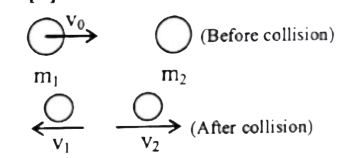
A


`m_(1)v_(0)=m_(2)v_(2)-m_(1)v_(1)" ".........(1)`
`e=(v_(1)+v_(2))/v_(0)=1" ".........(2)`
Solving (1) and (2)
`(v_(1)/v_(0))^(2)=((m_(1)-m_(2))/(m_(1)+m_(2)))^(2)`
Promotional Banner

Topper's Solved these Questions

Similar Questions

Explore conceptually related problems

A ball of mass in moving with speed u undergoes a head-on elastic collision with a ball of mass nm initially at rest. The fraction of the incident energy transferred to the second ball is

A neutron moving at a speed v undergoes a head-on elastic collision with a nucleus of mass number A at rest. The ratio of the kinetic energies of the neutron after and before collision is :

A ball of mass 'm' moving with speed 'u' undergoes a head-on elastic collision with a ball of mass 'nm' initially at rest. Find the fraction of the incident energy transferred to the second ball.

A body of mass m moving with velocity v makes a head-on collision with another body of mass 2 m which is initially at rest. The loss of kinetic energy of the colliding body (mass m ) is

A body of mass M moving with a speed u has a ‘head on’, perfectly elastic collision with a body of mass m initially at rest. If M > > m , the speed of the body of mass m after collision, will be nearly :

A moving body of mass m makes a head on elastic collision with another body of mass 2m which is initially at rest. Find the fraction of kinetic energy lost by the colliding particles after collision.

A body of mass 2 m moving with velocity v makes a head - on elastic collision with another body of mass m which is initially at rest. Loss of kinetic energy of the colliding body (mass 2 m) is

A body of a mass m moving with speed v collides elastically head on with another body of mass m, initially at rest. Show that the moving body will come to a stop after collision.

CAREER POINT-UNIT TEST 3-PHYSICS
  1. Two pendulums each of lengh l are initially situated as shown in figur...

    Text Solution

    |

  2. A 20 g bullet pierces through a plate of mass M(1)=1kg and then comes ...

    Text Solution

    |

  3. A body of mass m(1) moving at a constant speed undergoes an elastic he...

    Text Solution

    |

  4. A body of mass 5 kg explodes at rest into three fragments with masses ...

    Text Solution

    |

  5. A beg (mass M) hangs by a long thred and a bullet (mass m) comes horiz...

    Text Solution

    |

  6. A uniform metal dise of radius R is taken and out of it a disc of diam...

    Text Solution

    |

  7. A ball is dropped from a height h on the ground. If the coefficient of...

    Text Solution

    |

  8. Look at the drawing given in the figure which has been drawn with ink ...

    Text Solution

    |

  9. A cavity of radius b is made in a disc of mass M, radius R, as ahown i...

    Text Solution

    |

  10. The coordinates of centre of mass of the following quarter circular ar...

    Text Solution

    |

  11. Block C of mass M is moving with velocity V(0) and collides elasticall...

    Text Solution

    |

  12. A particle of mass m is made to move with uniform speed v(0) along the...

    Text Solution

    |

  13. Two men support a uniform horizontal beam at its two ends, if one of t...

    Text Solution

    |

  14. A rigid body is made of three identical thin rods, each of length L fa...

    Text Solution

    |

  15. A wooden log of mass M&length L is hinged by a frictionless of nail at...

    Text Solution

    |

  16. A thin spherical shell lying on a rough horizontal surface is hit by a...

    Text Solution

    |

  17. A circular platform is free to rotate in a horizontal plane about a ve...

    Text Solution

    |

  18. The ratio of the time taken by a solid sphere and that taken by a disc...

    Text Solution

    |

  19. A thin disc of mass 9M and radius R from which a disc of radius R/3 is...

    Text Solution

    |

  20. A ball moves over a fixed track as shown in the figure. From A to B ba...

    Text Solution

    |

