Home
Class 12
PHYSICS
Find the distance CQ if incident light r...

Find the distance CQ if incident light ray parallel to principal axis is incident at an angle i. Also, find the distance CQ if `irarr0` .

Text Solution

Verified by Experts
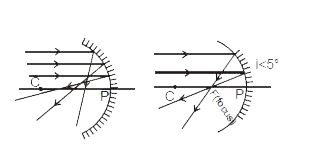

`cos I = R/(2CQ)`
`rArr CQ=R/(2 cos i)`
As i increases cos i decreases.
Hence CQ increases
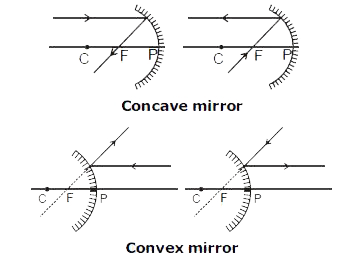
So, paraxial rays meet at a distance equal to R/2 from centre of curvature, which is called focus, Principal focus (F) is the point of intersection all the reflected rays for which the incident rays strike the mirror (with small aperture) parallel to the principal axis. In concave mirror it is real and in the convex mirror it is virtual. The distance from pole to focus is called focal length. Aperture (related to the size of mirror) is the diameter of the mirror.
Promotional Banner

Topper's Solved these Questions

  • GEOMETRICAL OPTICS

    MOTION|Exercise Exercise - 1 Section A - Plane Mirror|12 Videos
  • GEOMETRICAL OPTICS

    MOTION|Exercise Exercise - 1 Section B, C, D, E - Mirror formula and Magnification, Velocity in Spherical Mirror, Cutting of Mirrors, Combination of Mirrors, Intensity of light|10 Videos
  • FLUID

    MOTION|Exercise Exercise-4 level-II|5 Videos
  • GRAVITATION

    MOTION|Exercise Exercise - 4 Section - B Previous Years Problems|15 Videos

Similar Questions

Explore conceptually related problems

Radius of curvature of concave mirror is R and a light ray is incident on it parallel to principal axis at a height h above the principal axis. Calculate distance of the point from pole of mirror where reflected ray intersects with principal axis.

Monochromatic light rays parallel to the principal axis (the x axis) are incident on a convex lens of focal length f. If the lens oscillates such that it tilts up to a small angle theta on either side of the y axis, then find the distance between the exterme positions of the image. Take sec theta ~~ 1 + (theta^(2))/(2) for small theta .

A ray of light is incident on a concave mirror . It is parallel to the principal axis and its height from principal axis is equal to the focal length of the mirror. The ratio of the distance of point B to the distance of the focus from the centre of curvature is (AB is the reflected ray)

A parallel beam of monochromatic light of frequency v is incident on a surface. Intensity of the beam is I and area of the surface is A. Find the force exerted by the light beam on the surface for following cases– (i) the surface is perfectly absorbing and the light beam is incident normally on it. (ii) the surface is perfectly reflecting and the light beam is incident normally. (iii) the surface is perfectly absorbing and the light beam is incident at an angle of incidence theta . (iv) the surface is perfectly reflecting and the light beam is incident at an angle of incidence theta .

MOTION-GEOMETRICAL OPTICS-Exercise - 4 | Level-II
  1. Find the distance CQ if incident light ray parallel to principal axis ...

    Text Solution

    |

  2. The ratio of powers of a thin convex and thin concave lens is 3/2 and ...

    Text Solution

    |

  3. Figure shows object O. Final image I is formed after two refractions a...

    Text Solution

    |

  4. What will be the minimum angle of incidence such that the total intern...

    Text Solution

    |

  5. Two identical prism of index sqrt3 are kept as shown in the figure. A ...

    Text Solution

    |

  6. A point object is placed at a distance of 20cm from a thin plano-conve...

    Text Solution

    |

  7. Graph of position of image vs position of point object from a convex l...

    Text Solution

    |

  8. Parallel rays of light from Sun falls on a biconvex lens of focal leng...

    Text Solution

    |

  9. A simple telescope used to view distant objects has eyepiece and objec...

    Text Solution

    |

  10. A ray of light travelling in water is incident on its surface open to ...

    Text Solution

    |

  11. Statement-1 The formula connecting u,v and f for a spherical mirror is...

    Text Solution

    |

  12. In an experiment to determine the focal length (f) of a concave mirror...

    Text Solution

    |

  13. Two beam of red and violet colors are made to pass separately through ...

    Text Solution

    |

  14. A light beam is traveling from Region I to region IV (refer figure). T...

    Text Solution

    |

  15. An optical component and an object S placed along its optic axis are g...

    Text Solution

    |

  16. A ball is dropped from a height of 20 m above the surface of water in ...

    Text Solution

    |

  17. A student performed the experiment of determination of focal length of...

    Text Solution

    |

  18. A ray OP of monochromatic light is incident on the face AB of prism AB...

    Text Solution

    |

  19. The focal length of a thin biconvex lens is 20 cm. When an object is m...

    Text Solution

    |

  20. A biconvex lens of focal length 15 cm is in front of a plane mirror. T...

    Text Solution

    |

  21. A large glass slabe (mu=5//3) of thickness 8cm is placed over a point ...

    Text Solution

    |