Home
Class 12
PHYSICS
A ray of light from a denser medium stri...

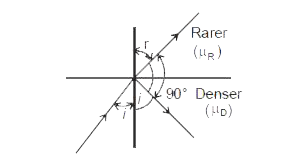
A ray of light from a denser medium strikes a rarer medium at an angle of incidence i. if the reflected and the refracted rays are mutually perpendicular to each other, what is the value of the critical angle ?

Text Solution

Verified by Experts

From Snell's law, we have
`(sin i)/(sin r)=mu_(g)/mu_(D)` or `mu=mu_(D)/mu_(g)` ...(i)
`=(sin r)/(sin i)`
According to the given problem,
`i+r+90^(@)=180^(@)`
or, `r=90^(@)-i`
Substituting the above value of 'r' in equation (i), we get
`mu=(sin(90^(@)-i))/(sin i)` or, `mu=cot i` ...(ii)
By definition `C=sin^(-1) (1/mu)`
or, `C=sin^(-1) (1/(cot i))` (using equation (ii))
or, `C=sin^(-1) (tan i)`
Promotional Banner

Topper's Solved these Questions

  • GEOMETRICAL OPTICS

    MOTION|Exercise Exercise - 1 Section A - Plane Mirror|12 Videos
  • GEOMETRICAL OPTICS

    MOTION|Exercise Exercise - 1 Section B, C, D, E - Mirror formula and Magnification, Velocity in Spherical Mirror, Cutting of Mirrors, Combination of Mirrors, Intensity of light|10 Videos
  • FLUID

    MOTION|Exercise Exercise-4 level-II|5 Videos
  • GRAVITATION

    MOTION|Exercise Exercise - 4 Section - B Previous Years Problems|15 Videos

Similar Questions

Explore conceptually related problems

A ray of light from a denser medium strikes a rarer medium at an angle of incidence i = tan^( -1)(1//2) . If the reflected and the refracted rays are mutually perpendicular to each-other, what is the value of the critical angle in degree?

A ray of light from a rarer medium strikes a denser medium at angle of incidence 60°. The reflected and refracted rays are perpendicular to each other. The refractive index of denser medium and angle of deviation respectively are

A ray of light from a denser medium strikes a rarer medium at an angle of incidenc i. The reflected and refracted rays make an angle of pi//2 with each other. If the angles of reflection and refraction are r and r^(') , then the criticall angle will be

A ray of light from a denser medium strikes a rarer medium at angle of incidence i . The refrected and the refracted rays make an angle of 90^@ with each other. The angles of reflection and refraction are r and r^' respectively. The critical angle is (i) sin^-1(tanr) (ii) sin^-1(tani) (iii) sin^-1(tanr) (iv) tan^-1(tani)

A ray of light from a denser medium strikes a rarer medium at an angle of incidence I (see figure ). The reflected and refracted rays make an angle of 90^(@) with each other. The angles of reflection and refraction are r and r^() . The critical angle is

A ray of light from a denser medium strike a rarer medium at an angle of incidence I (see Fig). The reflected and refracted rays make as angle of 90degrees with each other. The angles of reflection and refraction are r and r The critical angle is

Light from a denser medium 1 passes to a rarer medium 2. When the angle of incidence is theta the partially reflected and refracted rays are mutually perpendicular. The critical angle will be

A ray of light passes from a denser medium to a rarer medium at an angle of incidence i. The reflected and refracted rays make an angle of 90^@ with each other. The angle of reflection and refraction are resepectively r and r'. The critical angle is given by :

MOTION-GEOMETRICAL OPTICS-Exercise - 4 | Level-II
  1. A ray of light from a denser medium strikes a rarer medium at an angle...

    Text Solution

    |

  2. The ratio of powers of a thin convex and thin concave lens is 3/2 and ...

    Text Solution

    |

  3. Figure shows object O. Final image I is formed after two refractions a...

    Text Solution

    |

  4. What will be the minimum angle of incidence such that the total intern...

    Text Solution

    |

  5. Two identical prism of index sqrt3 are kept as shown in the figure. A ...

    Text Solution

    |

  6. A point object is placed at a distance of 20cm from a thin plano-conve...

    Text Solution

    |

  7. Graph of position of image vs position of point object from a convex l...

    Text Solution

    |

  8. Parallel rays of light from Sun falls on a biconvex lens of focal leng...

    Text Solution

    |

  9. A simple telescope used to view distant objects has eyepiece and objec...

    Text Solution

    |

  10. A ray of light travelling in water is incident on its surface open to ...

    Text Solution

    |

  11. Statement-1 The formula connecting u,v and f for a spherical mirror is...

    Text Solution

    |

  12. In an experiment to determine the focal length (f) of a concave mirror...

    Text Solution

    |

  13. Two beam of red and violet colors are made to pass separately through ...

    Text Solution

    |

  14. A light beam is traveling from Region I to region IV (refer figure). T...

    Text Solution

    |

  15. An optical component and an object S placed along its optic axis are g...

    Text Solution

    |

  16. A ball is dropped from a height of 20 m above the surface of water in ...

    Text Solution

    |

  17. A student performed the experiment of determination of focal length of...

    Text Solution

    |

  18. A ray OP of monochromatic light is incident on the face AB of prism AB...

    Text Solution

    |

  19. The focal length of a thin biconvex lens is 20 cm. When an object is m...

    Text Solution

    |

  20. A biconvex lens of focal length 15 cm is in front of a plane mirror. T...

    Text Solution

    |

  21. A large glass slabe (mu=5//3) of thickness 8cm is placed over a point ...

    Text Solution

    |
