Home
Class 12
PHYSICS
A cubical block of glass of refractive i...

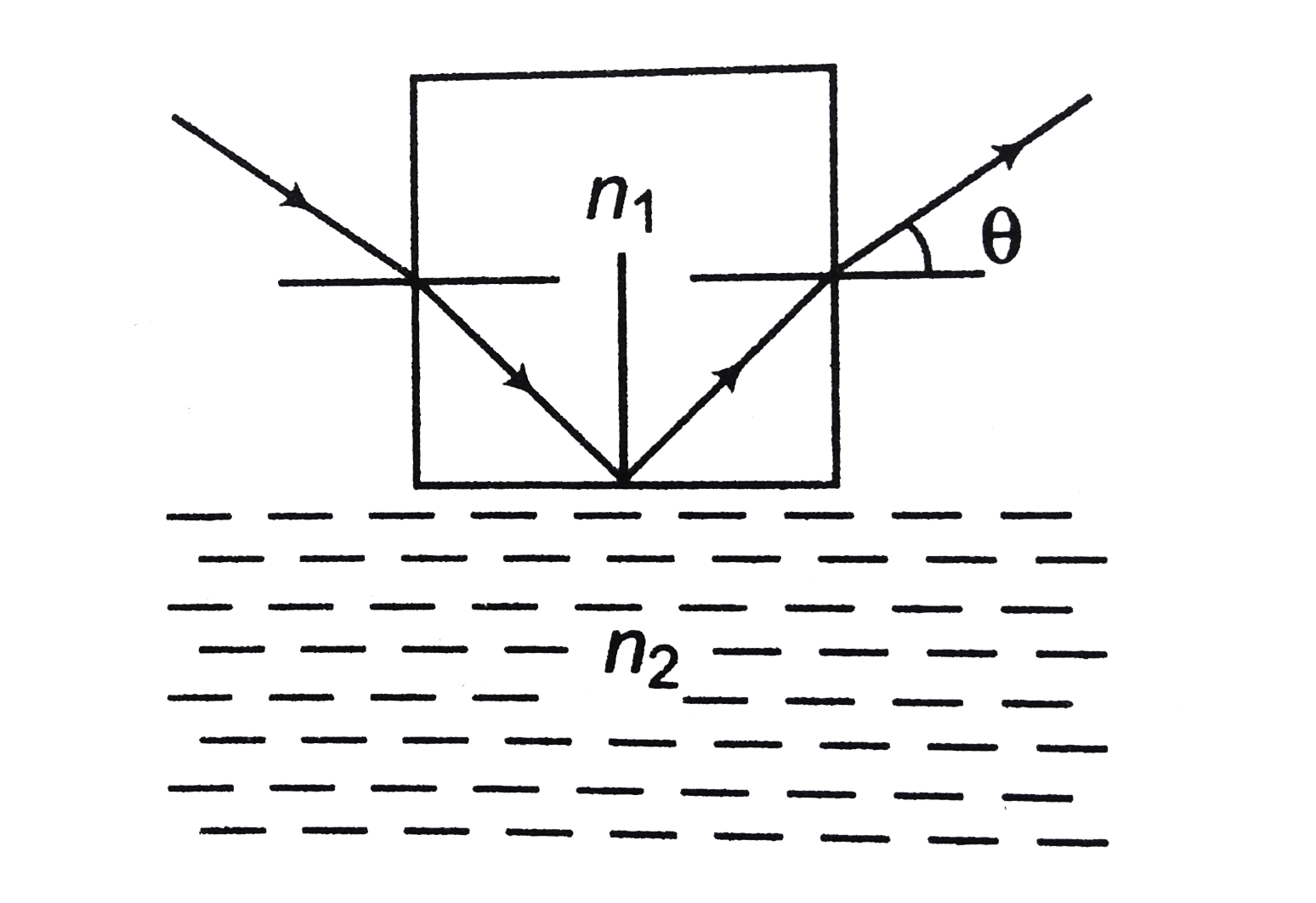
A cubical block of glass of refractive index `n_1` is in contact with the surface of water of refractive index `n_2.` A beam of light is incident on vertical face of the block. After refraction a total internal reflection at the base and refraction at the opposite face take place. The ray emerges at angle `theta` as shown. The value of `theta` is given by

Text Solution

Verified by Experts

The correct Answer is:

`sin theta lt sqrt(n_(1)^(2)-n_(2)^(2))`
Promotional Banner

Topper's Solved these Questions

  • GEOMETRICAL OPTICS

    MOTION|Exercise Exercise - 3 | Level-I (Section H - Prism)|3 Videos
  • GEOMETRICAL OPTICS

    MOTION|Exercise Exercise - 3 | Level-I (Section I - Dispersion of Light)|4 Videos
  • GEOMETRICAL OPTICS

    MOTION|Exercise Exercise - 3 | Level-I (Section F - Snells Law, Apparent depth and Normal shift, Refraction through a Glass slab, Lateral shift)|4 Videos
  • FLUID

    MOTION|Exercise Exercise-4 level-II|5 Videos
  • GRAVITATION

    MOTION|Exercise Exercise - 4 Section - B Previous Years Problems|15 Videos

Similar Questions

Explore conceptually related problems

A ray of light is incident on the surface of a glass plate of index of refraction 1.55 at the polarizing angle. Calculate the angle of refraction.

A ray of light is incident on the surface of plate of glass of refractive index 1.5 at the polarising angle. The angle of refraction of the ray will be

A glass prims ABC (refractive index 1.5) , immersed in water (refrective index 4/3 ). A ray of light is incident normally one face AB. If it is totally reflected at the face AC, then

A glass prism of refractive index 1.5 is immersed in water (refractive index 4/3). A light beam incident normally on the face AB is totally reflected to reach the face BC , Fig. if : .

A glass prism of refractive index 1.5 is immersed in water (refractive index 4/3). A light beam incident normally on the face AB is totally reflected to reach on the face BC if.

A ray of light is incident on the surface of a glass plate of refractive index 1.6 at polarzing angle. Calculate the angles of reflection and refraction.

An equilateral glass prism of refractive index 1.5 is immersed in water. Find the angle of deviation produced when a ray of light is incident at 42^(@) on one face of the prism. (Refractive index of water = 1.33)

For a given incident ray as shown in Fig., the condition of total internal reflection of ray will be satisfied if the refractive index of the block will be. .

A rectengular glass slab ABCD of refractive index n_1 is immersed in water of refractive index n_2(n_1gtn_2) . A ray of light is incident at the surface AB of the slab as shown. The maximum value of the angle of incidence alpha_max such that the ray comes out only from the other surface CD is given by
