
Home
Class 12
PHYSICS
An electron is released from the origin ...

An electron is released from the origin at a place where a uniform electric field E and a uniform magnetic field B exist along the negative y-axis and the nagative z-axis respectively. Find the displacement of the electron along the y-axis when its velocitybecomes perpendicular to the electric feld for the first time.

Text Solution

Verified by Experts
Let us take axes as shown in figure. According to the right-handed system, the Z-axis is upward in the figure and hence the magnetic field is shown downwards. At any time, the velocity of the electron may be written as
`vecu=u_(x)veci+u_(y)hatj`
The electric and magentic field may be written as
`vecE=-EvecjandvecB=-Bhatk`
respectivley. The force on the electron is
`vecF=-e(vecE+vecuxxvecB)=evecEvecj+eB(u_(y)veci-u_(x)vecj)`
Thus, `F_(x)=eu_(y)BandF_(y)=e(E-u_(x)B)`.
The components of the acceleration are
`a_(x)=(du_(x))/(dt)=(eB)/(m)u_(y)...(i)`
and `a_(y)=(du_(y))/(dt)=(e)/(m)(E-u_(x)B)...(ii)`
We have,
`(d^(2)u_(y))/(dt^(2))=-(eB)/(m)(du_(x))/(dt)=-(eB)/(m).(eB)/(m)u_(y)=-omega^(2)u_(y)`
where `omega=(eB)/(m)...(iii)`
This equation is similar to that for a simple harmonic motion. Thus,
`u_(y)=Asin(omegat+delta)...(iv)`
and hence,
`(du_(y))/(dt)=Aomegacos(omegat+delta)...(v)`
At `t=0`, `u_(y)=0and(du_(y))/(dt)=(F_(y))/(dt)=(eE)/(m)`
Putting in (iv) and (v)
`delta=0andA=(eE)/(momega)(E)/(B)`
Thus, `u_(y)=(E)/(B)sinomegat`
The path of the electron will be perpendicular to the Y-axis when `u_(y) = 0`. This will be the case for the first time at t where
`sinomegat=0`
or, `omegat=pi or,t=(pi)/(omega)=(pim)/(eB)`
Also, `u_(y)=(dy)/(dt)=(E)/(B)sinomegat`
or, `underset(0)overset(y)intdy=(E)/(B)sinomegatdt or,y=(E)/(Bomega)(1-cosomegat)`
At `t=(pi)/(omega)`,
`y=(E)/(Bomega)(1-cospi)=(2E)/(Bomega)`
Thus, the displacement along the Y-axis is
`(2E)/(Bomega)=(2Em)/(BeB)=(2Em)/(eB^(2))`

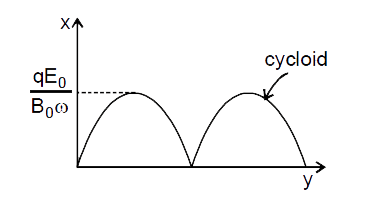
`a_(x)=(q)/(m)E_(0)sinomegat`
`underset(0)overset(v_(x))intdv_(x)=(qE_(0))/(m)underset(0)overset(t)intsinomegatdt`
`impliesv_(x)=(qE_(0))/(momega)(1-cosomegat)`
`underset(0)overset(x)intdx=(qE_(0))/(momega)underset(0)overset(t)int(1-cosomegat).dt`
`impliesx=(qE_(0))/(momega)[t-(sinomegat)/(omega)]`
Promotional Banner

Topper's Solved these Questions

  • MAGNETISM

    MOTION|Exercise EXERCISE-1|50 Videos
  • MAGNETISM

    MOTION|Exercise EXERCISE-2 (Level-I)|40 Videos
  • LOGIC GATES

    MOTION|Exercise EXERCISE - 2|10 Videos
  • MAGNETISM -1

    MOTION|Exercise Exercise - 3 SECTION -A|56 Videos

Similar Questions

Explore conceptually related problems

A uniform electric field and a uniform magnetic field are acting along the same direction in a certain region. If an electron is projected in the same direction then the electron

A uniform electric field and a uniform magnetic field are acting along the same direction in a certain region. If an electron is projected along the direction of the fields with a certain velocity then

A charge particle enters into a region containing uniform electric field (E) and uniform magnetic field (B) along x-axis and y-axis respectively.If it passes the region undeviated the velocity of charge particle is given by

A charge particle enters into a region containing uniform electric field (E) and uniform magnetic field (B) along x- axis and y-axis respectively.If it passes the region undeviated the velocity of charge particle is given by

MOTION-MAGNETISM -EXERCISE-4 (LEVEL-II)
  1. An electron is released from the origin at a place where a uniform ele...

    Text Solution

    |

  2. In a moving coil galvanometer, torque on the coil can be experessed as...

    Text Solution

    |

  3. In a moving coil galvanometer, torque on the coil can be experessed as...

    Text Solution

    |

  4. In a moving coil galvanometer, torque on the coil can be experessed as...

    Text Solution

    |

  5. In a moving coil galvanometer, torque on the coil can be experessed as...

    Text Solution

    |

  6. In a moving coil galvanometer, torque on the coil can be experessed as...

    Text Solution

    |

  7. In a moving coil galvanometer, torque on the coil can be experessed as...

    Text Solution

    |

  8. An infinite current carrying wire passes through point O and is perpen...

    Text Solution

    |

  9. Some laws/processes are given in Column I. Match these with the physic...

    Text Solution

    |

  10. A magnetic field vec(B) = B(0)hat(j) , exists in the region a ltxlt2a...

    Text Solution

    |

  11. Two wires each carrying a steady current I are shown in four configur...

    Text Solution

    |

  12. Statement -1 : The sensitvity of a moving coil galvanometer is increas...

    Text Solution

    |

  13. A particle of mass mand charge q, moving with velocity v enters Region...

    Text Solution

    |

  14. A steady current I goes through a wire loop PQR having shape of a righ...

    Text Solution

    |

  15. Six point charges , each of the same magnitude q, are arranged in dif...

    Text Solution

    |

  16. Electrical resistance of certain materials, known as superconductors, ...

    Text Solution

    |

  17. Electrical resistance of certain materials, known as superconductors, ...

    Text Solution

    |

  18. A thin flexible wire of length L is connected to two adjacent fixed po...

    Text Solution

    |

  19. An electron and a proton are moving on straight parallel paths with sa...

    Text Solution

    |

  20. Which of the field patterns given below is valid for electric field as...

    Text Solution

    |

  21. A long insulated copper wire is closely wouind as a spiral of 'N' turn...

    Text Solution

    |

