Home
Class 12
PHYSICS
Two straight conducting rails form a rig...

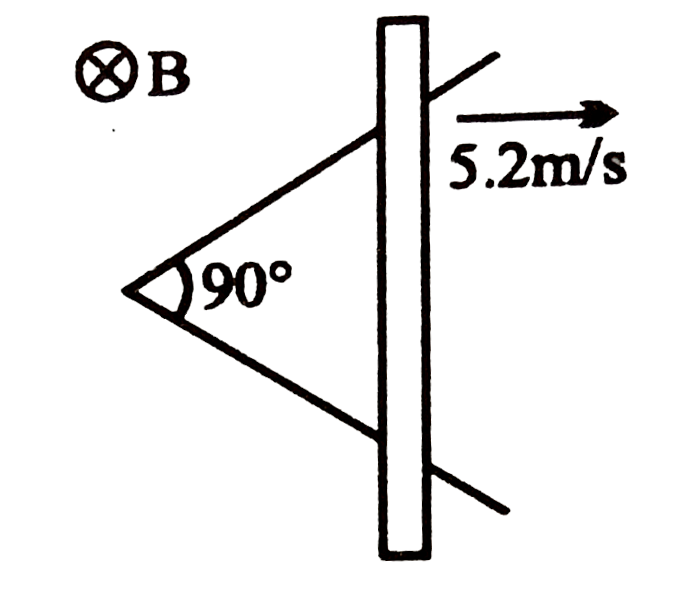
Two straight conducting rails form a right angle where their ands are joined. A conducting bar contanct with the rails starts at vertex at the time `t=0` & moves symmetrically with a constant velocity of `5.2 m//s` to the right as shown in figure. A `0.35 T` magnetic field point out of the page. Calculate:
(i) The flux through the tringle by the rails & ber at `t=3.0 s`.
(ii) The emf around the tringle at that time.

In what manner does the emf around the tringle vary with time.

Text Solution

Verified by Experts

The correct Answer is:

`85.22 Tm^(2)`,
Promotional Banner

Topper's Solved these Questions

  • ELECTROMAGNETIC INDUCTION

    MOTION|Exercise EXERCISE-4 (LEVEL-I)|11 Videos
  • ELECTROMAGNETIC INDUCTION

    MOTION|Exercise EXERCISE-4 (LEVEL-II)|13 Videos
  • ELECTROMAGNETIC INDUCTION

    MOTION|Exercise EXERCISE-3 (LEVEL-I)|13 Videos
  • ELECTRO MAGNETIC WAVES

    MOTION|Exercise EXERCISE - 3 (SECTION - B)|8 Videos
  • ELECTROMAGNETISM

    MOTION|Exercise Exercise|136 Videos

Similar Questions

Explore conceptually related problems

Two straight conducting rails form a right angle where their ends are joined. A conducting bar in contact with the rails starts at the vertex at time t = 0 and moves with constant velocity v along them as shown in Fig. A magnetic field vec(B) is directed into the page. the induced emf in the circuit at any time t is proportional to

Two straight conducting rails from a right angle where their end are joined. A conducting bar polaced over the rails starts at vertex at the time t=0 and moves with a constant velocity v to the right as shown in the figure. Calculate (a) the flux through the triangle (isosceles) by the rails and bar at t=t_(0) the emf around the triangle at that time (c) in what manner does the emf around the triangle vary with time

The two conducting rails are placed perpendicular to each other, such that their ends are joined as shown in figure. A conducting bar is now placed over the rails and start moving with constant velocity v starting from the vertex at time t = 0. (i) The flux through the triangle (isosceles) by the rails and bar at t=t_(0) . (ii) The emf around the triangle at that time. (iii) In what manner does the emf around the triangle vary with time.

A conducting rod, with a resistor of resistance R. is pulled with constant speed v on a smooth conducting rail as shown in figure. A constant magnetic field vecB is directed into the page. If the speed of the bar is doubled, by what factor does the rate of heat dissipation across the resistance R change?

Two parallel long smooth conducting rails separated by a distance l are connected by a movable conducting connector of mass m . Terminals of the rails are connected by the resistor R and the capacitor C as shown in figure. A uniform magnetic field B perpendicular to the plane of the rail is switched on. The connector is dragged by a constant force F . Find the speed of the connector as a function of time if the force F is applied at t = 0 . Also find the terminal velocity of the connector.

A conducting bar mass m and length l moves on two frictionless parallel conducting rails in the presence of a uniform magnetic field B_(0) directed into the paper. The bar is given an initial velocity v_(0) to the right and is released at t = 0 . The velocity of the bar as a function of time is given by

A conducting wire xy of lentgh l and mass m is sliding without friction on vertical conduction rails ab and cd as shown in figure. A uniform magnetic field B exists perpendicular to the plane of the rails, x moves with a constant velocity of
